The air in the early autumn of 2001 smelled of chemical hairspray, sweet vanilla perfume, and the hot, metallic scent of professional television monitors baking under studio lights. You could hear the distant, waves-like roar of teenagers lined up along Times Square, their voices bouncing off the concrete and glass. To the casual eye, it was the golden age of pop royalty, a clean-cut fairy tale packaged in glossy magazines and late-night countdown shows. But when you look past the glittering surface, the atmosphere tells a different story.
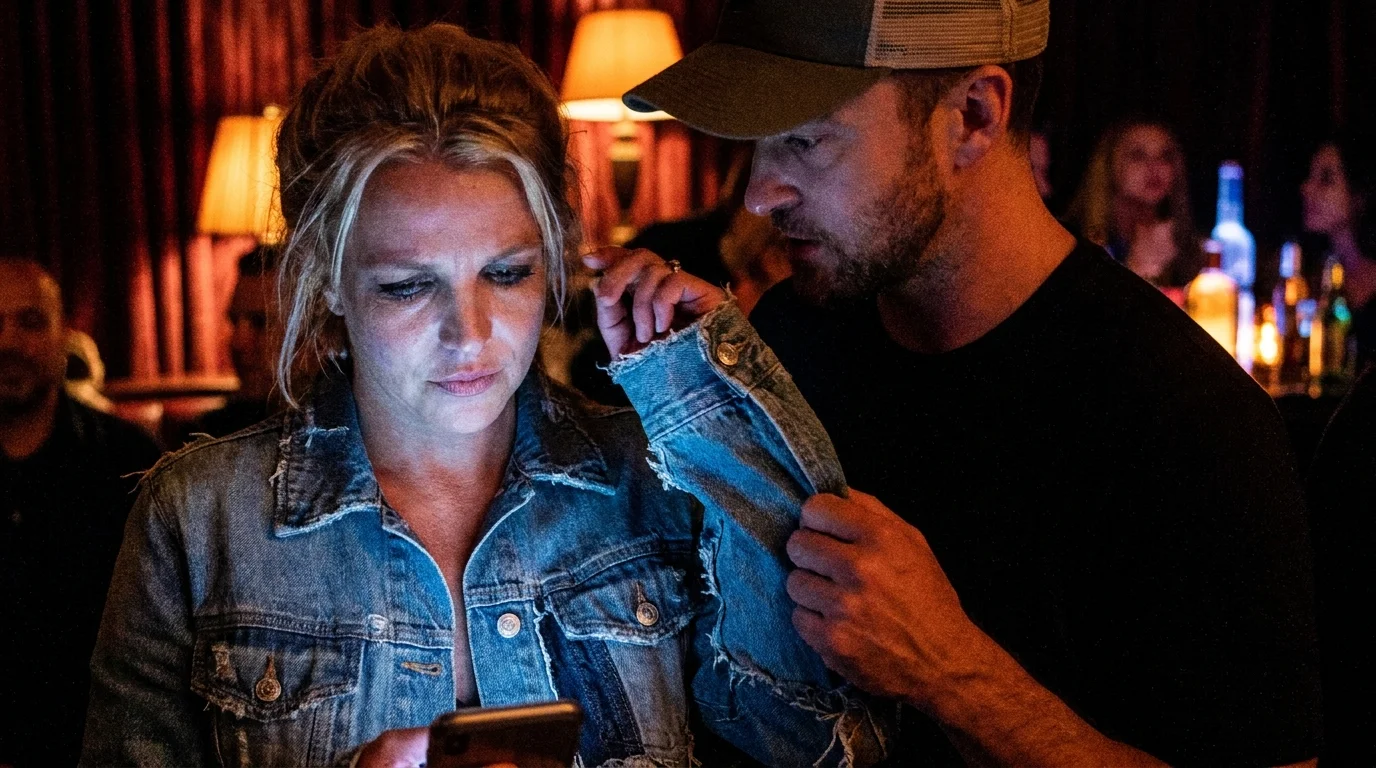
There was a heavy, stifling quality to those red carpet arrivals. Behind the smiles lay the exhausting work of maintaining a public fantasy while navigating private friction under a microscope. If you watch the old tapes closely, you see a tightened grip on a matching patchwork denim sleeve. It was a physical anchor, a knuckles-white clench that felt like affection then, but looks like anchor-dragging now.
You were watching two young people carrying the financial survival of massive record labels on their backs. The expectation was total compliance with the narrative of perfect young love, but the physical reality was far more tense. Their bodies often rigidified when the cameras started rolling, revealing a silent negotiation for space and survival.
The gloss of the era hid the slow-burning discomfort of a young woman being systematically overshadowed. When we look back now, the illusion of equal partnership dissolves under the cold light of historical hindsight, revealing the structural cracks in what we once considered the ultimate pop romance.
Reading the Unspoken Script of the Double-Denim Era
To understand what went wrong, you have to stop looking at the relationship as a shared kingdom and start viewing it as a stage where only one microphone was truly live. The prevailing memory of this era is one of matching outfits and shared triumphs, a cultural high-water mark for teen pop. But this memory functions like a heavily edited highlight reel, stripping away the micro-expressions that signaled distress.
We must shift our focus from the aesthetics of their appearances to the mechanics of their interactions. It was not a partnership of equals; it was a system of containment where one person’s public identity was slowly whittled down to serve the other’s rising star. To survive the spotlight, one partner was constantly forced to dim its light so that the other’s ego would never be eclipsed by her immense, organic popularity.
- Taylor Swift and Travis Kelce treat stadium exits as calculated corporate mergers
- Sabrina Carpenter complex dating history relies on deleted studio photos exposing narrative gaps
- Brad Pitt unscripted cinematic combat scenes exposed a massive real world romance
- The Hunger Games quietly recast a major district tribute after a disastrous chemistry read
- Nicholas Hoult faced intense corporate rejection during secret caped crusader screen tests
Clara Vance, a forty-two-year-old archival media researcher who analyzes television broadcast history, spent months digitizing early-2000s MTV interviews to study the evolution of celebrity body language. She noticed that the physical interactions between the two stars were rarely collaborative. This silent hierarchy of voice dictated who spoke, who smiled, and who was forced to remain quiet in the background of their own shared milestones.
The Mechanics of Public Dominance
The Microphone Monopoly
During joint interviews, the physical control of the microphone served as a literal boundary of voice. You can observe instances where the microphone was held tightly in one hand, positioned squarely in front of one chest, and only briefly extended to the other partner like a concession. This subtle hoarding of the physical medium ensured that any statement made had to be filtered through, or interrupted by, the dominant partner.
The Spatial Containment
Another recurring pattern is the physical angling of the body to block or frame the other partner. By placing a shoulder forward or stepping slightly ahead in the frame, the dominant partner effectively reduced her physical footprint on the red carpet. This physical shielding disguised itself as protective chivalry, but its practical effect was the marginalization of her presence, turning a global icon into a silent, supportive accessory.
The Interruption Protocol
When she did speak, her words were often met with immediate, playful dismissals or mock-corrections. This behavioral tactic framed her thoughts as cute but inconsequential, reinforcing the public narrative that she was the naive counterpart to his more mature, calculated persona. It was a subtle, public gaslighting that conditioned the audience to view her as someone who needed to be spoken for.
Reclaiming the Narrative: How to Spot Behavioral Control
Recognizing these patterns in historical footage helps us identify similar dynamics in our modern world. It requires a shift in how we observe public and private interactions, looking beyond the words spoken to the physical grammar of the body. By paying attention to small physical cues, we can see the true spatial tilt of partners and understand the silent rules of the room.
To evaluate these dynamics in media or personal observation, consider these subtle signs of structural imbalance:
- The Spatial Anchor: Notice if one person constantly holds the other’s wrist or arm in a way that restricts natural movement or gesturing.
- The Conversational Filter: Watch for partners who consistently interrupt to explain or rephrase what the other person just said.
- The Eye-Contact Check: Observe if one person constantly looks at the other for approval before answering simple questions.
The Boundary Evaluation Tool
To help ground these observations, use this simple framework to measure physical and conversational balance in public spaces. Focusing on the three-second pause before responding can reveal if a conversation is genuinely balanced or tightly controlled by a dominant partner.
- Observe the spatial tilt: Determine if both individuals occupy equal physical space in the room or frame.
- Measure conversational airtime: Note if one person speaks for more than sixty percent of a joint conversation.
- Identify the touch dynamic: Assess whether physical touch feels mutual or if it serves to direct and steer one person’s movement.
Why the Revisionist Mirror Matters Today
Looking back at these early red carpet moments is not about assigning retrospective blame; it is about understanding how our culture normalized the quiet erasure of young women. For years, we laughed at the jokes and admired the matching outfits, entirely blind to the exhaustion behind the smiles. We accepted the narrative that was fed to us because it fit the comfortable mold of a pop-star romance.
By slowing down the footage and analyzing the physical reality of these moments, we begin reclaiming our collective focus and rewriting the history of how we treat our icons. It allows us to build a more empathetic culture, one that values the voice of the individual over the tidy convenience of a celebrity fairy tale.
“True partnership is measured by the space we allow each other to occupy without needing to ask permission first.” — Clara Vance
| Key Point | Detail | Added Value for the Reader |
|---|---|---|
| The Microphone Grip | Holding the microphone close to one’s own chest during joint interviews. | Teaches you to spot conversational gatekeeping in group dynamics. |
| The Shoulder Shield | Angling the body to step in front of a partner, blocking them from the camera. | Helps identify subtle spatial marginalization in social settings. |
| The Constant Correction | Interrupting a partner with humor to dismiss or rephrase their statements. | Builds awareness of conversational undermining disguised as playful banter. |
Frequently Asked Questions
How can I identify these behavioral patterns in modern media interviews? Look at the hand placement on the microphone and notice who controls the flow of the conversation. If one person constantly redirects the focus to themselves, it is a clear sign of conversational dominance.
Was this behavior conscious or a product of early 2000s media training? While media training played a role, physical boundary management often reflects subconscious beliefs about power and control within a relationship.
Why are we only realizing these red flags now? The cultural shift toward emotional intelligence and feminist critique has given us the tools to analyze media with greater nuance than we had twenty years ago.
What is the difference between protective body language and dominant body language? Protective language allows the partner room to move and speak freely, whereas dominant language restricts their physical and vocal agency.
How do these insights apply to everyday relationships? They remind us to watch for subtle conversational imbalances and physical patterns that make one partner feel small or unheard.