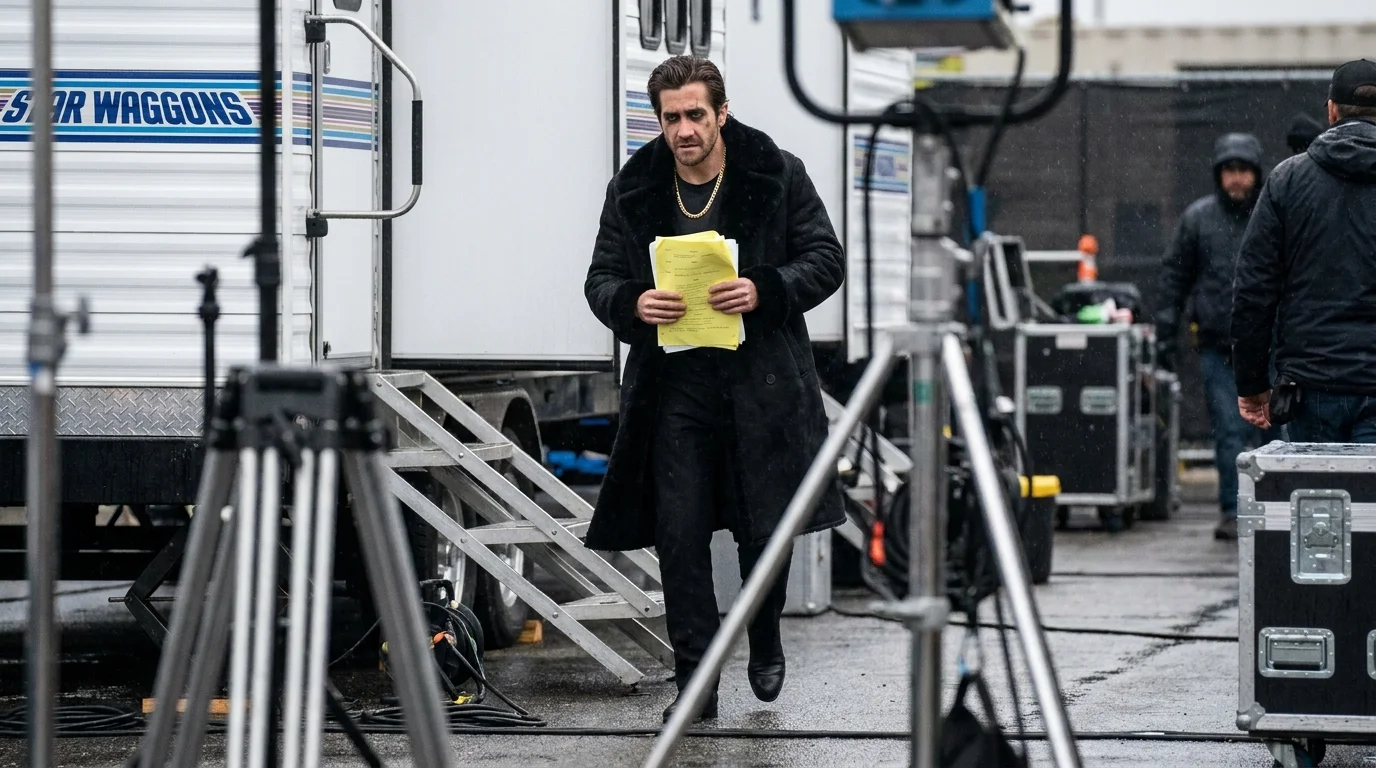
Picture a sterile, dimly lit waiting room in late-nineties London. The air smells of damp wool coats and stale paper cups of cheap black tea. Outside, the gray rain taps against the glass, but inside, the silence is heavy, broken only by the rustle of script pages. A young actor, not yet a household name, sits with his fingers tracing the edges of a bright yellow script. It is a poorly memorized fantasy script printed on bright yellow paper, the kind of high-security casting side meant to prevent leaks but instead acting as a neon beacon of anxiety.
We often imagine Hollywood auditions as elegant handshakes and immediate creative chemistry. We assume that natural talent shines through the moment a future star steps into the light, effortlessly claiming their destiny. But the actual machinery of casting is far colder, a clinical assessment where years of preparation can collapse under the weight of a single misread line.
On this particular afternoon, Jake Gyllenhaal stood in front of a table of creative giants. He was auditioning for the role of Frodo Baggins, a character destined to carry the weight of an entire cinematic empire. The room was quiet, save for the hum of a small video camera recording his every movement. He began to speak, his voice echoing in the small room, but something was deeply wrong; the lines felt heavy, disconnected from the earthiness required of a Shire-dweller.
The illusion of effortless success vanished within seconds. Instead of a soaring epic moment, the young actor found himself drowning in a sea of Elvish names and dense dialogue. His hands, still clutching those bright yellow pages, began to sweat. The performance was a mismatch of modern American intensity and classic high-fantasy British cadence, a mistake that would soon invite a devastating critique from the director himself.
The Myth of the Seamless Audition
Many actors view an audition as a test of their emotional range, believing that raw feeling can mask a lack of structural preparation. This is the classic trap of relying on passion over process. In reality, a high-stakes audition is more like a mechanical stress test. If your foundation is cracked, the high-pressure environment of a casting room will instantly shatter it. When Peter Jackson watched Gyllenhaal perform, he didn’t see an artist experimenting; he saw a mechanism failing to engage with the material on its most basic terms.
To master any high-pressure room, you must abandon the belief that charisma can substitute for meticulous, muscle-memory preparation. The transition from a promising amateur to a seasoned professional requires treating your craft not as an emotional lottery, but as a precise system of micro-habits. When the stakes are at their highest, you do not rise to the level of your goals; you fall to the level of your systems.
- Sam Neill near miss James Bond audition changes Hollywood history
- Megan Fox resurfaced late night interview completely reverses public perception
- Kris Jenner red carpet flinch sparks massive family rift rumors
- Tom Segura extreme backstage demands expose a jarring comedy tour reality
- Keanu Reeves handles massive global fame trusting one specific lifestyle rule
Marcus Thorne, a fifty-eight-year-old London casting associate who witnessed the late-nineties fantasy gold rush, recalls how American actors frequently struggled with the transition to European-style mythologies. “They would arrive with all this internal psychological fire,” Thorne explains, “but they lacked the vocal grounding. They didn’t understand that in fantasy, the language itself is a physical landscape you have to walk through, not just words you read off a page.”
Adapting to the High-Stakes Audition Ecosystem
For the Method-Driven Performer
This approach requires deep internal preparation but often falters when immediate physical adjustments are demanded on the spot. If you rely solely on emotional memory, a sudden note from a director can feel like a personal attack rather than a course correction. You must learn to separate your personal identity from the raw material you present to the room.
For the Classical Script Analyst
This style prioritizes the exact meter and rhythm of the text, which is incredibly useful for period pieces. However, without a strong physical presence, it can easily slide into a cold, academic reading that fails to capture the human core of the character. You must breathe life into the architecture of the words.
For the Modern Screen Audition
The modern self-tape era demands a hybrid style where vocal precision meets relaxed, understated body language. You must treat the camera as a confidant, keeping your micro-expressions controlled while delivering lines with absolute conviction. The goal is to project absolute certainty, even when the script feels alien in your mouth.
The Anatomy of a Rejection Recovery
To survive and thrive after a public professional failure, you must detach your personal worth from the outcome of your work. This is the exact pivot Gyllenhaal made after his disastrous meeting with Peter Jackson, who famously told him he was the worst actor he had seen that day because he failed to use a British accent. Jackson did not mince words; he pointed out the absolute lack of basic preparation, a moment of direct humiliation that could have crushed a lesser artist.
Here is how you can systematically rebuild your approach when your preparation fails under pressure:
- Deconstruct the negative feedback by stripping away the emotional sting and focusing purely on the mechanical error.
- Establish a vocal warm-up routine that anchors your speech in your chest, preventing throat tightness when adrenaline spikes.
- Practice script memorization under active distraction, reading lines while walking, doing dishes, or listening to white noise.
- Limit your preparation window to three intense thirty-minute sessions per day to prevent mental fatigue and over-intellectualizing the text.
Tactical Toolkit for High-Pressure Presentations
- Preparation Medium: Off-white or light blue paper (never high-contrast neon yellow, which strains the eyes under bright studio lights).
- Vocal Grounding Pitch: A low, resonant hum held for forty-five seconds before entering the room to drop your larynx.
- Eye Contact Ratio: Maintain direct eye contact for seventy percent of the reading, using the remaining thirty to naturally consult the text.
Finding the Value in the Rubble
Every major career pivot is born from a moment of profound public discomfort. For Gyllenhaal, Jackson’s blunt critique—”You are the worst actor I have ever seen”—was not the end of his career, but the foundation of his modern reputation as one of cinema’s most obsessive and prepared actors. It stripped away the naive assumption that natural charm could carry him through any room, forcing him to build a rigorous, bulletproof preparation method that would later define his iconic performances.
When we embrace our most embarrassing professional defeats, we stop running from the possibility of failure. We begin to see rejection not as a permanent label, but as a sharp, necessary tool used to carve away our bad habits and reveal our actual strength. In the end, the brightest career arcs are not those that avoid the fire, but those that are forged within it.
“The moment you stop trying to look perfect is the moment you actually start doing the work.” — Marcus Thorne
| Key Point | Detail | Added Value for the Reader |
|---|---|---|
| The Yellow Script Pitfall | High-contrast security paper distracts the eye and increases visual fatigue during high-stress readings. | Switch to pastel or off-white paper to keep your focus on the text structure rather than the color. |
| The Direct Feedback Loop | Jackson’s blunt rejection highlighted a total lack of basic vocal preparation and research. | Learn to treat harsh critiques as direct instructions for mechanical adjustments instead of emotional attacks. |
| Distraction-Based Practice | Memorizing lines while performing unrelated physical tasks builds deep cognitive stability. | Builds muscle memory so your delivery remains stable under extreme situational anxiety. |
Did Jake Gyllenhaal actually audition for Frodo Baggins?
Yes, early in his career, Gyllenhaal auditioned for the role of Frodo Baggins in The Lord of the Rings trilogy but failed to prepare the required British accent.
What did Peter Jackson say to Jake Gyllenhaal during the audition?
Peter Jackson bluntly told Gyllenhaal that he was one of the worst actors he had seen, asking him why nobody had warned him about the accent.
How did this failed audition affect Gyllenhaal’s career?
Instead of discouraging him, the harsh critique forced Gyllenhaal to adopt an intense, meticulous approach to character preparation that now defines his career.
Why do studios use bright yellow paper for auditions?
Bright yellow or colored paper is used as a security measure to prevent script photocopying and leaks, though it can strain an actor’s eyes under tension.
How can you recover from a deeply embarrassing interview or audition?
The key is to detach your personal identity from the performance, treat the negative feedback as mechanical data, and rebuild your preparation systems.