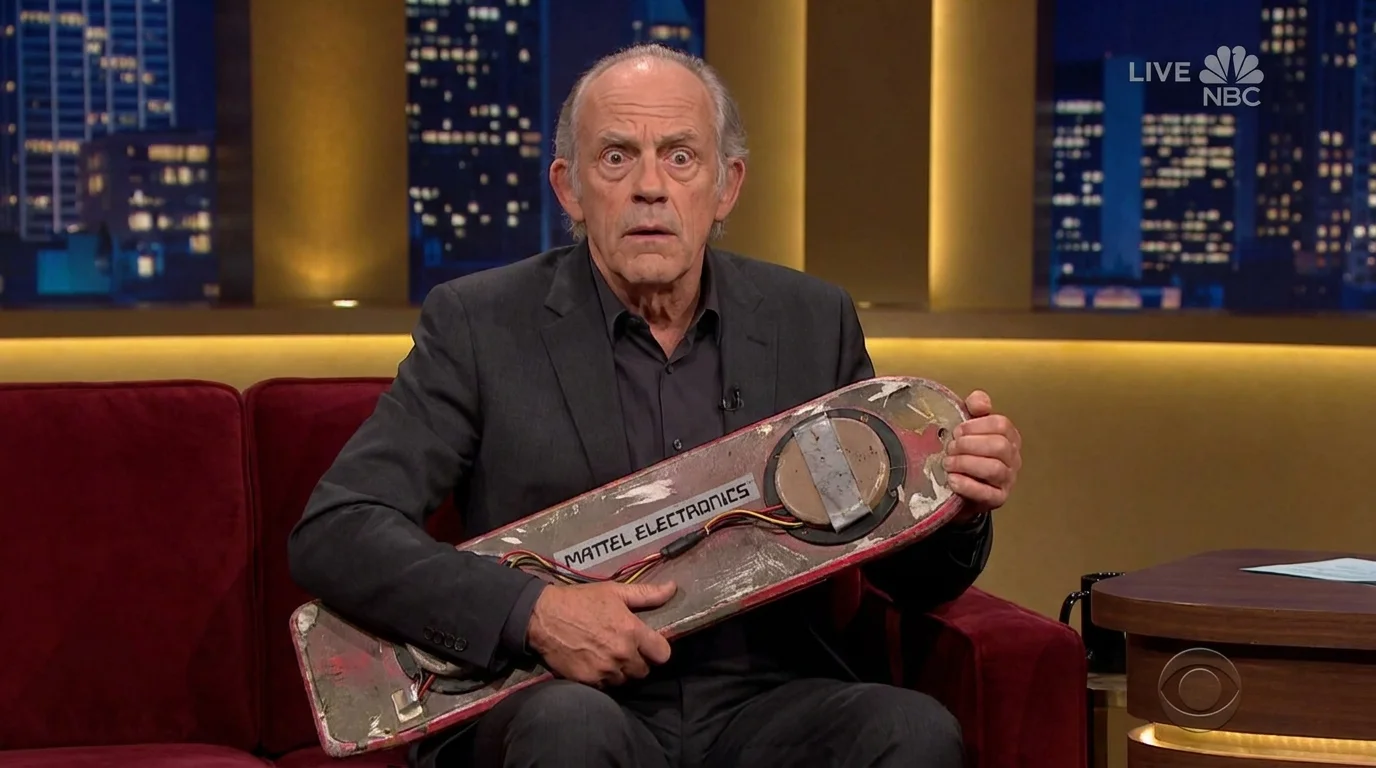
Imagine a dimly lit, climate-controlled warehouse in North Hollywood. The scent of aging polyurethane and stale machine oil hangs heavy in the air. Resting on a steel shelf, half-covered by a gray canvas tarp, sits a discarded, heavily scuffed prop hoverboard from early test shoots. Its neon paint is chipped, showing the raw pink foam underneath, a silent relic of a timeline that never was.
You might expect the archives of a legendary cinematic masterpiece to hold only triumphant souvenirs. But the **most revealing artifacts are** often those born from failure. Before the iconic red puffer vest and self-lacing shoes took over global pop culture, there was a different, far darker version of Hill Valley being built frame by painful frame.
For five weeks, the cameras rolled on a movie that looked identical on paper but felt entirely foreign in the monitor. The crew stood in the cold night air of the Burbank backlot, watching a brilliant young actor pour his soul into the role of Marty McFly. Yet, something was deeply wrong; the air in the scene felt heavy, almost suffocating, rather than electric.
The industry often tells you that raw talent is the ultimate currency. If you hire a powerhouse performer who commits completely to the page, success should follow naturally. The reality is far more fragile: **creative chemistry cannot be forced** by sheer willpower, and sometimes, the most skilled hand ruins the delicate machinery of comedy.
Why Weight Ruins Whimsy
To understand why this shift happened, you must look at the project as a delicate mechanical clock. If one gear is weighted for a grandfather clock and the other is built for a pocket watch, the teeth will grind until the springs snap. Eric Stoltz did not approach Marty McFly with a light touch; he approached him with the crushing gravity of a classic Method actor.
He insisted on being addressed only as ‘Marty’ off-camera, wore his wardrobe home, and dug deep into the existential dread of a teenager realizing his parents might never fall in love. When he shared the screen with Christopher Lloyd’s Doc Brown, the kinetic, ping-pong energy of the script withered. Lloyd was throwing softballs of manic genius, but they were hitting a brick wall of intense, dramatic realism. **The timing fell completely flat** because one actor was performing in a gritty indie drama while the other was playing to the back row of a vaudeville theater.
- Scarlett Johansson faced harsh rejection for a massive studio thriller
- Ted Lasso nearly starred a completely different network comedy legend
- Anne Hathaway resurfaced interview completely validates past fan public defenses
- Gerard Piqué tense paparazzi encounter sparks massive relationship rift rumors
- Lea Michele awkward red carpet snub polarizes Broadway theatre fans
Consider the perspective of Bob Gale, the co-writer who watched the daily footage with a growing knot in his stomach. At 33 years old, Gale knew that every foot of exposed 35mm film represented thousands of dollars, but more importantly, it represented a slowly dying vision. He realized that Stoltz’s intensity was actively suffocating Lloyd’s performance, dragging the eccentric Doc Brown down into an uncomfortably tense dynamic instead of lifting him to the beloved mad scientist we know today.
The Three Silent Friction Points
The Drama Trap (For the Purist)
Some storytellers believe that dramatic weight adds realism to high-concept premises. When Stoltz played the scene where his mother flirts with him in 1955, it felt genuinely tragic and deeply unsettling, rather than a masterclass in awkward comedic tension. **The audience needs a release valve** of self-aware humor, or the premise curdles into something too dark to enjoy.
The Comedic Dance Partner (For the Improviser)
True comedic chemistry functions like a fast-paced tennis match. Lloyd’s frantic gesticulations and wild-eyed delivery required an actor who could bounce back with a quick, breezy sarcasm. Marty was meant to be the grounded anchor, yes, but he also had to move with the same kinetic rhythm as the DeLorean itself, something Stoltz’s slow, deliberate pacing simply couldn’t offer.
The Invisible Recasting Cost (For the Strategist)
Replacing a lead actor five weeks into a tight production schedule is a financial nightmare that most studios would veto instantly. Yet, director Robert Zemeckis made the call because he knew that **the silent friction on screen** would eventually cost far more at the box office than the millions needed to reshoot almost half of the film with Michael J. Fox.
Finding the Right Creative Friction
Correcting a fundamental mismatch in your own collaborative projects requires quick, decisive action. You must look past individual excellence and evaluate the collective output with clinical objectivity. It is always better to scrap weeks of misaligned effort than to spend years defending a compromised final product.
Here is how you can **identify and manage silent chemistry** failures before they derail your team:
- Conduct unrecorded, low-pressure trial runs to observe natural conversational pacing.
- Analyze the physical spacing and body language between key collaborators during initial brainstorms.
- Watch for one individual dominating the creative space, which often forces others to retreat into a defensive shell.
- Establish a clear ‘chemistry veto’ protocol where partners can voice concerns about collaborative rhythm without fear of professional reprisal.
To help you evaluate these hidden dynamics, keep this Tactical Collaboration Toolkit in mind:
- Optimal Pacing Ratio: 1:1 exchange of ideas without long, contemplative pauses during fast-paced phases.
- The Tension Threshold: If a meeting feels like an interrogation rather than a conversation, the pairing is mismatched.
- The Reset Window: Address collaborative friction within the first 15% of a project timeline to avoid catastrophic sunk-cost traps.
The Gift of the Hard Reset
There is a profound comfort in realizing that even the most brilliant minds can fail simply because they are in the wrong room. Marty McFly was never meant to be a tortured soul; he was a kid who just wanted to play his guitar and get back home to his girlfriend. Accepting that some **combinations are fundamentally incompatible** allows you to let go of the guilt of walkouts and restarts.
When you look at that scuffed, prototype hoverboard in the archives, you aren’t looking at a monument to failure. You are looking at the courage to stop, admit a mistake, and pivot toward true alignment, proving that sometimes, the hardest choices are the only ones that lead to timeless magic.
“The greatest trap in creative collaboration is assuming that talent can conquer a fundamental mismatch in rhythm.” — Bob Gale
| Key Point | Detail | Added Value for the Reader |
|---|---|---|
| Dramatic Gravity | Scenes feel heavy and awkward | Recast with a lighter, physical comedian |
| Rhythmic Clash | Overlapping dialogue or long pauses | Run unscripted chemistry reads early |
| The Sunk-Cost Trap | Hesitation to scrap unusable footage | Enforce a strict 15% timeline reset rule |
Frequently Asked Questions
Why was Eric Stoltz fired from Back to the Future? He was replaced because his intense, dramatic acting style lacked the lighthearted comedic timing required for Marty McFly, creating a tense dynamic with Christopher Lloyd.
How much of the movie had to be reshot? Roughly five weeks of footage had to be entirely scrapped and reshot once Michael J. Fox took over the role.
Did Christopher Lloyd know about the casting change? Yes, although the transition was handled quietly, the cast quickly noticed the massive shift in energy and timing on set.
Where can you see the original Eric Stoltz footage? Small snippets and silent behind-the-scenes clips have resurfaced in anniversary documentary releases, showcasing the stark stylistic difference.
What was the budget impact of the recasting? The reshoots added roughly $3 million to the production budget, a massive gamble that ultimately paid off as a multi-billion dollar franchise.