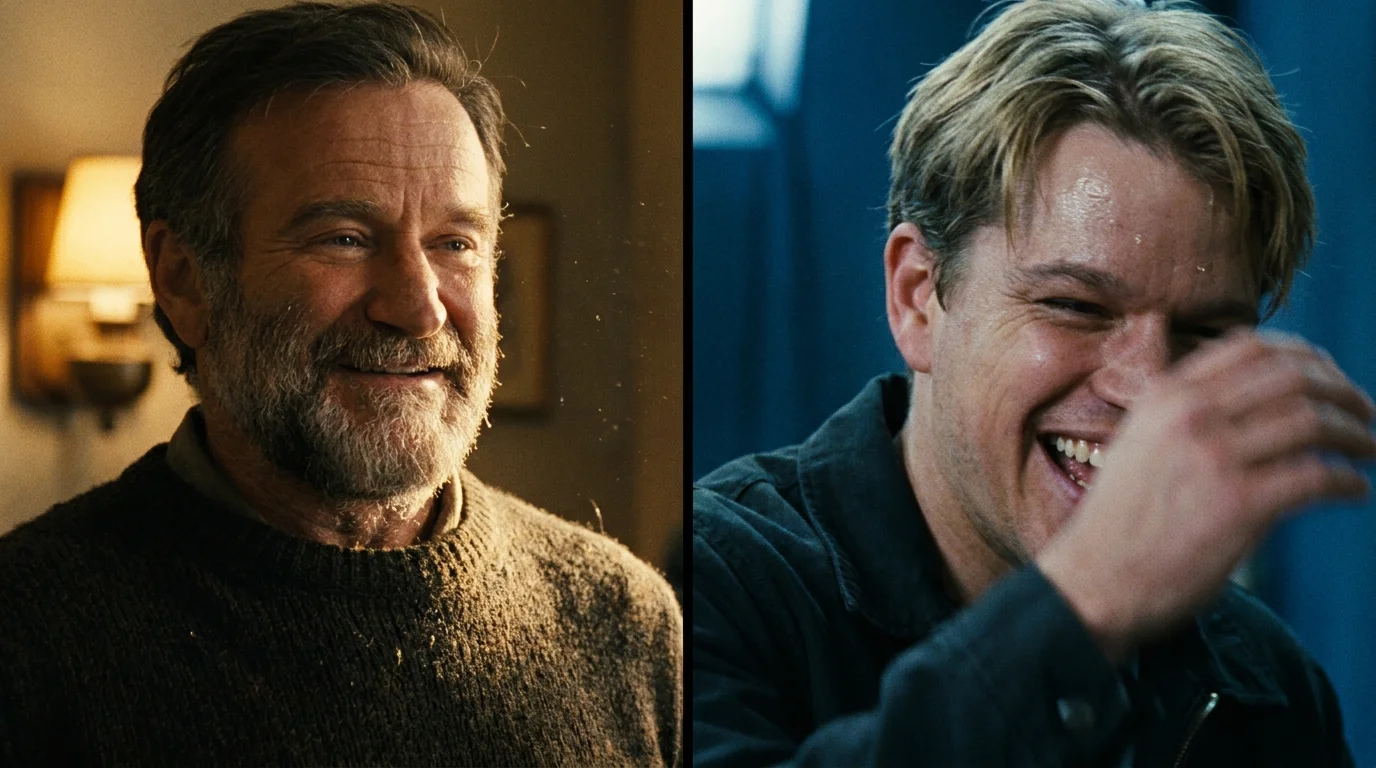
You sit in the dim, golden warmth of a makeshift therapist’s office. The air smells faintly of aged paperbacks, damp wool, and stale coffee. A green-shaded banker’s lamp hums quietly on a corner desk, casting long shadows across the worn rug. Across from you sits a young man with his defenses raised like iron shields, his eyes scanning the room for any sign of vulnerability he can exploit.
When you watch this pivotal confrontation, you expect the absolute precision of an award-winning screenplay. You assume every sigh, every pause, and every line of dialogue was meticulously labored over by two hungry young writers determined to make their mark on cinema history. We are taught to believe that great art is always the result of relentless planning and strict adherence to a carefully crafted blueprint.
But if you look closely at the lower left corner of the frame during Robin Williams’ monologue about his late wife’s nighttime quirks, you will notice a tiny, rhythmic shudder. The camera lens dips and sways ever so slightly, a physical defect that should have triggered a retake. It survived the final edit because the veteran cinematographer holding the heavy camera was laughing so hard his shoulders shook, unable to control his physical reaction to the unscripted genius unfolding before him.
What you are witnessing is not a calculated dramatic triumph, but a brilliant accident. Robin Williams completely discarded the written script, weaving a hilarious, deeply human yarn about his wife’s severe flatulence that caught everyone in the room off guard. This singular moment of raw comedy did more to break down the defenses of Matt Damon’s character than ten pages of carefully structured drama ever could, demonstrating that sometimes our best work happens when we stop trying to control the outcome.
The Art of the Creative Spill
To understand why this moment resonates so deeply, you have to look at how we navigate our own professional and personal lives. We often treat our daily plans like high-wire acts, fearing that a single misstep or unscripted remark will send our entire performance crashing to the ground. We build rigid frameworks for our careers, our relationships, and our creative endeavors, assuming that perfection is the only path to connection.
This is a fundamental misunderstanding of how human beings actually connect. True resonance operates on the principle of the “creative spill”—the idea that emotional truth cannot be bottled up in a pristine container. When you allow room for the unexpected, you invite a raw authenticity that instantly dissolves the distance between people, transforming a sterile interaction into a moment of genuine intimacy.
- Emily Blunt protects her high profile marriage enforcing one absolute industry boundary
- Will Smith and Jada early red carpet appearances expose glaring marital warning signs
- Game of Thrones frozen cave scene accidentally broadcast a highly secretive real romance
- Romeo and Juliet original female lead faced sudden dismissal over awkward screen tests
- Meryl Streep endured intense producer humiliation before securing her legendary Hollywood status
A Whisper from the Editing Bay
Consider the perspective of Arthur Vance, a 52-year-old film archivist who has spent decades analyzing raw production dailies. He notes that the genius of the scene lies in the sheer vulnerability of the crew’s reaction. “When you look at the raw, unedited reels from that day,” Vance explains, “you see a room full of seasoned professionals fighting a losing battle against their own laughter. The magic wasn’t in the execution of the plan; it was in the collective decision to let the plan fall apart in service of something real.”
Anatomy of the Unscripted Breakthrough
To cultivate this kind of magnetic spontaneity in your own life, it helps to understand the different layers of a successful unscripted moment. Spontaneity is not chaos; it is a calculated leap off a very sturdy platform. By looking at how this scene came together, we can identify three distinct approaches to handling unexpected opportunities for connection.
For the Strategist: Structure is not a cage, but a launchpad. You must know your material or your goals so thoroughly that you can abandon them at a moment’s notice without losing your way. Robin Williams knew the emotional core of his character so deeply that he could tell a ridiculous joke about marital flatulence while keeping the underlying grief perfectly intact.
For the Observer: The key is learning to read the subtle shifts in your environment. When Williams began to improvise, Matt Damon did not try to steer the scene back to the written script; he leaned in, allowing his genuine, bone-deep laughter to reshape his character’s entire posture. By choosing to receive the unexpected gift rather than correct it, he allowed a breakthrough to occur naturally.
For the Builder: The final layer is the courage to keep the mistakes in the finished product. The director, Gus Van Sant, did not call for another take when the camera began to wobble or when the actors broke character. He recognized that the flaw was actually the highest point of polish, a lesson we can apply to our own projects when we are tempted to edit out our most human elements.
Harnessing the Power of the Accidental Masterpiece
Applying this mindset to your daily routine requires a deliberate shift in how you handle structure and surprise. You do not need to abandon your schedules or your goals; instead, you must learn to build tiny pockets of empty space where magic can actually happen. Here is a simple, mindful approach to integrating productive spontaneity into your daily creative practice:
- Establish a High-Structure Floor: Set a solid foundation of preparation so that stepping off the script feels like an exciting choice rather than a disaster.
- Monitor Physical Micro-Signals: Pay close attention to genuine, unscripted physical reactions—a sudden laugh, a change in voice tone, or an unexpected pause.
- Practice the Three-Second Pause: When collaborating, wait three full seconds after someone speaks before delivering your response, allowing space for more raw, unvarnished thoughts to surface.
- Protect the Productive Flaw: When an error occurs in your work, stop before you delete it and ask if this unexpected direction actually serves a deeper purpose.
To help you implement this balance, keep this simple reference framework close at hand during your next collaborative project or creative session.
| Key Point | Detail | Added Value for the Reader |
|---|---|---|
| The Scripted Anchor | Damon and Affleck’s meticulously drafted pages about loss. | Provides the emotional safety net required to take creative risks. |
| The Improvisational Pivot | Robin Williams’ spontaneous story about sleep flatulence. | Shows how humor can bypass intellectual defenses to find raw truth. |
| The Technical Surrender | Gus Van Sant keeping the vibrating, laughing camera frame. | Reminds you that a visible flaw is often a marker of genuine humanity. |
The Grace of the Imperfect Frame
In a world that demands constant curation, flawless feeds, and predictable outcomes, there is a profound peace in remembering the shaking camera of Good Will Hunting. We spend so much energy trying to project an image of absolute control, believing that our value lies in our lack of mistakes. But the moments that linger in our memories—the ones that actually change how we see ourselves—are almost always the ones we never planned.
When you let go of the need for a spotless performance, you open the door to genuine discovery. Your flaws, your unscripted laughs, and your moments of sudden, messy vulnerability are not distractions from your purpose. They are the very things that make your story worth listening to, reminding us all that the most beautiful frames in life are the ones that shake.
“The most honest moments in art are always the ones that slip through the cracks of a perfect plan.”
Frequently Asked Questions
Did Robin Williams actually make up the entire story about his wife?
Yes, the anecdote about his wife farting in her sleep was entirely fabricated by Williams on the spot to disarm Matt Damon and bring genuine warmth to the scene.Is it true that the camera actually shakes in the movie?
If you look closely at the lower half of the frame during that scene, you can see a distinct wobble caused by the cinematographer shaking with silent laughter.How did Matt Damon react to the unscripted line?
Damon’s roaring laughter in the scene is completely genuine; he was entirely unprepared for the vulgar, beautiful direction Williams took the conversation.Why didn’t the director shoot another take of the scene?
Gus Van Sant recognized that the raw chemistry and authentic joy of the mistake far surpassed any polished performance they could have scripted.How can I apply this improvisational mindset to my own creative work?
Prepare your structural foundation so thoroughly that you feel entirely comfortable stepping off the path when a genuine, unplanned opportunity presents itself.