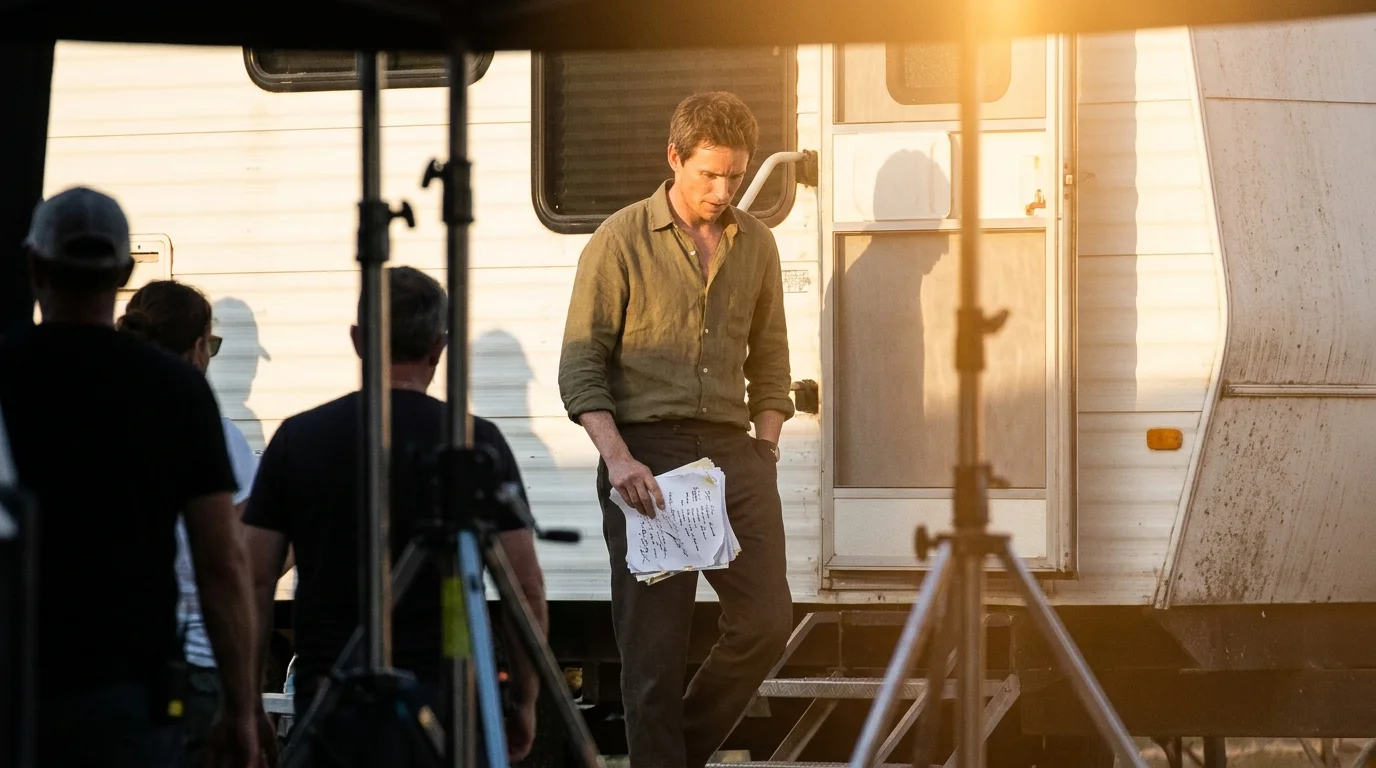
A soundstage casting room under fluorescent lighting carries an unmistakable, sterile quiet. You can hear the low hum of the air conditioner, the shuffle of production assistants behind folding tables, and the faint rustle of heavily redacted pages. In your hand, the dog-eared paper script sides marked with bleeding black ink notes feel fragile, almost ridiculous against the backdrop of a multi-billion-dollar franchise machine.
We tend to imagine Academy Award winners floating seamlessly through Hollywood, bypassing the awkward cattle-call humiliations that define early stage careers. The common assumption suggests that once an actor captures the industry’s highest gold statuette, every casting director simply rolls out red carpet welcome mats. The reality inside private audition bays is far more unforgiving.
When a screen test goes wrong, prestige offers no safety net. You stand alone against a blank backdrop, stripped of cinematic lighting, dramatic orchestral scores, and high-end digital effects, attempting to make absolute absurdity sound like high art. It is here that even the most celebrated dramatic masters can instantly crumble under the weight of naked, unpolished vulnerability.
The Audition Mirage: When Classical Technique Collapses on Camera
The transition from Shakespearean stagecraft to high-concept Hollywood blockbusters is not a straight staircase; it is a minefield. In high-stakes franchise casting, studios rarely hand actors actual character names or real scenes due to militant non-disclosure agreements. Instead, actors receive dummy sides—generic scenes disguised to protect plot twists—forcing them to guess the entire visual tone in a vacuum.
When Eddie Redmayne walked into his top-secret audition for what would eventually become Kylo Ren in Star Wars: The Force Awakens, he faced this exact structural trap. Without a helmet, vocal modulator, or lightsaber prop, he was given a brief villainous monologue alongside the cryptic prompt to deliver menace. He famously decided to experiment with bizarre vocal breathing techniques—inhaling sharply and barking lines through clenched teeth to mimic Darth Vader’s mechanical choke.
After multiple takes of wheezing and raspy guttural deliveries, the casting director finally cut the tape mid-sentence, asking deadpan: “Do you have another voice, or are you just going to keep doing that?” In that single, excruciating beat, the illusion of classical prestige evaporated completely.
- Brendan Fraser resurfaced talk show clip completely reversed harsh early career narratives
- Michelle Trachtenberg video clip triggers intense fan debate over tense red carpet posture
- Christian Bale switches red carpet press routes stopping awkward promotional junket questions
- Daniel Craig demands absolute digital blackout enforcing a strict fame survival ritual
- Emily Ratajkowski unscripted bedroom video reveals a calculated talent agency marketing rollout
The Unforgiving Geometry of the Reading Room
To understand why this failure resonates so deeply with audiences, you have to look at the mechanics of rejection through the lens of veteran industry insiders. Marcus Vance, a 44-year-old independent casting associate based in Los Angeles, has witnessed hundreds of high-profile actors implode during franchise cold reads.
“Audiences forget that reading for an iconic villain in an empty room feels like trying to run underwater,” Vance explains. “A stage actor wants to build a psychological cathedral, but a franchise director is just checking to see if your bone structure matches their toy merchandising line. When those two worldviews collide without context, the result is almost always total creative humiliation.”
The Three Traps of High-Stakes Screen Testing
Whether you are facing a Hollywood audition panel or pitching an ambitious project in a corporate boardroom, the hidden mechanics of high-pressure evaluations generally fall into three distinct vulnerabilities.
1. The Context Vacuum
When leadership hides critical project details behind secrecy protocols, performers are forced to fabricate intentions from thin air. Redmayne’s mistake was attempting to supply the special effects himself. Overcompensating for missing information by turning up the performance volume always reads as desperation rather than depth.
2. The Classical Over-Commitment
Trained dramatic actors often rely heavily on intense physical immersion. Yet, without an ensemble cast to ground the energy, pure immersion looks unhinged in a sterile office. Uncalibrated theatrical intensity tends to overwhelm camera sensors calibrated for subtle micro-expressions.
3. The Feedback Freeze
When an evaluator cuts the tape or interrupts your presentation with dry skepticism, the instinct is either to double down out of panic or shut down entirely. Navigating public creative dismissal demands detaching your core self-worth from the immediate outcome of an artificial test.
Mindful Calibration: Resetting After Creative Disaster
Recovering from a catastrophic misfire requires a deliberate, step-by-step psychological reset. You do not need to bury your failures; you simply need to categorize them accurately.
Treating high-stakes rejections as operational data rather than personal indictments keeps your creative momentum alive. Keep your approach uncluttered and direct:
- Acknowledge the artificial setting: Recognize that an audition room or pitch meeting tests your tolerance for awkwardness, not your ultimate talent.
- Strip away excess decoration: If you lack key context, perform with minimalist clarity rather than extravagant character choices.
- Release the post-mortem loop: Limit your post-event critique to exactly ten minutes, then archive the notes and move to the next engagement.
The Bigger Picture: Finding Grace in Public Failure
There is immense comfort in watching a revered artist recount their most embarrassing career misstep with genuine humor. When Redmayne publicly recounts making strange breathing noises in a quiet room, he dismantles the untouchable mystique of Hollywood perfectionism. It reminds us that mastery does not eliminate awkwardness; it simply gives you the grace to laugh about it later.
True professional longevity belongs to those who can withstand the sting of an interrupted tape, drop the bleeding ink scripts into the recycling bin, and step into the next room ready to begin again.
“True artistic resilience is the quiet willingness to look completely ridiculous in an empty room, knowing your worth survives the laughter.”
| Key Point | Detail | Added Value for the Reader |
|---|---|---|
| The Secrecy Dilemma | High-budget studio auditions rely on dummy scripts and zero plot context. | Shows why over-preparation can backfire without environmental awareness. |
| The Kylo Ren Audition | Redmayne attempted theatrical villain breathing, prompting the tape to be cut. | Normalizes catastrophic performance failures among top-tier professionals. |
| The Psychological Pivot | Transforming humiliating rejections into shared humorous anecdotes. | Teaches practical resilience and detaches identity from temporary outcomes. |
Frequently Asked Questions
Which specific role was Eddie Redmayne auditioning for when this failure happened?
He was testing for the masked villain Kylo Ren (ultimately played by Adam Driver) in Star Wars: The Force Awakens, operating under strict project secrecy.Why was the audition dialogue hidden from him?
Major entertainment studios use dummy sides—generic or rewritten scenes—to prevent plot spoilers from leaking, forcing actors to guess the tone blindly.What exact feedback stopped his screen test?
The casting director halted the take and asked if he possessed an alternate voice or intended to keep making strange breathing noises.How did Redmayne recover his career momentum after the failed test?
He pivoted immediately back to grounded character work, securing his Oscar-winning role in The Theory of Everything shortly thereafter.What can everyday professionals learn from this celebrity audition fail?
High-stakes evaluation rooms test artificial compliance rather than true long-term value; framing rejections as operational feedback prevents creative burnout.