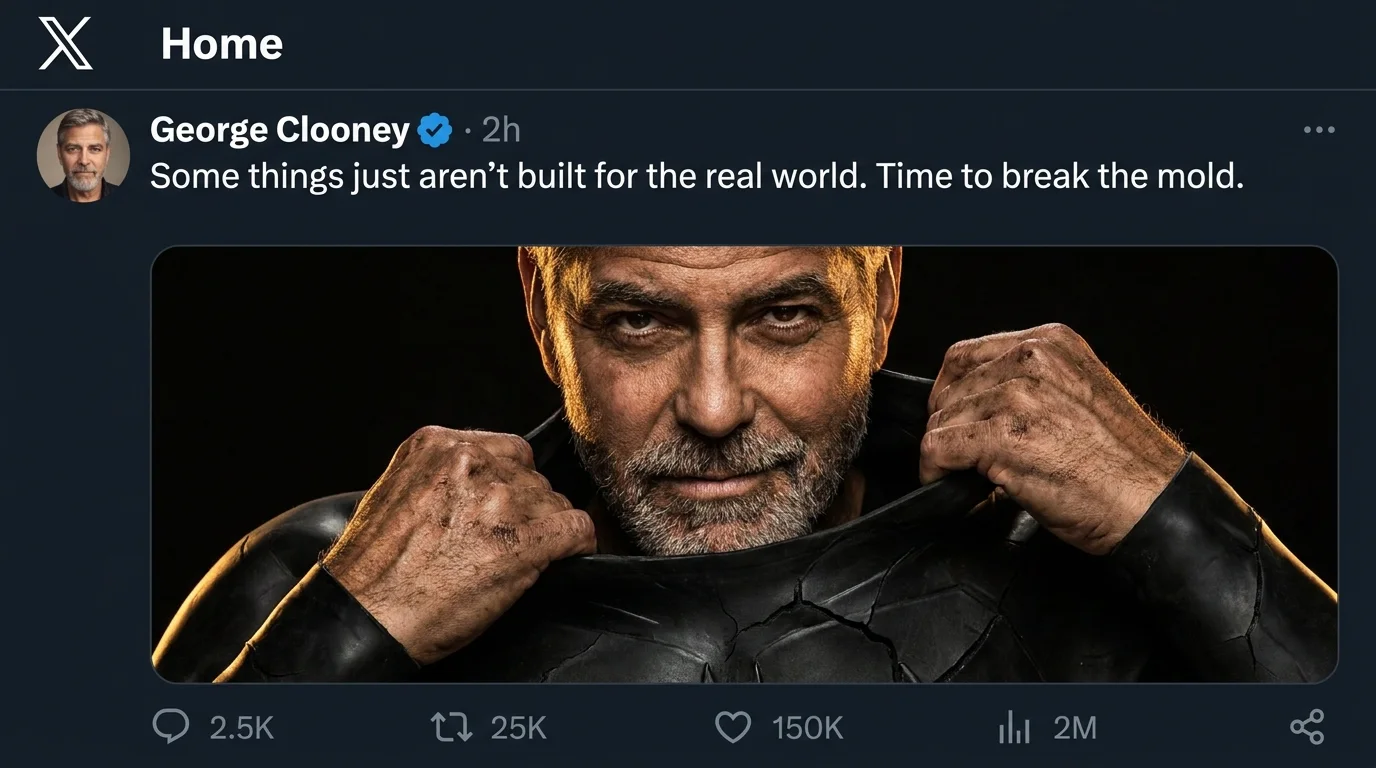
The air inside a fifty-pound slab of dark neoprene doesn’t circulate. You feel the heat pooling against your temples, smelling the chemical bite of setting industrial adhesive and latex paint baking beneath ten thousand watts of soundstage lighting. Every slight movement produces the muffled groan of dense foam fighting your collarbone, turning a simple neck turn into a full-torso pivot.
Standing immobilized on a Burbank soundstage in 1997, George Clooney stared through narrow eyelets at an industry machine operating at peak excess. The common wisdom held that stepping into an iconic cowl was the definitive golden ticket to permanent A-list dominance. Instead, the cracked molded rubber superhero suit became a physical cage that mirrored a suffocating legal reality.
When Batman & Robin premiered to immediate critical derision and catastrophic word-of-mouth, the conventional prognosis was grim. A failure of that magnitude usually leaves an actor stranded in studio purgatory, answering to executives looking for a scapegoat. But if you look past the neon glare and the camp dialogue, that specific box office disaster executed something far more valuable than a commercial hit ever could: it shattered a binding multi-picture studio mandate.
The Alchemy of the Unmitigated Disaster
In mainstream entertainment, a modest hit is often more dangerous to an artist than an outright disaster. A middling commercial success locks you into sequels, optional pickup windows, and promotional obligations that swallow five to seven years of your prime creative output. You become a well-compensated cog within an ongoing production schedule, unable to accept outside scripts without explicit studio permission.
When a franchise suffers complete structural failure, the contractual apparatus collapses instantly. The options for subsequent sequels are quietly dropped, release windows are wiped clean from the slate, and development executives abandon their hold on your calendar to minimize their own financial exposure. The disaster effectively severs the invisible strings holding the talent captive.
Clooney recognized that the public embarrassment of a monumental box office misfire gave him something rare in late-nineties Hollywood: total operational clean slate. By publicly shouldering the blame for the misfire rather than deflecting it onto the director or the studio, he disarmed the press while using the cancellation of future sequel options to pivot entirely toward auteur-driven cinema.
- Samuel Monroe Jr casual film screening sighting flaunts tailored camel overcoat and boots
- Al Pacino ignited movie history shouting unscripted insults across a tense courtroom set
- Kevin Bacon protects his thirty year Hollywood marriage enforcing remote farm isolation
- Pamela Anderson and Tommy Lee vintage interviews betrayed obvious physical distance and tension
- Nina Dobrev and Ian Somerhalder unscripted rainy scene gazes revealed real offscreen romance
The Contractual Clean Break in Practice
Marcus Vance, a 54-year-old entertainment contract strategist based in Century City, frequently studies the fallout of legacy studio agreements from that era. He points out that the true danger for rising television stars crossing over into features was the aggressive multi-option clause tucked into standard talent riders.
“When an actor transitions from a hit network show, studios lock them into three-picture or five-picture priority holds,” Vance explains. “If the tentpole works, you belong to that intellectual property until the box office dips below the margin. But if the tentpole craters in week one, the studio issues a mutual release to clear the balance sheet. For an actor with real taste and strategic patience, that release is worth ten times the original signing fee.”
Architecting the Pivot: Three Strategic Layers
Surviving a public career stumble requires shifting your attention from visibility to leverage. When the studio apparatus loosens its grip, you have a narrow window to establish new boundaries before the market redefines you.
1. The Creative Counterweight
Rather than chasing another high-budget safety net, pivot toward distinct directorial voices who prioritize style and tone over corporate marketing checklists. Clooney immediately aligned with Steven Soderbergh for 1998’s Out of Sight, taking a drastic cut in upfront compensation in exchange for critical credibility and adult-oriented storytelling.
2. The Risk-Sharing Partnership
Forming an independent production banner creates an insulating layer between you and traditional studio interference. By launching Section Eight Productions with Soderbergh, the focus shifted from being an auditioning employee to functioning as a packaging partner on boundary-pushing projects like Three Kings and O Brother, Where Art Thou?.
3. The Downstream Equity Strategy
Trading massive guaranteed paychecks for ownership of the underlying master or gross points gives you artistic veto power. When you stop depending on a studio’s upfront check, you no longer have to wear their rubber suits.
Mindful Career Reclamation
Reclaiming autonomy after a professional misstep requires quiet, deliberate maneuvers rather than frantic public explanations. You dismantle the trap by changing the terms of your engagement.
- Acknowledge the flaw without defensiveness: Taking direct ownership of a poor outcome instantly deprives critics of their leverage.
- Trade scale for control: Accept smaller production footprints in exchange for final script approval or distribution input.
- Build your own development pipeline: Acquire literary rights and original concepts before taking them to institutional financiers.
- Diversify revenue away from performance: Expand into producing, directing, or external ventures to eliminate the financial pressure of taking bad roles.
The Strategic Inversion Toolkit:
- Evaluation Metric: Assess projects by creative control percentage rather than gross talent fee.
- Contract Priority: Insist on firm expiration windows for unproduced options (maximum 18 months).
- Autonomy Target: Ensure at least 50% of your upcoming commitments are self-initiated or privately developed.
The Freedom Found in the Wreckage
We often treat professional setbacks as detours from an ideal path, assuming uninterrupted upward momentum is the only marker of success. Yet a smooth trajectory inside a rigid framework frequently leads to creative stagnation, trapping you in roles designed by committee to please everyone and move merchandise.
A public catastrophe clears the room. It strips away the fair-weather collaborators, silences the corporate micro-managers, and hands you back the keys to your own time. When the molded rubber cracks and the franchise dissolves, the resulting silence isn’t a defeat—it is the sound of an open door.
The fastest way to regain your creative freedom is to let an unworkable system fail completely under its own weight.
| Key Point | Detail | Added Value for the Reader |
|---|---|---|
| Contractual Severance | Box office collapse automatically dissolved studio sequel options and priority holds. | Reveals how structural failure eliminates restrictive legal obligations. |
| Auteur Alignment | Immediate transition to directors like Steven Soderbergh and the Coen Brothers. | Demonstrates how credibility is rebuilt through prestige partnerships over budget size. |
| Autonomous Production | Creation of Section Eight Productions to develop self-directed intellectual property. | Provides a blueprint for moving from talent-for-hire to equity ownership. |
Frequently Asked Questions
How did a box office failure help George Clooney’s career long-term?
The collapse of the franchise voided multi-film sequel obligations, allowing him to step away from generic studio blockbusters and immediately pursue prestige projects like Out of Sight and Three Kings.Why didn’t the studio hold him to his original contract?
When a massive tentpole underperforms critically and commercially, studios regularly choose not to exercise costly future talent options, effectively releasing actors from exclusivity windows.What was Section Eight Productions?
It was the production company founded by George Clooney and Steven Soderbergh in 2000, designed to produce critically acclaimed independent films like Michael Clayton, Far from Heaven, and Good Night, and Good Luck.How did Clooney handle the media fallout from the movie?
Instead of blaming the studio, writers, or director, he consistently took personal responsibility in interviews, disarming critics and establishing a reputation for self-aware professionalism.What is the main takeaway for creative professionals facing failure?
A visible failure can be used strategically to sever bad commitments, reset professional expectations, and transition toward projects where you hold genuine creative control.