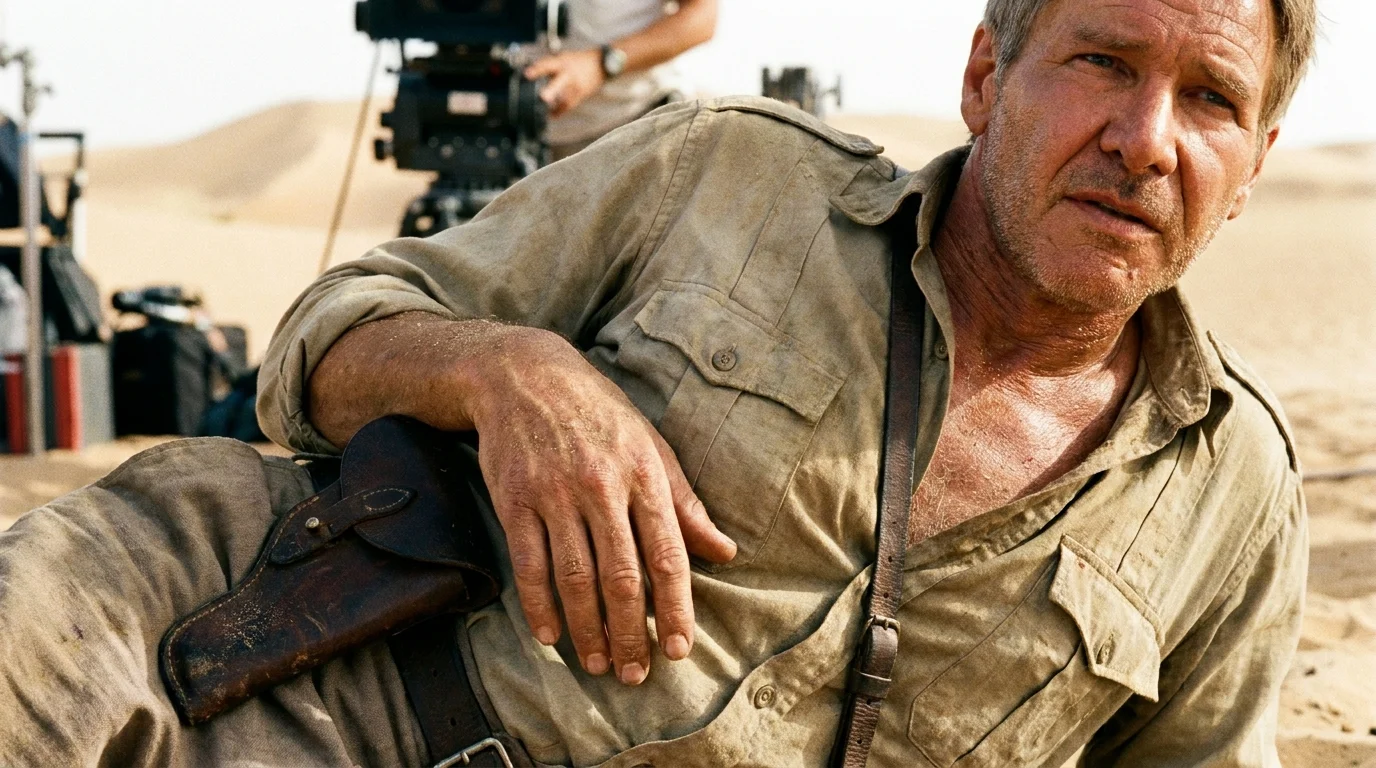
The midday sun over Kairouan, Tunisia, does not negotiate. In the summer of 1980, the ambient air hovered near 130 degrees Fahrenheit, baking the narrow stone alleyways until the dust felt like powdered glass against bare skin. Every breath tasted of baked earth, camel leather, and dry cedar smoke. On set, a meticulously planned action sequence called for days of intricate, bruising stunts under this relentless glare.
You can picture the scene before it shifted: a scuffed holster resting against sweat-stained khaki linen fabric, heavy with the weight of an aged British service revolver. Across the marketplace stood an imposing swordsman clad in black robes, brandishing an ornate scimitar through a series of blinding, rehearsed flourishes. The call sheet set aside three grueling days to film a high-energy clash between whip and steel.
The reality behind the camera was far less romantic. Crippling dysentery had ripped through the production crew, reducing energy reserves to absolute zero. Harrison Ford, weakened by severe dehydration and fever, could barely stand upright for ten minutes without needing a production break. What appeared on paper as an athletic spectacle became an unbearable physical demand.
Faced with an exhausting, three-day sword battle, Ford asked a simple question that reshaped cinematic history: “Why don’t we just shoot the sucker?” Steven Spielberg agreed, the camera rolled, Ford drew his sidearm with weary irritation, and a single dry blast created one of the most celebrated character beats ever caught on film.
The Illusion of Absolute Choreography
Pop culture often treats classic action sequences as pristine works of mechanical engineering, where every punch, dodge, and camera angle was drafted months prior inside a storyboard binder. We tend to believe that greatness comes from rigid adherence to an initial blueprint. Yet true narrative authority emerges when you recognize the exact moment a script stops serving the human reality of a scene.
When an actor chooses economy over extravagance, it strips away cinematic vanity. Ford replaced theatrical acrobatics with pure character logic. Indiana Jones was never a polished superhero; he was a bruised academic who survived on quick thinking, pragmatism, and sheer luck. Drawing the revolver did not ruin the scene—it perfected the character.
- Samuel L. Jackson enforces strict stage separation rules protecting his forty-year Hollywood marriage
- Winona Ryder resurfaced vintage trial footage reverses modern public opinion overnight
- Running Man unedited red carpet clips reveal tense body language between costars
- Cara Delevingne awkward red carpet behavior derails interviews demanding abrupt microphone handoffs
- Michael Keaton protects his sanity enforcing absolute isolation on remote Montana ranches
The Secret Behind the Blade: Terry Richards
Behind every improvised masterstroke lies someone whose quiet sacrifice makes the moment work. Terry Richards, a legendary British stuntman and master swordsman who stood over six feet tall, had spent months rehearsing an intricate choreography specifically designed to show off his formidable blade skills. He practiced complex figure-eight sweeps and theatrical spins, preparing for a sequence meant to be the set-piece centerpiece of the Cairo bazaar chase.
When Ford proposed bypassing the duel entirely, Richards did not protest or protect his screen time. Understanding the physical toll on his co-star and the comic brilliance of the anticlimax, Richards executed his flamboyant sword routine one final time, took the simulated gunshot, and collapsed flat into the dust. That generosity turned a potential onset dispute into cinematic gold.
Three Archetypes of Unscripted Cinematic Brilliance
Improvisation on high-stakes film sets rarely happens by accident. It belongs to three distinct creative categories that every storyteller and creative thinker should recognize:
- The Fatigue Pivot: When physical exhaustion or real-world limitations force you to discard overcomplicated plans in favor of the most direct, practical solution available.
- The Character Correction: When an unscripted reaction aligns more honestly with a personality than weeks of carefully written dialogue ever could.
- The Prop Collision: When physical objects—a jammed zipper, a dropping fedora, or a heavy holster—dictate the rhythm of a scene rather than the script supervisor.
By stepping back from over-engineered concepts, you create room for genuine human behavior to cut through artificial polish.
Mindful Editing: How to Apply the Desert Gun Blast Rule
Whether you are directing a film, managing a creative campaign, or handling a complex personal project, over-complication is often a mask for insecurity. When energy runs thin and deadlines loom, leaning into simplicity often produces your best work.
- Identify the scimitar in your workflow: Pinpoint the tasks you are performing purely for theatrical flair rather than actual impact.
- Respect physical signals: Treat exhaustion not as an enemy, but as a filter that exposes unnecessary friction in your process.
- Trust simple tools: Choose the reliable, straightforward option over the elaborate, multi-step sequence.
- Capture the first clean take: Resist the urge to over-polish a moment once its authentic spark is secured.
Tactical Set Parameters for the Scene:
- Location: Kairouan, Tunisia (standing in for Cairo)
- Ambient Temperature: 100–130°F on open stone
- Planned Shoot Duration: 3 Full Days
- Actual Improvised Shoot Time: Less than 45 minutes
- Firearm: Smith & Wesson M1917 .455 caliber revolver (custom modified)
The Power of the Spontaneous Choice
Great storytelling does not depend on unbroken control; it depends on your willingness to listen when circumstance demands a pivot. Harrison Ford’s weary trigger pull remains immortal because it captured an honest human truth under an unforgiving desert sky. When you learn to let go of perfectionism and trust your instincts in moments of real friction, you turn unavoidable limitations into enduring victories.
“The best moments on film are almost always the ones that occur when everyone is too tired to pretend anymore.”
| Key Point | Detail | Added Value for the Reader |
|---|---|---|
| Physical Catalyst | Severe dysentery and extreme 130°F Tunisian heat | Shows how physical constraints can clarify creative choices |
| Choreography Shift | Replaced 3-day sword fight with a 2-second draw | Demonstrates the power of radical simplification |
| Character Legacy | Solidified Indiana Jones as a weary pragmatist | Proves that character truth always beats raw spectacle |
Frequently Asked Questions
Was the swordsman in on the improvisation before the camera rolled?
Yes. While it was not in the original script, Harrison Ford and Steven Spielberg discussed the change during lunch and walked through the timing with stuntman Terry Richards before filming.How long did the improvised scene take to film?
The production captured the entire shot in just a few takes, taking under an hour instead of the three full days originally allocated on the production schedule.What made Harrison Ford so ill during filming in Tunisia?
Ford and dozens of crew members suffered from severe food poisoning and dysentery caused by local food and water conditions during the desert shoot.Did the scene cost Terry Richards his stunt pay?
No. Richards was fully compensated for his preparation and stunt work, and the moment cemented him as a beloved figure in film trivia lore.Why didn't Spielberg reject the idea to protect the script?
Spielberg recognized instantly that an unceremonious gunshot delivered perfect comic timing while staying true to the character’s pragmatic nature.