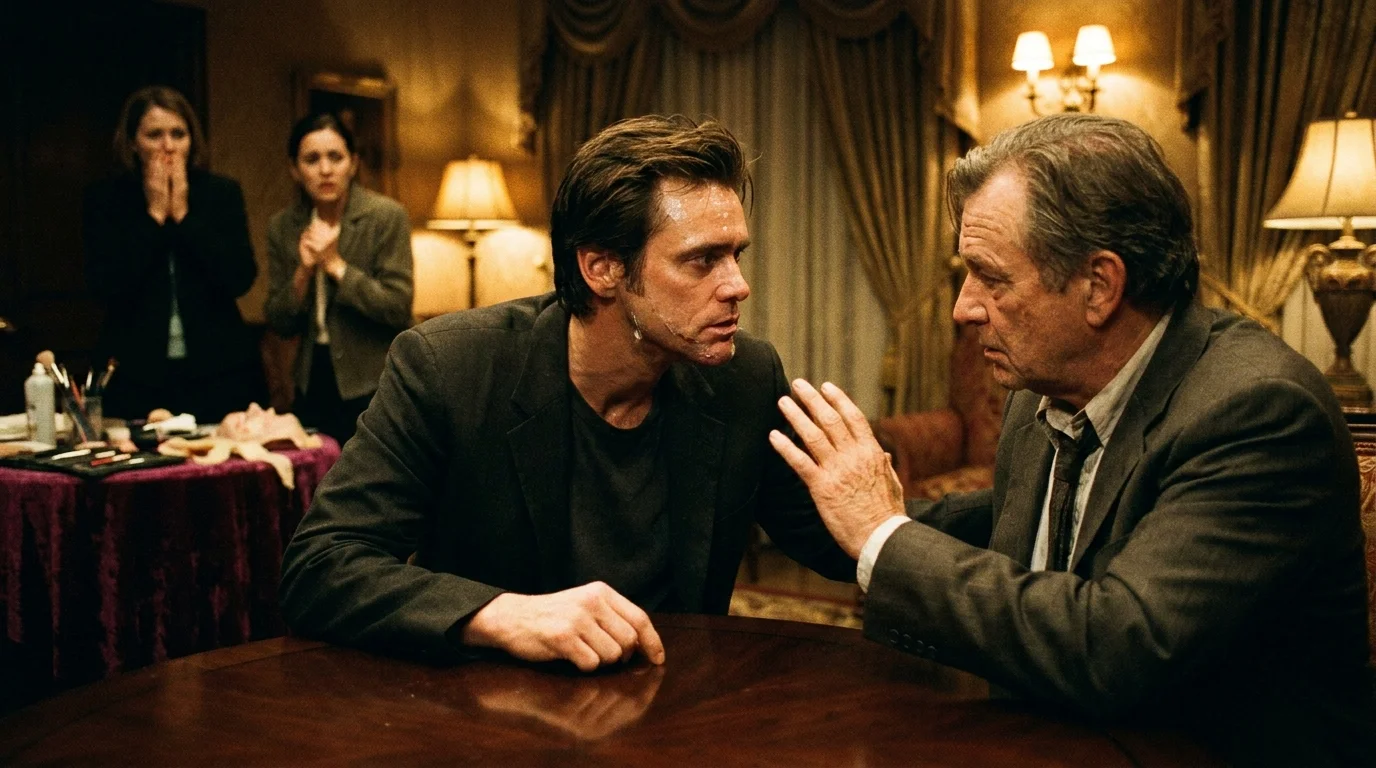
A heavy smell of spirit gum and stale dark coffee hangs over Stage 15 at Universal Studios. In the corner of the trailer sits a smeared prosthetic makeup chair surrounded by frustrated production assistants clutching call sheets stamped with red ink. The chair still carries the chalky residue of shaved eyebrows, discarded latex bald caps, and torn paper cups crushed underfoot during a mid-morning shouting match. You might look at prestige cinema through the lens of pure creative martyrdom, expecting high art to demand absolute self-erasure.
Instead, the reality of a working film set is brutally mechanical. It is an intricate web of eighty hourly workers, union-mandated meal penalties, and focus pullers trying to gauge lens distance while an actor lunges unexpectedly into dark corners. When Jim Carrey dissolved into the persona of the late provocateur Andy Kaufman—and Kaufman’s foul-mouthed alter ego, Tony Clifton—during the 1999 production of Man on the Moon, he didn’t simply commit to a performance. He severed the silent contract that keeps a multi-million-dollar set from collapsing under its own weight.
You see the legendary tales framed as brilliant dedication on late-night panels: the star refusing to respond to his legal name, staging physical confrontations with professional wrestlers, and demanding that production executives treat an imaginary lounge singer with genuine corporate deference. But behind the monitor, director Miloš Forman was forced to negotiate basic camera blocking through intermediaries because Carrey claimed the actual actor was unreachable. The romantic myth tells you this level of artistic possession is the price of genius; the logistical record shows a crew working sixteen-hour turnarounds while walking on eggshells around a phantom.
The total immersion trap reveals a harsh institutional truth: when an artist removes all friction between personal identity and a fictional construct, they do not absorb the cost alone. They offload the emotional, financial, and physical friction entirely onto the working crew beneath them.
The Live-Wire Fallacy: Why Immersive Acting Breaks the Machine
To understand what happened during that infamous shoot, you have to discard the idea that method acting is a personal meditation. Think of a high-budget film production not as an open canvas, but as a high-voltage workshop. Every department operates a specific tool—lighting, boom mics, precision dolly tracks—calibrated to predictable human movements. When a lead performer acts like an ungrounded, whipping live wire across the concrete floor, everyone else has to drop their tools just to avoid getting shocked.
Forman’s set became a daily exercise in hostage negotiation. Carrey’s insistence on staying in character between setups meant that simple logistical checks—such as verifying sound levels or resetting a ruined three-point lighting rig—required crew members to indulge hostile improv routines. What was celebrated on film festival reels two decades later was, in the moment, a grinding drain on union crew members who were simply trying to earn their day rate and return home to their families before midnight.
- Meghan Markle engineered podcast tears expose a calculated corporate formula launching her lifestyle empire
- Josh Hartnett severed suffocating multi-picture studio contracts after Hollywood Homicide became a catastrophic bomb
- Noah Jupe flashes vintage Prada leather tailoring during a casual rainy London outing
- Robin Williams unscripted monologue in Good Will Hunting triggers uncontainable raw camera operator shaking
- Kevin Kline and Phoebe Cates enforce strict Manhattan isolation protecting their thirty-five year marriage
Creative obsession without boundaries often functions as an exercise in unchecked professional entitlement. The line between transformative acting and workplace intimidation vanishes the second an unscripted stunt puts a camera operator’s safety or a sound mixer’s hearing at risk.
The Cost on the Floor: A Focus Puller’s Perspective
Marcus Vance, a 54-year-old veteran first assistant camera technician based in Santa Clarita, spent decades pulling focus on major studio productions. While he did not work on the Kaufman biopic directly, he spent five months on a comparable prestige production where the lead refused to break character for 120 consecutive days. His account cuts through the romantic folklore of Hollywood transformations.
“When an actor refuses to hit their marks because ‘the character wouldn’t stand there,’ you aren’t seeing rebellion,” Vance explains while cleaning a 50mm prime lens on his workbench. “You are watching twenty people lose their dinner break. We work on tolerances measured in fractions of an inch. If you wander off into the shadows to feel the scene, the shot is soft, the take is ruined, and the studio blames the crew, not the star. True craft isn’t making everyone else guess where you are going to breathe.”
The Ripple Effect: How Unchecked Immersion Fractures a Set
When an immersive acting approach backfires, the fallout divides cleanly across the studio ecosystem, leaving different departments to manage specific operational strains.
1. The Physical Floor Crew
Camera operators, grips, and makeup technicians bear the immediate physical load. Unpredictable movements force technicians to haul 40-pound Steadicam rigs through extended, aimless takes without rehearsal cues. When prosthetic applications are ripped off in fits of character-driven frustration, makeup artists must spend extra unpaid hours rebuilding delicate foam latex pieces before dawn call times.
2. The Mid-Tier Ensemble and Supporting Cast
Co-stars are forced into non-consensual improvisation, never knowing if a scripted emotional beat will be met with scene-stealing hostility or sudden silence. Professional actors who rely on reciprocal rhythm find their preparation nullified by a partner who treats the script as an obstacle rather than a shared map.
3. The Executive Suite and Scheduling Desk
Line producers and assistant directors face compounding budget overruns. Unscripted delays push shoots into golden time—double-rate overtime penalties—triggering tense conference calls with studio executives who must weigh the prestige of awards buzz against mounting insurance liabilities.
The Professional Re-Calibration: Sustainable Focus Under Pressure
You do not need to burn down the room to deliver an unforgettable creative performance. Whether you are stepping in front of a lens, delivering a high-stakes keynote, or executing an intense technical project, true authority comes from intense internal focus paired with immaculate external courtesy. Consider this framework your tactical toolkit for deep immersion:
- The 10-Minute Decompression Valve: Never carry intense creative adrenaline straight into operational discussions. Set a strict ten-minute buffer between completing a demanding scene or task and reviewing raw output with your team.
- The Operational Safeword: Establish a clear, unambiguous signal with your direct collaborators that instantly halts all roleplay or experimental focus, allowing technical adjustments to happen without character friction.
- Clear Spatial Boundaries: Respect the physical marks laid down by your crew. Creative freedom exists within the frame, not by forcing the camera crew to scramble outside the lit stage.
- Direct Off-Camera Communication: If an upcoming take requires sudden physical contact or extreme emotional dissonance, brief your scene partners in plain, grounded language before the slate drops.
The Bigger Picture: Mastery Leaves the Room Intact
The cultural obsession with the tormented, unyielding artist is slowly giving way to a more mature truth. The greatest performances in cinema history were not built on the wreckage of the people holding the boom poles. They were built on trust, precision, and the quiet understanding that the camera sees the truth even when you respect the call sheet.
When you master your craft, you no longer need the crutch of total chaos to prove your dedication. You realize that stepping out of character to ask a tired production assistant for fresh water—using your real voice, with genuine gratitude—does not weaken your art. It sustains the very engine that allows your art to exist.
Real mastery does not require you to make everyone else pay the tax for your creative process.
| Key Point | Detail | Added Value for the Reader |
|---|---|---|
| Set Logistics | Overtime penalties and missed camera marks directly damage crew well-being. | Shows why artistic decisions must respect operational limits. |
| Method Backfire | Extreme immersion alienates collaborators and inflates production budgets. | Reveals the hidden reputational cost of uncontrolled intensity. |
| Sustainable Craft | Clear boundaries and mutual respect produce sharper, repeatable output. | Provides a grounded blueprint for executing high-pressure work without burning bridges. |
Frequently Asked Questions
Did the Man on the Moon producers try to halt Jim Carrey’s method approach?
Yes. Director Miloš Forman and key producers repeatedly held crisis meetings to manage the schedule overruns and hostile off-camera dynamics, but they ultimately accommodated the behavior to keep production moving.Why did Universal Studios withhold the behind-the-scenes footage for years?
Studio leadership worried that the raw documentary footage would make Carrey look hostile and alienate his massive mainstream fan base during the film’s initial theatrical window.Is method acting standard practice across major Hollywood studios today?
No. Contemporary productions increasingly favor collaborative technique and intimacy coordinators over unchecked immersion to maintain rigorous workplace safety and strict production schedules.What is the primary operational problem with staying in character between setups?
It breaks down standard communication channels. Technical crews cannot get accurate answers regarding lighting cues, physical positioning, or audio adjustments if the performer refuses to communicate as a professional coworker.Can an actor deliver prestige performances without method immersion?
Decades of film history prove that classical preparation, strict rehearsal, and immediate access to emotional memory consistently yield award-winning work without causing set friction.