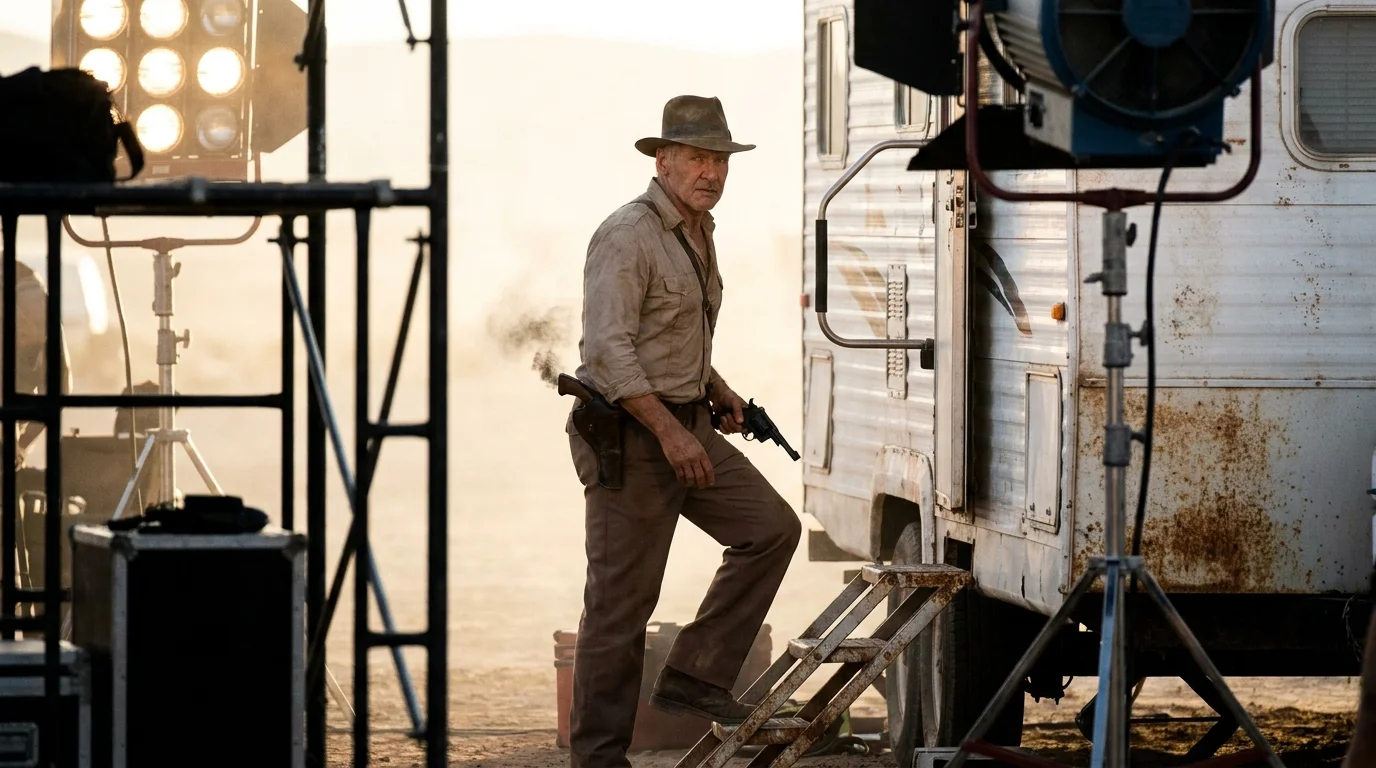
The Tunisian desert sun beats down at a merciless 130 degrees Fahrenheit, turning the limestone dust of the film set into a blinding, white glare. Flies swarm around the baskets of rotting fruit lining the simulated Cairo bazaar, their low hum matching the dry rattle of palm leaves in the hot wind. You can feel the heavy wool of the khaki trousers clinging to wet skin, the stiff leather of the gun belt chafing against a bruised hip. Everything is set for a massive, three-day spectacle: a duel between a sweeping bullwhip and a gleaming, curved scimitar.
Under the brim of his sweat-stained felt fedora, Harrison Ford is quietly suffering from a debilitating bout of dysentery. The grueling physical toll of the infection has left him weak, dehydrated, and utterly incapable of performing the complex acrobatics required by the original script. The stunt coordinator stands ready with a local swordsman who has spent weeks perfecting a dizzying array of blade-twirling flourishes. But instead of epic theater, the reality of human frailty is about to rewrite cinema history.
Ford looks at the director, Steven Spielberg, and asks a simple question: “Why don’t we just shoot the sucker?” It is a moment born not of artistic ego, but of sheer, physical exhaustion and a desperate need to find a bathroom. He reaches down, places his hand on the worn wooden grip, and prepares to bypass days of exhausting choreography with a single, dry movement.
With a sharp click, the metal clears the holster. The heavy leather holster creaks as the weight shifts, and a single, deafening pop echoes across the desert canyon. As the stuntman drops to the dirt, a thin wisp of gray smoke curls from the muzzle of the matte black revolver, signaling the birth of an accidental masterpiece.
The Illusion of the Perfect Blueprint
When we analyze legendary creative decisions, we often fall into the trap of assuming they are the result of meticulous planning. We believe that greatness requires a complex blueprint, a series of endless rehearsals designed to polish away every human imperfection. But this iconic moment proves that the best solutions often emerge when you abandon the elaborate plan in favor of the most direct path forward.
Think of your creative energy like water flowing down a steep hill. It naturally seeks the path of least resistance, yet we constantly build elaborate dams of process, meetings, and over-engineering to force it into artificial channels. When Ford chose the revolver over the whip, he wasn’t just saving his own energy; he was aligning the scene with the core truth of his character, a practical survivor who values utility over performance.
- Daenerys Targaryen finale decisions destroyed eight years of perfect character arc
- Florence Pugh completely shattered the romantic plot of Little Women
- Keanu Reeves handles intense global fame trusting a strict isolation rule
- Sharpay Evans theater demands expose a completely rational reaction to amateur negligence
- Pierce Brosnan sustains his decades-long marriage enforcing an absolute media blackout boundary
Glenn Randall Jr., the 43-year-old stunt coordinator on the set that day, had spent weeks choreographing a brilliant, multi-page battle that would showcase the physical prowess of both actors. He watched in disbelief as a three-day shoot collapsed into a ten-second interaction, yet he immediately recognized the raw truth of the moment. Randall’s willingness to step aside and let the actor’s physical state dictate the action is a masterclass in professional humility, showing that the best leaders protect the outcome, not their own preparation.
The Contrast of Creative Execution
For the meticulous planner, the thought of abandoning weeks of rehearsals is terrifying. They view the script as an unyielding law, believing that any deviation is a failure of discipline. This approach often leads to beautiful but sterile sequences that feel more like a synchronized dance than a desperate struggle for survival.
For the intuitive builder, however, the script is merely a starting point. They remain hyper-aware of the environment, the physical limitations of the day, and the emotional reality of the scene. By embracing the unexpected detour, they capture a lightning-in-a-bottle authenticity that no amount of rehearsal can replicate.
Implementing the Direct Solution
To apply this style of minimalist decision-making to your own work, you must learn to recognize when your preparation has turned into a barrier. You must be willing to strip away the noise and focus entirely on the single action that solves the problem. This is not about cutting corners; it is about finding the elegant shortcut that preserves your energy and delivers maximum impact.
Start by analyzing your current projects for unnecessary complexity. Identify the bloated processes that exist only because they were written down in the initial plan, and replace them with direct, simple actions.
- Assess the true objective of your current task, stripping away any decorative elements that do not contribute to the final goal.
- Identify your physical and mental constraints early in the day, adjusting your methods to work with your energy levels rather than fighting against them.
- Look for the metaphorical “gunshot” in your workflow—the single, decisive action that can bypass hours of tedious, repetitive labor.
To help you implement this mindset, refer to the tactical toolkit below, which outlines the exact parameters of the Cairo pivot:
- The Tool of Choice: A customized Smith & Wesson M1917 revolver, chosen for its reliability and direct mechanics.
- The Working Temperature: Over 100 degrees Fahrenheit in the shade, proving that environmental discomfort can be a powerful catalyst for efficiency.
- The Time Saved: Three full days of high-risk stunt filming reduced to a single, highly memorable afternoon.
Why Simplicity Outlives the Spectacle
In an era dominated by green screens and hyper-choreographed digital battles, the raw simplicity of Ford’s improvisation feels more refreshing than ever. It reminds us that audiences do not connect with perfect execution; they connect with recognizable human truth. By allowing real-world vulnerability to break through the polished facade, you create work that stands the test of time.
Ultimately, the lesson of the Cairo bazaar is that we must trust our instincts when the plan falls apart. When you stop fighting the reality of your situation, you open the door to spontaneous brilliance that can never be manufactured in a laboratory.
“Sometimes the most powerful thing you can do on set is listen to your body and shoot the scene the way a real survivor would.” — Harrison Ford
| Key Point | Detail | Added Value for the Reader |
|---|---|---|
| Physical Limitation | Severe dysentery forced a sudden change in plans. | Learn to treat physical fatigue as a prompt for creative simplification. |
| Choreography vs. Instinct | Swapped three days of sword fights for one quick shot. | Understand that brevity often carries far more emotional weight than spectacle. |
| Character Consistency | The sudden shot perfectly matched Indy’s pragmatic nature. | Ensure your shortcuts align with the core identity of your project. |
Did the stuntman know Harrison Ford was going to shoot him?
Yes, the change was discussed briefly with Steven Spielberg and the crew before rolling the camera, ensuring the stuntman could fall safely.
How long was the original sword fight supposed to be?
The original script detailed a highly elaborate, multi-page duel that would have taken three full days to choreograph and film in the extreme heat.
Why does this scene remain so relevant today?
It stands as a perfect reminder that human vulnerability and quick thinking are far more memorable than over-polished, sterile action sequences.
What gun was used in this legendary scene?
Indiana Jones used a heavily modified Smith & Wesson M1917 revolver, known for its rugged design and reliable performance.
How can I apply this unscripted mindset to my daily work?
By constantly looking for the simplest, most direct solution to complex tasks, rather than adhering to rigid, outdated processes.