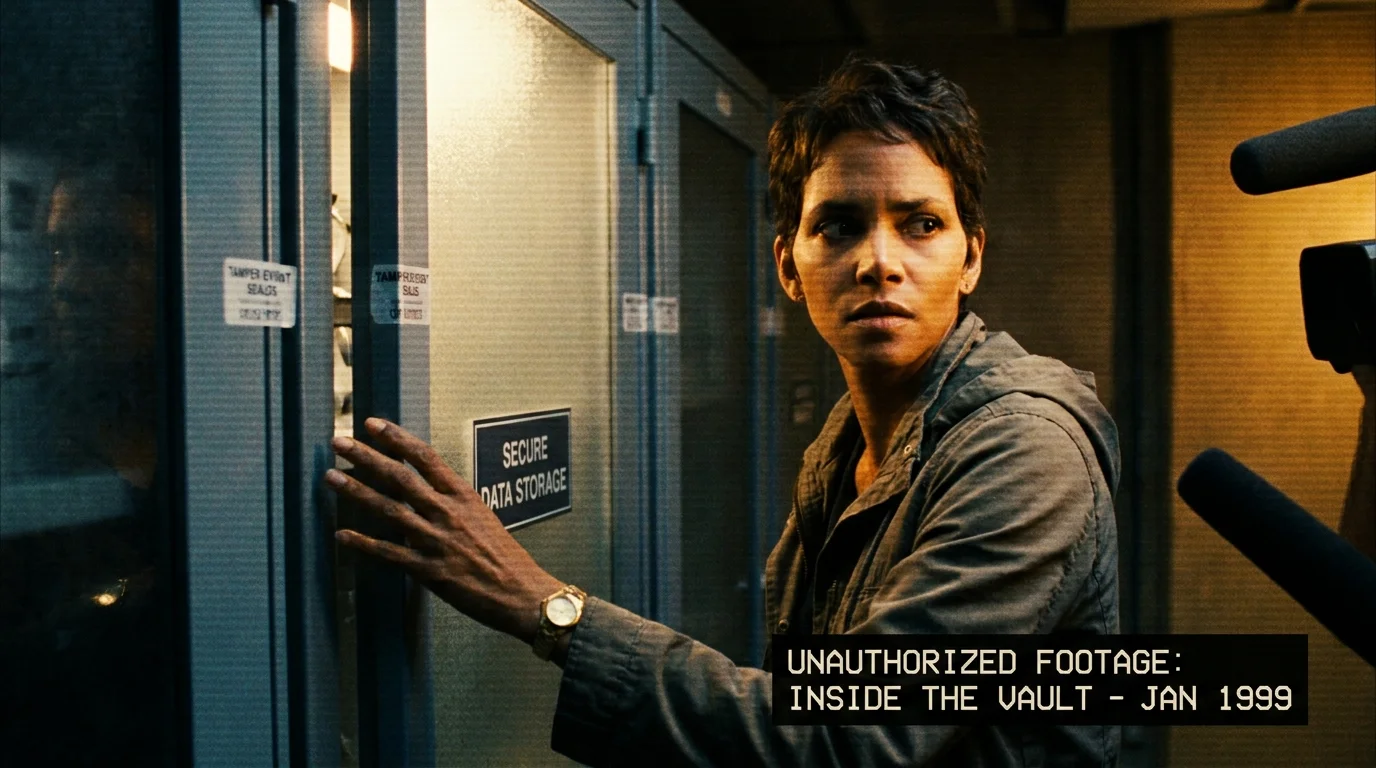
Behind a reinforced steel door in a nondescript corporate park just outside Burbank, the temperature rests at a perpetual sixty-five degrees Fahrenheit. The room hums with the dull, dry drone of industrial climate control. On an anodized aluminum shelf, three sealed external hard drives sit encased in anti-static foam, their serial numbers scrawled across neon green gaffer tape: The Mothership — Archival Master — Do Not Mount. There are no applause tracks, no director commentary cuts, and no late-stage promotional trailers loaded onto flash drives.
You would reasonably expect a forty-million-dollar sci-fi vehicle starring an Academy Award winner like Halle Berry to command a carpeted Beverly Hills press junket, complete with velvet ropes and rehearsed television interviews. Instead, the studio killed the microphones before the first reporter could even check their audio levels. The official story leaked to trade outlets suggested production delays and impossible reshoots, painting the picture of a broken creative endeavor that simply could not cross the finish line.
That explanation is a calculated decoy. When an established media conglomerate quietly cancels a nearly finished motion picture and locks the footage in a digital vault, they are rarely protecting you from a bad script. They are executing an accounting maneuver, choosing the cold certainty of an immediate tax asset over the unpredictable returns of a public release.
The Phantom Bomb and the Ledger Shell Game
For decades, the public understood cinematic failure as a public spectacle. A movie was shot, edited, marketed, and pushed into theaters or onto streaming home screens, where audiences either embraced it or let it bleed money. In that traditional model, artistic risk dictated corporate fate. The modern studio ledger operates under a completely different logic, treating raw footage not as a creative expression, but as an inventory asset subject to strategic amortization.
When executives look at a completed production that requires an estimated ten to fifteen million dollars in visual effects polishing and mandatory cast reshoots, they run two parallel financial forecasts. The first model projects subscriber retention, brand prestige, and backend licensing. The second model calculates the instantaneous tax relief of declaring the entire production a total loss under federal tax rules. If writing down the asset wipes forty million dollars in taxable income off the parent company’s fiscal ledger, the film is worth far more dead on a hard drive than alive on an algorithm.
- Scarlett Johansson studio lawsuit sparks viral flood of nostalgic bloopers masking executive warfare
- Jojo Siwa unscripted bedroom breakdowns alienate superfans exposing rigid talent agency marketing scripts
- Kimiko Glenn streaming contract loophole strips massive hit residuals to flimsy paper pennies
- Jared Leto method immersion isolates film crews dumping foul rotting carcasses on rehearsal tables
- Chrissy Teigen triggers tearful podcast confessions right before unveiling greasy nonstick cookware lines
Marcus Vance, a forty-eight-year-old veteran post-production supervisor who spent over two decades navigating studio editorial suites across Los Angeles, understands the mechanical precision of these sudden corporate deaths. Vance recalls the exact morning his team was ordered to stand down on a similar mid-tier streaming feature: “We had the sound mix ninety percent locked and the dialogue polish scheduled for Thursday. Then an unsigned memorandum landed from finance, directing us to wipe the active servers, box the local drives, and cease all contact with the actors’ representation. The executives never even asked to screen the latest assembly. The project wasn’t cancelled because it failed an audience test; it was cancelled because the fiscal quarter was ending in fourteen days.”
Deconstructing the Erasure: The Three Stages of a Manufactured Loss
The quiet burial of high-budget streaming productions does not happen by accident. It follows an engineered institutional playbook designed to minimize public blowback while satisfying internal auditors.
The Reshoot Standoff. The process begins by fabricating an insurmountable scheduling crisis. When child actors grow or principal cast members book subsequent productions, reshoots naturally become expensive and logistically complicated. Rather than solving these standard scheduling hurdles, the studio weaponizes them. Executives classify standard pickup shots as impossible obstacles, formally documenting that the project cannot be completed as contracted without irresponsible capital expenditures.
The Promotional Blackout. The absolute death knell for any feature targeted for a tax write-down is the prevention of public distribution. Under strict corporate accounting guidelines, an asset cannot be written off as an abandoned loss if it has entered active commercial exploitation. Canceling promotional junkets is not an act of embarrassment; it is a legal safeguard. By preventing the actors from doing press and withholding trailers from public view, corporate legal teams ensure the film remains categorized as an unreleased, abandoned manufacturing asset.
The Amortization Lock. Once the loss is certified, the film enters a legal purgatory. The studio cannot legally license the footage to a third-party streamer, sell the intellectual property to another distributor, or upload it to an ad-supported video catalog without incurring severe financial penalties for improper tax avoidance. The physical and digital masters must remain locked away indefinitely, effectively erased from cultural memory to preserve the tax benefit.
The Diagnostic Audit: Spotting Corporate Write-Down Subterfuge
Identifying the difference between an organic creative failure and a manufactured tax write-down requires looking past trade headlines and reading the underlying corporate behavior. You can decode these industry moves using a clear set of structural markers:
- Sudden Junket Cancellations: If scheduled press junkets or festival appearances are abruptly pulled without a clear medical or legal cause, the studio is intentionally keeping the asset out of commercial commerce.
- The “Cost-to-Finish” Narrative: Watch for anonymous studio leaks claiming that finishing visual effects or reshoots would be cost-prohibitive. This specific phrasing establishes the legal predicate that the asset is commercially unviable to complete.
- Complete Erasure Across Platforms: When a studio removes an announced title entirely from investor decks, press portals, and upcoming slate sheets overnight, it signals an immediate balance sheet write-off rather than a delay.
- Cast Radio Silence: When high-profile stars like Halle Berry remain bound by non-disclosure agreements and offer only measured, diplomatic remarks about sudden project cancellations, the studio’s legal apparatus is prioritizing balance-sheet protection over artist relationships.
The Creative Aftermath and the Preservation Crisis
When completed cinema is treated as disposable balance-sheet ballast, the dynamic between artists and platforms shifts from creative partnership to defensive self-preservation. For generations, even the most notorious cinematic disasters lived on through late-night television broadcasts, bargain DVD bins, and word-of-mouth cult followings. They existed as tangible pieces of history that audiences could critique, revisit, and evaluate on their own terms.
Today, erasing creative work to offset corporate debt denies audiences that basic cultural dialogue. When sealed hard drives sit untouched in climate-controlled lockers, thousands of hours of skilled labor from costume designers, gaffers, cinematographers, and performers are treated as nothing more than a non-operating expense deduction. Recognizing these moves for what they are—calculated corporate tax plays rather than failures of artistic merit—is the first step toward understanding the real economics shaping modern entertainment.
“A studio does not lock an A-list movie in an iron vault because it lacks quality; they lock it away because corporate tax code can make dead celluloid more profitable than live art.”
| Key Point | Detail | Added Value for the Reader |
|---|---|---|
| Manufactured Abort | Studio halts standard reshoots and claims impossibility | Separates real production hurdles from accounting strategies |
| Press Suppression | Junkets and trailers are systematically withheld | Explains why public promotion legally invalidates tax deductions |
| Permanent Vaulting | Assets are legally barred from third-party licensing | Clarifies why shelved projects cannot simply be sold to competitors |
Frequently Asked Questions
Why can’t a written-down film like The Mothership be sold to another streaming network?
Once a studio claims a full corporate tax loss on an abandoned asset, federal accounting rules prohibit them from monetizing that exact work. Selling the finished cut or raw footage to an outside competitor would constitute commercial exploitation, forcing the studio to repay the tax benefits alongside potential penalties.Did the film get shelved because the creative cut was unwatchable?
While studio publicists often lean on rumors of creative quality or challenging reshoots, these narratives primarily serve to justify abandonment to shareholders. Millions of dollars are spent releasing flawed films annually; an outright vaulting almost always points to corporate debt management and tax optimization.Does Halle Berry still get paid if the movie is never released?
Yes. Established A-list actors work under “pay-or-play” contracts, which guarantee their full compensation regardless of whether the studio actually finishes, distributes, or archives the final motion picture.What happens to the actual physical footage after a tax write-down?
The conformed hard drives, raw digital rushes, and audio tracks are cataloged, sealed, and moved to secure corporate archives. The studio retains the copyright but is legally restricted from releasing the material into public commerce.Is this practice becoming standard across the entertainment industry?
Following massive corporate media mergers, tax write-downs on unreleased and completed projects have become a frequent tactic for conglomerate balance sheets looking to offset acquisition debts quickly.