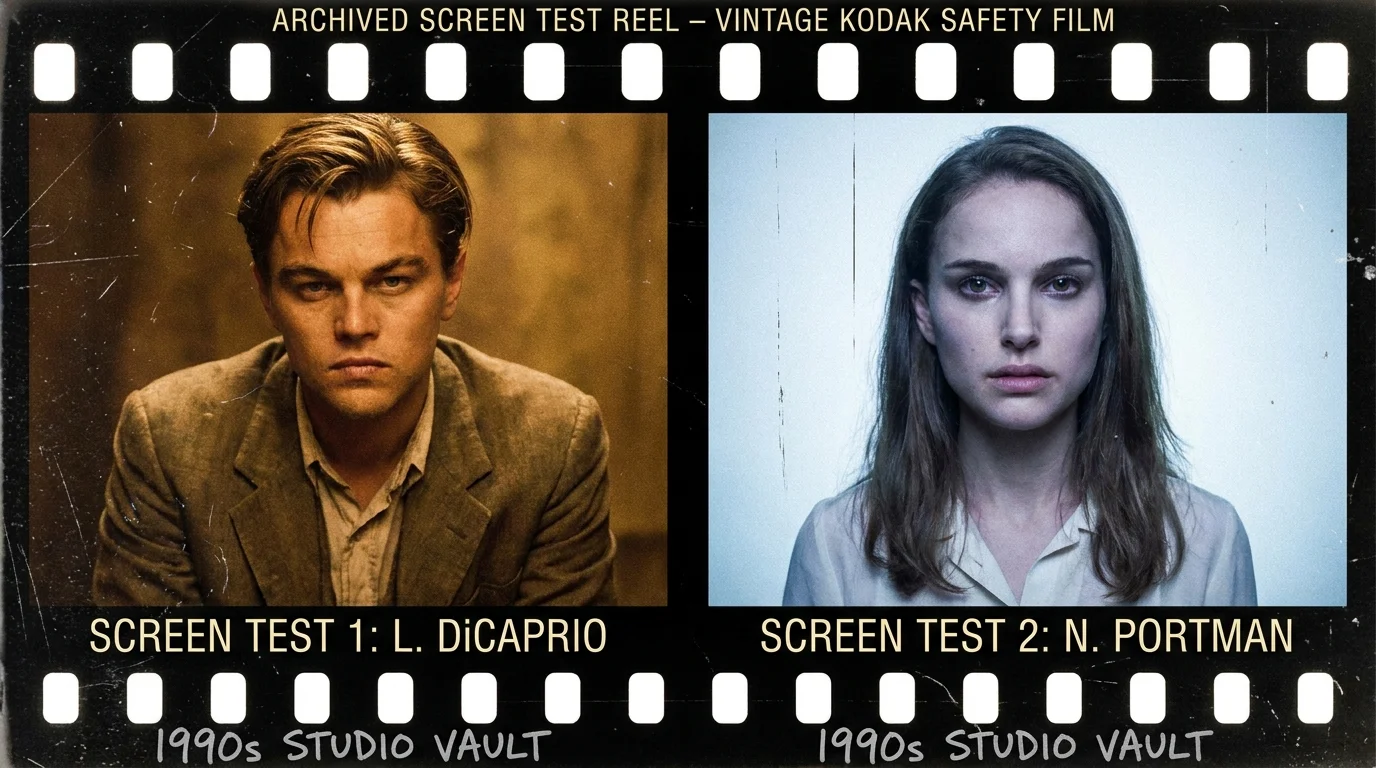
Imagine a climate-controlled vault in Burbank, California. The air is cold, smelling faintly of vinegar and decaying acetate. On a steel rack sits a dusty, archived 35mm screen test reel, its handwritten label fading under decades of silence. Inside those coiled strips of celluloid lies an alternate version of 1996, frozen in time and hidden from public view.
You probably remember the iconic fish tank scene from Baz Luhrmann’s masterpiece—the blue-tinted water, the soft hum of the filter, and the electric spark between two star-crossed lovers. That single sequence defined a generation’s view of tragic romance. But before those cameras rolled in Mexico City, a different pair stood in the artificial studio light, attempting to conjure decades of cold silence into a believable passion.
The standard Hollywood narrative tells us that casting is purely about emotional chemistry and line delivery. We assume that if two brilliant actors read the legendary verses with enough intensity, the illusion will hold. The unvarnished reality of filmmaking is far more cold-blooded; it is a game of geometry, lens compression, and the unforgiving architecture of the human face.
The Architecture of a Frame: Why Chemistry is a Question of Scale
When you watch a film, you are not just watching performances; you are consuming a carefully constructed spatial relationship. Luhrmann’s hyper-stylized world demanded an intensity that felt mythic, not predatory. The moment a twenty-one-year-old Leonardo DiCaprio was framed next to a thirteen-year-old Natalie Portman, the narrative tilt collapses into an uncomfortable reality. The screen ceased to project Shakespearean tragedy and instead highlighted a jarring biological gap that no amount of poetic dialogue could mask.
This was not a failure of talent. Portman was already a formidable force, fresh off her brilliant performance in Léon: The Professional. It was an atmospheric misalignment where the biological clock of the actors disrupted the timelessness of the script. The camera, in its brutal honesty, refused to play along with the illusion of peer-to-peer romance.
Donald McAlpine, the seasoned sixty-two-year-old cinematographer, saw the discrepancy immediately through his viewfinder. Standing on the darkened soundstage, McAlpine watched the test footage run through the gate and knew the film did not lie. The way the hard key light hit Portman’s youthful features compared to DiCaprio’s emerging adult jawline created an irreconcilable contrast, prompting him to quietly warn Luhrmann that no level of diffusion could bridge this developmental gulf.
- John Krasinski abandoned his superhero audition after trying on the actual suit
- I Will Find You originally cast a completely different streaming thriller lead
- Russell Crowe nearly led a major fantasy franchise before backing out
- Megan Fox completely predicted Hollywood darkness in resurfaced red carpet interview
- Clive Davis raw red carpet footage triggers intense industry rift rumors
Analyzing the Visual Disparity: Three Frames That Broke the Illusion
The decision to recast was not made during a dramatic boardroom meeting; it was decided in the screening room as the production team analyzed three specific setups that made the age gap impossible to ignore.
In the parallel profile shots, the physical bone structure differences became glaring. DiCaprio, though possessing a boyish charm, had the broader skeletal frame of a young man, while Portman still held the delicate, rounded contours of early adolescence. The physical height difference forced an unnatural vertical angle that disrupted the classic horizontal symmetry of romantic framing.
During the over-the-shoulder sequences, the perspective warped completely. DiCaprio’s shoulder dominated the foreground, swallowing up Portman’s frame and making her look incredibly small and vulnerable. This composition shifted the dynamic from mutual romance to protective custody, signaling a protective instinct rather than a romantic yearning.
Finally, the tight close-up under a 50mm lens exposed the final mismatch. Portman’s eyes carried a brilliant, youthful focus, but next to DiCaprio’s seasoned, twenty-something intensity, the romantic subtext curdled. The lens magnified every year of development, proving that visual dominance that stripped Juliet of her narrative agency was an unavoidable consequence of the casting.
The Deconstruction: How the Lens Exposed the Age Gap
If you want to understand how a camera lens acts as a truth-detector, you must look at how spatial composition dictates emotion. The production team realized that trying to force this pairing would require compromising the very visual style of the film. Here is the technical breakdown of how those screen tests failed the safety parameters of visual storytelling:
- The Focal Length Compression: The crew utilized a longer focal length to compress the physical space between the actors. This technique, meant to foster intimacy, actually emphasized the difference in their eye-lines, making the height gap look artificial.
- The Lighting Contrast: Standard three-point lighting setups designed to soften Portman’s features ended up casting DiCaprio in a harsher light, emphasizing his mature brow and making him look even older by comparison.
- The Eye-Line Angle: Because of the height disparity, DiCaprio had to look down at a sharp angle, creating a visual imbalance that stripped the character of Juliet of her equal footing in the relationship.
To analyze visual chemistry in your own creative projects, consider using this optimal lens focal lengths guide to keep composition balanced and emotionally resonant:
Tactical Toolkit for Visual Chemistry Analysis:
– Lens Choice: 50mm and 85mm Prime lenses to capture natural human proportions without unwanted compression.
– Angle Ratio: Keep the horizontal eye-line within a 5-degree variance to maintain equal power dynamics in a romantic close-up.
– Lighting Contrast: Use a soft 2:1 ratio on both actors to ensure skin textures and shadows match seamlessly.
The Graceful Pivot That Saved a Classic
Recasting is often viewed as a production failure, a chaotic scramble to fix a sinking ship. In this case, however, the quiet exit of Natalie Portman was an act of preservation for both the film and her blossoming career. By stepping aside, she avoided being cast in a role that would have complicated her transition into adult stardom.
Claire Danes was eventually brought in, bringing a grounded, peer-to-peer maturity that matched DiCaprio’s energy perfectly. Embracing the creative pivot allowed both actors to flourish on their own timelines, proving that sometimes the best directorial decision is knowing when to let the camera guide your ethics.
“Sometimes the most painful creative cut is the one that protects the humanity of the story.” — Donald McAlpine
| Key Point | Detail | Added Value for the Reader |
|---|---|---|
| Eye-line Alignment | Steep vertical angle creating a power imbalance in the Portman tests. | Restores mutual romantic agency on screen. |
| Skeletal Contrast | Extreme contrast between adolescent and young-adult frames. | Ensures the romance feels peer-to-peer and natural. |
| Light Diffusion | Heavy diffusion was required to blend the age gap artificially. | Enhances the raw, visceral realism of the final film. |
Frequently Asked Questions
Why was Natalie Portman recast in Romeo + Juliet?
She was recast because the visual age gap between her and Leonardo DiCaprio looked too pronounced on camera, making the romantic scenes feel highly inappropriate.How old was Leonardo DiCaprio during the filming of Romeo + Juliet?
Leonardo DiCaprio was 21 years old during production, which made casting a truly age-accurate 13-year-old Juliet impossible for the studio.Did Natalie Portman actually shoot scenes for the movie?
Yes, she completed several days of screen tests and initial rehearsals in Vancouver before the studio and director mutually agreed to recast the role.What camera angles made the age difference look worse?
High-angle close-ups and tight over-the-shoulder shots compressed the space, highlighting Portman’s delicate features against DiCaprio’s broader, mature frame.Who replaced Natalie Portman as Juliet?
Claire Danes was cast as Juliet, bringing an on-camera maturity that perfectly balanced DiCaprio’s energy and secured the film’s iconic status.