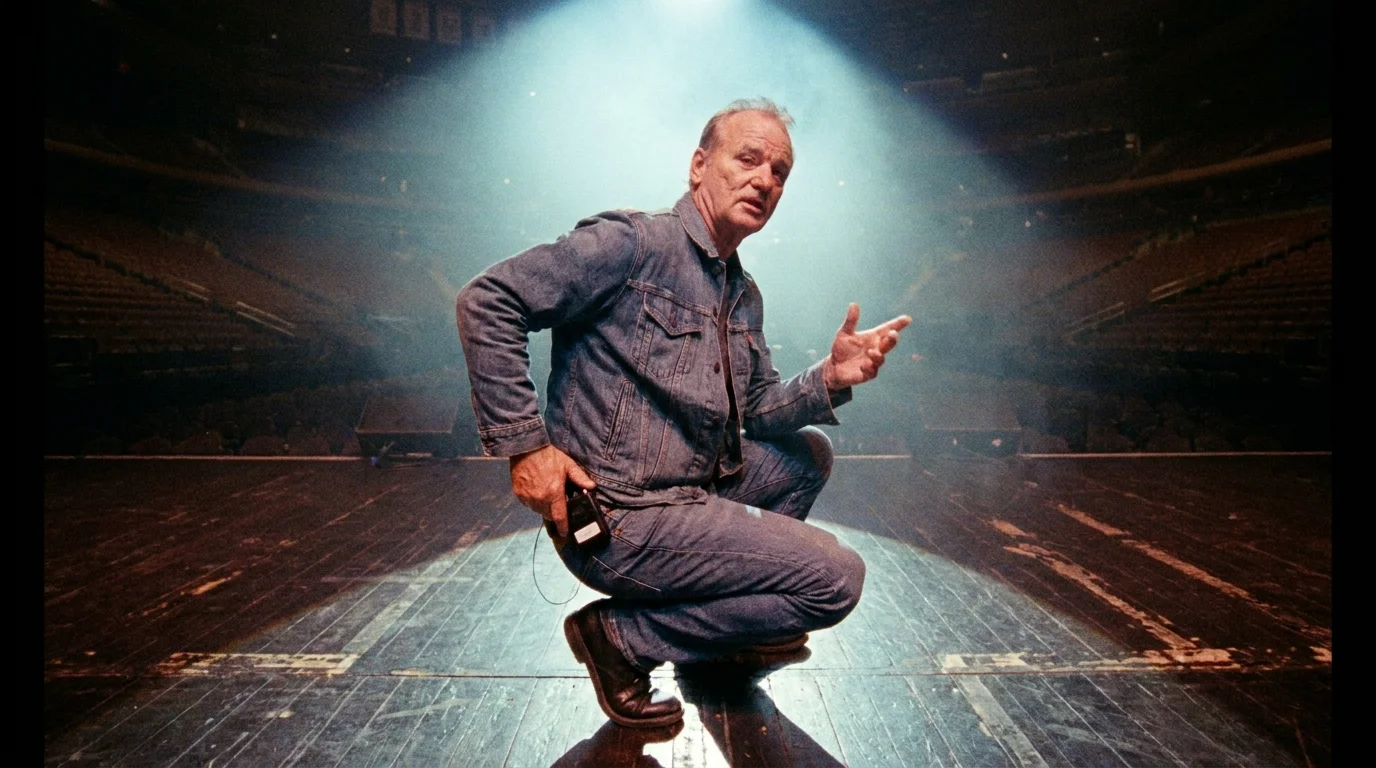
The midday sun over south Florida in late 1979 did not feel like cinematic history; it felt like wet wool pressed against sunburned skin. Across the patchy turf of Rolling Hills Golf Club, cicadas droned a persistent, vibrating hum that competed with the sputter of an idling lawnmower engine. On paper, the production was teetering on chaos, burdened by swollen budgets, weather delays, and a script that felt increasingly bloated with competing storylines.
You look at a movie set and imagine precision: marks taped to the floor, dialogue memorized down to the syllable, and directors executing a rigid blueprint. Yet on that humid afternoon, pure creative surrender took over the camera rig. The call sheet called for Carl Spackler, the unhinged greenskeeper, to simply practice his golf swing between routine landscaping chores. There were no jokes written on the legal pad. There was no pre-cleared monologue about Augusta National.
Instead, an actor stepped into the sweltering grass holding a rusty pitchfork and a bent iron, staring blankly past the lens into an imaginary gallery of thousands. What happened over the next two minutes transformed a messy sports comedy into an enduring touchstone of American cinematic improvisation.
The Architecture of the Controlled Collapse
Most creative work fails not because of poor ideas, but because the creator grips the steering wheel until their knuckles turn white. In film production, the script functions as an insurance policy, a safety harness meant to protect millions of dollars from human error. When you rely solely on the harness, you eliminate catastrophe, but you also extinguish surprise.
Murray understood that genuine comedy demands a quiet disregard for safety. Rather than reading the scene as an instructional recipe, he treated the landscape like a jazz musician treats an off-key piano. The physical environment—the wilted chrysanthemums, the wet earth, the distant tree line—became active scene partners rather than static dressing.
Consider how Harold Ramis, then a thirty-five-year-old first-time director navigating an unruly ensemble cast, handled the sudden deviation. Ramis did not halt production to protect the writer’s room; he quietly stepped back behind the sun-glared viewfinder, held his breath, and signaled the camera operator to keep rolling. He recognized instantly that Murray was operating inside an altered frequency where the scripted rhythm had to be discarded entirely to make room for lightning.
- Samuel L. Jackson protects forty-year marriage enforcing a strict annual separation pact
- Johnny Depp early press interviews exposed glaring behavioral warnings fans completely missed
- Jennifer Coolidge forgotten nineties audition footage resurfaces to shatter early career misconceptions
- Duncan Sheik tense red carpet posture sparks intense Broadway revival rift theories
- Don’t Worry Darling studio leaks sparked brutal reviews to fuel defensive ticket sales
Dissecting the Improvised Anatomy
Carl Spackler’s “Cinderella story” speech is often remembered as a lucky burst of manic energy, but its survival rests on three distinct structural instincts that any observant creator can study.
The Physical Anchor
Before uttering a single word about championship tournaments, Murray establishes an absurd physical labor. He does not posture; he decapitates innocent flower heads with a rhythmic, mechanical stroke. By wedding an extraordinary fantasy to an ordinary chore, the speech feels grounded in tangible dirt rather than abstract stand-up comedy.
The Shifting Vocal Cadence
Listen closely to the audio track and the murmur feels intimately conspiratorial, like a boy whispering to himself under a blanket fort. He adopts the hushed, breathless timbre of a CBS golf announcer whispering from behind a gallery rope at the Masters, contrasting solemn athletic reverence with outright dementia.
The Micro-Pauses
Amateur performers rush to fill dead air, fearing that silence invites interruption. Murray does the inverse: he allows the mower exhaust to hang in the humidity, pausing long enough for the viewer to wonder if the character has lost his train of thought completely before striking the decisive blow.
Applying the Unscripted Discipline
Translating this level of raw instinct into your own creative or communicative output requires stepping away from over-rehearsed cadences. You do not need a golf course to practice the discipline of letting the plan fracture.
Start by identifying where your current routine is choking out natural spontaneity. When you prepare for high-stakes presentations or written arguments, strip away the word-for-word scripts that induce panic the second a variable shifts.
- Ditch the script for touchstones: Memorize only your entry point and your exit line. Everything between should respond directly to the room’s temperature.
- Anchor your hands: If physical nervous energy threatens to derail your speech, ground yourself with a tactile object or steady posture. Physical calm breeds mental agility.
- Embrace the low-volume whisper: When everyone expects you to project authority by shouting, drop your volume. Lowering your vocal register forces your audience to lean in and listen closely.
- Treat mistakes as scenery: If an unscripted interruption occurs, integrate it immediately rather than fighting to ignore it.
The Tactical Toolkit
To build comfort with spontaneous execution, limit your preparation window to precisely four minutes before entering a high-pressure conversation. Practice speaking at half-tempo, ensuring that your breaths dictate your sentence breaks rather than your anxiety.
The Value of the Blank Frame
We live in a culture obsessed with post-production polish, algorithmic predictability, and automated templates designed to smooth away every human irregularity. We spend hours polishing outlines, curating public personas, and refining plans until the life has been completely pressed out of them.
Yet when you rewatch that solitary figure hacking away at Florida turf, the raw beauty lives entirely in the rough edges. The monologue endures because it reminds us that our most resonant moments are rarely the ones we carefully arranged on a clean spreadsheet. They are the unprompted sparks struck when we are brave enough to let the camera roll on an empty page.
“True spontaneity is not the absence of preparation; it is the absolute confidence to abandon your plans the instant reality presents a sharper truth.”
| Key Point | Detail | Added Value for the Reader |
|---|---|---|
| The Unwritten Origin | Zero dialogue existed on the shooting page; Murray improvised the entire scene in one take. | Demonstrates that high-impact work often emerges from trusting instinct over rigid protocols. |
| The Dual Reality | Spackler contrasts the quiet dignity of Augusta National with violent flower decapitation. | Teaches the narrative power of pairing high-status authority with low-status physical reality. |
| Directorial Restraint | Harold Ramis resisted calling ‘cut’ despite having no idea where the bit was heading. | Shows that effective leadership frequently means stepping out of the way of natural talent. |
Frequently Asked Questions
Did Bill Murray rehearse the Cinderella story monologue beforehand?
No. Director Harold Ramis gave Murray a loose prompt about practicing his swing, and Murray invented the character’s internal play-by-play commentary entirely on the spot.How many takes were required to film the iconic scene?
The entire sequence was completed in a single continuous take, with the camera operator following Murray’s unchoreographed movements across the grass.What kind of flowers was Murray actually hitting?
He was hacking off the heads of yellow chrysanthemums planted specifically along the edge of the golf club’s landscaping borders.Why did the scene almost get cut from the initial schedule?
The production was heavily behind schedule due to extreme Florida storms, making loose improvisational scenes prime targets for cancellation by studio executives.How can I use this technique in public speaking?
Stop memorizing entire speeches verbatim. Define your foundational objective, anchor yourself physically, and allow your delivery to adapt naturally to your environment.