The damp chill of an overcast Massachusetts morning hung outside the soundstage, but inside the cramped, wood-paneled replica of Sean Maguire’s office, the air was warm and stifling. You could hear the faint, low-frequency hum of heavy incandescent lamps heating up dust motes drifting across worn oriental rugs. The script called for a clinical moment of grief, an orderly transition where an older, wounded therapist holds emotional court against an arrogant math prodigy. Every line had been measured by young screenwriters who spent years polishing each word until the dialogue gleamed like freshly cut slate.
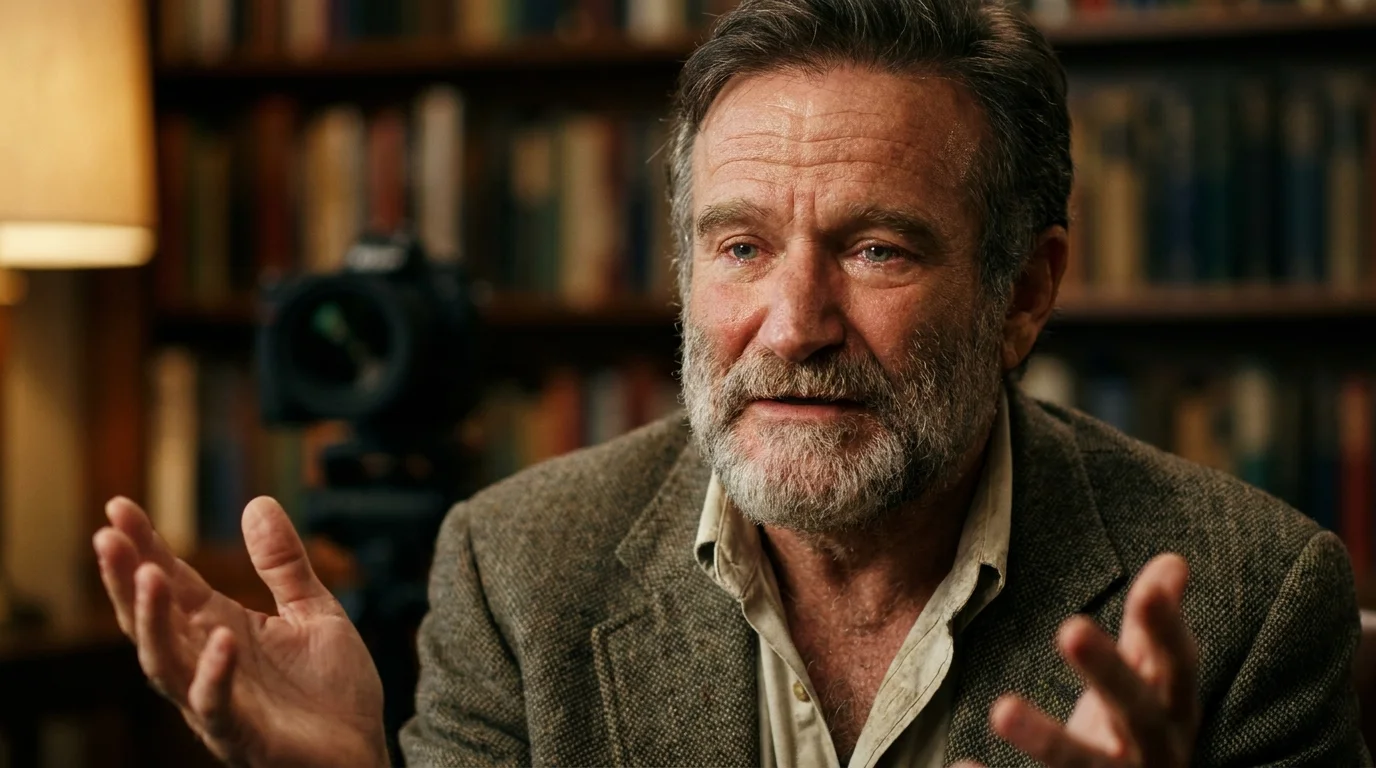
Then, Robin Williams leaned back into his armchair, crossed his legs, and simply drifted off the page. He abandoned the printed cadence entirely, lowering his voice to a soft, conversational rumble that felt less like an audition for an Academy Award and more like a late-night confession shared across a diner booth. When he began murmuring about his late wife waking herself up with her own flatulence, there was no alert, no preparatory cue, and no nod to the director.
If you look closely at the finished film during that exchange, the picture frame does not sit firmly on its hydraulic mount. It shivers. That faint vibration was not a stylistic choice or an editorial flourish; it was the physical consequence of a camera operator fighting for breath while trying to choke back an uncontrollable belly laugh. The technician was **shaking with genuine emotion**, locked between professional terror of ruining a multi-thousand-dollar roll of celluloid and the sublime reality of witnessing lightning strike unprompted.
The Anatomy of the Unscripted Pivot
Most creative systems teach you that control equals quality. You are conditioned to believe that if you outline every interaction, rehearse every response, and guard your perimeter against accidents, you will manufacture perfection. Yet true resonance functions less like architectural drafting and more like navigation in heavy fog: you must read the water directly under your keel rather than relying purely on an outdated chart.
When Williams went rogue in that small office, he did not destroy the scene; he unlocked its bloodstream. By throwing an unscripted, deeply human eccentricity into the center of the room, he forced his scene partner to stop reciting lines and start reacting as an actual human being. Matt Damon’s helpless laughter on screen was not an actor playing amusement; it was a startled kid watching a master pull reality out of thin air.
This shift from execution to discovery transforms any creative effort from a mechanical task into a living event. When you cling to a rigid blueprint, you exchange presence for safety. The moment you permit the unplanned flaw to breathe, you give everyone else in the room permission to drop their armor.
- Kevin Bacon protects his decades-long marriage enforcing an unbroken off-grid farmhouse rule
- Jason Sudeikis early red carpet interviews displayed glaring relationship warning signs fans missed
- Christian Bale resurfaced indie audition tape shatters long-standing method acting rumors
- Judge Judy tense red carpet posture sparks fierce theories over network dispute
- Woody Harrelson monitor blackout exposed synthetic confidence during live hosting gig
The View from the Viewfinder: An Observer’s Account
Consider the quiet perspective of veteran camera operator Arthur Collins, who spent thirty-four years balancing seventy-pound film rigs on his shoulder across soundstages in Boston and New York. On that particular afternoon, his eye was pressed hard against the rubber eyepiece, his thumb resting gently on the follow-focus ring. Collins later recounted that when Williams initiated the improvised story, the room’s atmospheric pressure seemed to drop five millibars in an instant.
“You spend decades training yourself to be a stone statue,” Collins remembered during a private retrospective lecture. “You don’t breathe during takes. You lock your hips, you brace your knees, and you become a metal tripod. But when Robin hit that third unscripted line about the dog, my diaphragm gave out. I wasn’t just watching a performance; I felt like I was trespassing on someone’s real, aching memory. The entire rig wobbled, and I thought Gus would call cut and scream at me. Instead, nobody said a word. The silence after the laughter died down was so thick you could slice it with a putty knife.”
Three Layers of Instinctive Presence
To understand why this moment reverberates decades later, you have to dissect how spontaneous truth dismantles scripted armor across different psychological settings.
- The Grounded Confession: Stripping away intellectual jargon to name a mundane, embarrassing detail. You anchor high-stakes conversations by referencing raw domestic truth, shifting the dynamic from ideological debate to shared vulnerability.
- The Rhythmic Rupture: Intentionally interrupting a rehearsed tempo. By pausing where no pause was written, or laughing when solemnity was expected, you short-circuit rehearsed defensiveness in the people facing you.
- The Protective Instinct: Diverting a volatile confrontation with self-effacing warmth. Rather than matching hostility with cold authority, you disarm resistance by revealing your own imperfections first.
Each of these variations requires you to abandon your inner monitor. You cannot calculate spontaneity; you can only create the internal stillness necessary to catch it when it floats past your shoulder.
Practicing the Art of the Measured Detour
You do not need an Oscar-winning screenplay or a movie set to apply this brand of intuitive presence. Whether you are leading a volatile boardroom meeting, navigating an estranged friendship, or writing an essay, rigid adherence to your prepared script often builds a wall between you and the outcome you actually desire.
Begin by observing your physical reaction to conversational deviation. Notice how your body tightens when an interaction drifts away from your anticipated agenda. **Soften your physical posture** instead of scrambling to drag the exchange back to your talking points.
- Hold your response for three full heartbeats after the other person finishes speaking, letting the silence clear the room.
- Acknowledge the weird, specific detail in the room rather than relying on abstract, sanitized concepts.
- Allow your conversational tone to drop an octave when tension climbs, mirroring quiet intimacy instead of loud panic.
- Watch your listener’s eyes: when their focus softens from guarded scrutiny to genuine curiosity, hold that tempo without rushing.
Think of this as your practical toolkit for human calibration: a baseline vocal volume that never strains, a willingness to sacrifice your smartest pre-planned sentence for an honest observation, and the patience to let someone laugh until their ribs ache before steering back to business.
The Enduring Space Between the Lines
We rewatch unscripted masterclasses not because we admire technical perfection, but because we are starved for proof that uncalculated honesty still works. In an era dominated by hyper-curated self-presentation, algorithmic cadences, and focus-grouped public lives, an unscripted slip that rocks the camera tripod is a relief.
When you allow yourself to drift off-book, you stop performing your life and start occupying it. The beauty of Williams’s gift was never his speed; it was his courageous willingness to leave his seat, wander into the uncharted grass, and trust that his humanity would hold the frame steady even when the camera shook.
“Real connection never happens inside the lines you spent all night practicing; it catches fire the second you dare to describe the mess.”
| Key Point | Detail | Added Value for the Reader |
|---|---|---|
| Rigid Adherence | Following predetermined scripts without adapting to environmental shifts. | Recognize when your need for total control is strangling authentic collaboration. |
| The Spontaneous Anchor | Introducing specific, imperfect domestic realities into serious moments. | Disarms high-friction confrontations by re-establishing common human ground. |
| The Vibrational Cue | Physical proof of real engagement, like a laughing or tearful crew member. | Teaches you to measure success by genuine emotional resonance rather than compliance. |
Frequently Asked Questions
Did the director know Robin Williams was going to improvise that speech?
No. Gus Van Sant gave Williams wide latitude across multiple takes, but the specific monologue about his wife’s personal habits was completely unprompted and invented on the spot.Why didn’t they reshoot the scene to fix the shaking camera?
Van Sant and editor Pietro Scalia realized that the physical tremor from the laughing camera operator added an irreplaceable layer of documentary authenticity that could never be recreated.How can I use this approach in professional negotiations?
Drop your rehearsed corporate jargon the moment tension spikes. Reference a grounded, tangible reality about the project to cut through administrative performance and reset trust.Is spontaneity always better than preparation?
Preparation provides the safety net that makes spontaneity possible. Williams knew his character’s pain intimately, which is what allowed his unwritten lines to land with such precise emotional truth.What is the best way to handle an unexpected pause or silence?
Resist the urge to fill the vacuum immediately with nervous words. Let the silence breathe for two or three seconds to allow genuine feeling to surface naturally.