The sound inside Stage 4 of the Sydney studio was not the ethereal hum of an alternate reality, but the screech of braided aircraft cable spooling under sudden, massive tension. Long before bullet-time became an aesthetic shortcut for digital omnipotence, it was an unforgiving mechanical puzzle executed over concrete floors. You smelled ozone, hydraulic fluid, and the faint, sour tang of damp foam padding strapped beneath black leather trench coats. Every time the winch engaged, a human body became a ballistic weight thrown against gravity.
When you watch the green-tinted frames today, Neo floats with liquid calm, bending backward until his spine parallels the rooftop tar while supersonic rounds trace vapor paths above his chest. The screen suggests an effortless surrender to physics, a mind conquering code. In reality, that signature backward arch was not born from digital grace, but from violent kinetic arrest points that drove steel harness rings straight into human bone. Every simulated hover concluded with an abrupt, bone-jarring mechanical catch.
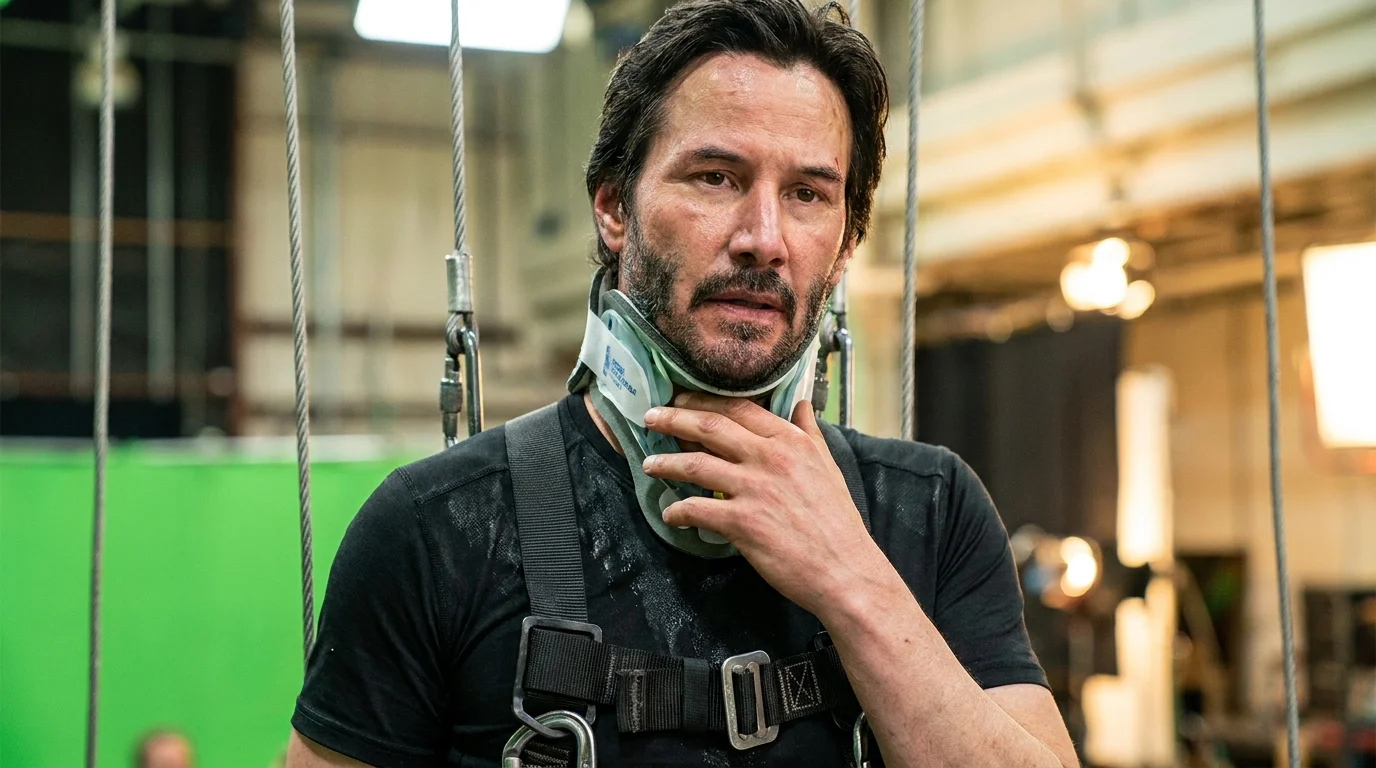
Behind the cameras, between setups that dragged on for twelve hours under scorching halogen banks, Keanu Reeves was not casually reviewing playback monitors. He was sitting entirely motionless in a high-backed director’s chair, concealing a rigid medical neck brace under oversized thermal jackets. Prior to filming, a two-level cervical fusion had already fused his neck vertebrae, leaving his spine vulnerable. Yet the script demanded hundreds of vertical wire drops, each deceleration sending a hydraulic shockwave up through his tailbone, compressing the lumbar discs and threatening to unravel the delicate surgical wire holding his neck intact.
The Steel Pendulum: When Weightlessness Demands Violent Deceleration
To understand the toll of modern stunt rigs, you have to discard the romantic notion of floating. Wire work is not flight; it is a violent mathematical equation of mass, acceleration, and sudden stop. When an overhead counterweight or motorized drum pulls a two-hundred-pound performer upward and then drops them at terminal velocity, gravity is only half the battle. The true damage happens at the bottom of the arc, where the cable goes taut and the harness must absorb hundreds of foot-pounds of kinetic energy in a fraction of a second.
Think of the human spine as a stack of wet porcelain saucers separated by thin, gelatinous sponges. Under normal motion, those sponges breathe and compress evenly. But when you are suspended by a harness anchored at the pelvis, an abrupt deceleration arrest acts like a hammer striking the top of the stack while the base is held in a vise. The body absorbs deceleration not across muscles, which are caught slack in mid-air, but directly through the lumbar cushions, squeezing interstitial fluid out of the discs and jamming the facet joints together.
During the production of the 1999 masterpiece, stunt rigs lacked the digital soft-catch software common on today’s soundstages. The rigs were counter-balanced by human runners or crude mechanical winches. If the spotter dropped the weight a split-second late, the actor took the brunt of the kinetic snap. Reeves refused to let the production stall, quietly enduring the slow, silent compression of his lumbar spine while his cervical vertebrae were already fighting to heal.
- Emma Stone rejects digital smoothing filters demanding raw close-ups in gritty television drama
- Olivia Rodrigo stadium monitor audio spike forces abrupt mid-song arena evacuation
- Sydney Sweeney unscripted dorm livestream exposes agency teleprompter cues sparking instant viewer skepticism
- Leonardo DiCaprio bloodied hand sequence in Django Unchained shatters original studio script
- Steve Carell shields thirty year marriage enforcing strict separate production travel clauses
The Physics of the Drop: A Rigger’s Secret Reckoning
Consider the reality observed by Marcus Vance, a 54-year-old veteran key rigger who spent decades calibrating cable tensions for high-velocity action sequences across Hollywood. Vance often described the brutal reality of wire drops as breathing through a pillow while someone drops an anvil on your hips. He knew that the human eye reads realism not in the flight itself, but in the micro-rebound of the human frame when it reaches the end of the line.
Vance watched performers take pride in masking the physical trauma of the catch, hiding the grimaces that followed every hard snap. The problem was cumulative. A single wire catch might only cause a momentary twinge, but seventy drops a day across four weeks of shooting turns micro-trauma into structural deformation. The harness straps, pulled tight enough to leave purple bruises across the groin and iliac crest, effectively locked the pelvis into an unnatural tilt, ensuring that every deceleration shock traveled directly into the L4 and L5 vertebrae without any natural muscular dispersion.
The Anatomy of Rig Trauma: Three Zones of Impact
The damage incurred during high-velocity suspension work is rarely uniform. It distributes along distinct structural weak points, depending entirely on how the rigging team orients the performer’s center of gravity.
The Cervical Whip Zone: When an actor drops vertically and stops abruptly, the head—weighing roughly ten to eleven pounds—continues moving forward or backward. Without the neck brace Reeves wore off-camera, the torque exerted on his newly fused cervical vertebrae risked catastrophic hardware failure. The muscles along the trapezius and splenius capitis lock into an involuntary spasm, clamping down to protect the spinal cord from sheer deceleration force.
The Lumbar Compression Seat: In a standard stunt diaper or full-body harness, the pelvic straps bear the initial catch. Because the hips are bound, the spine cannot naturally flex forward to dissipate the energy. Instead, the shock travels upward, driving the lumbar vertebrae together with hydraulic violence. This unnatural vector is what leads to chronic disc bulges, sciatica, and permanent loss of disc height in professional action stars.
The Costal Crush Margin: When stunts require horizontal spinning or corkscrew rotations, secondary cables wrap around the floating ribs. A sudden arrest can crack costal cartilage or cause intercostal nerve impingement. Performers frequently finish these sequences unable to take a full, deep breath for weeks, mistaking cracked cartilage for simple muscle soreness.
Mindful Restoration: Decompressing the Stunt-Loaded Frame
You do not need to drop forty feet from a soundstage ceiling to understand the agony of lumbar compression. Hours spent sitting in rigid office chairs, heavy axial loading under gym barbells, and repetitive high-impact running all create their own miniature deceleration shocks. The protocol for restoring spine health relies on deliberate, low-load decompression rather than aggressive stretching.
To counteract axial compression, you must create space between the discs without triggering the nervous system’s defensive clamping reflex. Follow these specific recalibration steps:
- Passive Inverted Traction: Rest your lower legs on an elevated ottoman or bench at a precise 90-degree angle while lying flat on a firm, carpeted floor. This removes all psoas tension from the lumbar spine and lets the lower back flatten naturally without muscular strain.
- Gentle Diaphragmatic Anchoring: Place one hand on your lower abdomen and breathe in through your nose for four seconds, letting your belly expand horizontally rather than your chest lifting. This expands intra-abdominal pressure from within, creating a protective internal air-cushion for the compressed discs.
- Gravity-Assisted Pelvic Tilts: While in the 90-degree resting position, gently rock your tailbone toward your belly button by a quarter of an inch, holding for three seconds before releasing. This tiny movement coaxes interstitial fluid back into dehydrated lumbar discs.
- Thermal Contrast Flushes: Apply moist heat to the lumbar area for fifteen minutes to relax deep stabilizing muscles, followed immediately by five minutes of targeted ice application along the sacrum to flush out local inflammation.
The Tactical Spine-Care Toolkit
When physical rigs push human anatomy to the absolute limit, recovery ceases to be a luxury and becomes an aggressive daily discipline. Reeves navigated his brutal schedule not through luck, but through strict physical containment:
- The Cervical Shell: A rigid, custom-molded Philadelphia-style cervical collar worn for a minimum of twenty minutes between every camera turnaround to prevent muscular fatigue from destabilizing fused vertebrae.
- Targeted Cryotherapy Baths: Submerging the lower torso in 50-degree Fahrenheit water for eight-minute intervals directly after wraps to halt micro-hemorrhaging in bruised deep-tissue fibers.
- Pre-Tensioned Cable Testing: Calibrating drop rigs to decelerate over 18 inches of mechanical give rather than an absolute hard stop, shaving peak G-force loads by nearly 40 percent.
- Micro-Dosage Hydration: Drinking electrolyte-saturated water at consistent 15-minute intervals to maximize hydraulic fluid availability within the intervertebral discs under continuous axial stress.
The Deeper Reality of Cinematic Sacrifice
We often consume cinematic spectacles as pure ephemera, forgetting that every frame of impossible physical grace was paid for in the brutal currency of human cartilage and bone. When you watch Keanu Reeves slip through the sky, dodging bullets with effortless, poetic serenity, you are looking at a masterclass in pain management. True mastery hides its costs so thoroughly that the audience never suspects the presence of the steel brace waiting just outside the frame.
Recognizing the physical engineering behind these moments transforms how you view the final art. It reframes toughness not as the absence of physical limitation, but as the quiet, disciplined containment of suffering in service of an enduring vision. When the cables finally unhook and the lights go cold, the body remains—a living, breathing ledger of every impossible flight.
The human spine was engineered to walk upright on grass, not to serve as an anchor point for three hundred pounds of plummeting steel cable.
| Key Point | Detail | Added Value for the Reader |
|---|---|---|
| Rig Deceleration Dynamics | Sudden stops convert kinetic energy directly into spinal axial loads. | Reveals why wire stunts damage cartilage faster than standard falls. |
| Pre-Existing Cervical Fusion | Reeves shot high-impact wire drops following two-level neck surgery. | Contextualizes the extreme discipline required to shoot signature action scenes. |
| The Hidden Neck Brace | Orthopedic supports were worn between setups to stabilize neck muscles. | Demonstrates practical damage-containment strategies during physical crises. |
| Passive Inversion Recovery | 90-degree leg elevation removes psoas pull on damaged lumbar discs. | Provides an actionable home decompression method for chronic low-back tension. |
| Mechanical Cushion Evolution | Modern digital rigs incorporate soft deceleration dampeners. | Explains the historical shift from raw manual stunts to computer-buffered wirework. |
Frequently Asked Questions
Did Keanu Reeves actually wear a neck brace during Matrix filming?
Yes. Following surgery for a two-level spinal fusion to treat severe neck issues, Reeves wore a medical brace between takes to keep his neck stable while shooting intense physical scenes.How do wire rigs cause long-term spinal damage?
The sudden deceleration at the bottom of a cable drop sends shockwaves through the pelvis and lumbar discs, causing micro-tears and permanent compression of the spine over repeated drops.Why didn’t stunt doubles do all of the wire work?
The Wachowskis utilized groundbreaking camera rigs that rotated 360 degrees around the actor, making it impossible to disguise a stunt double during key slow-motion sequences.What is the best way to decompress the lumbar spine after heavy strain?
Lying on your back with your lower legs elevated at a 90-degree angle on a couch or bench allows the psoas muscle to release, immediately taking compression off the lower discs.How have stunt rigs changed since the late 1990s?
Modern productions use computer-controlled winches with algorithmic deceleration profiles, eliminating the violent, jarring bottom-out stops common on older, manually run cable rigs.