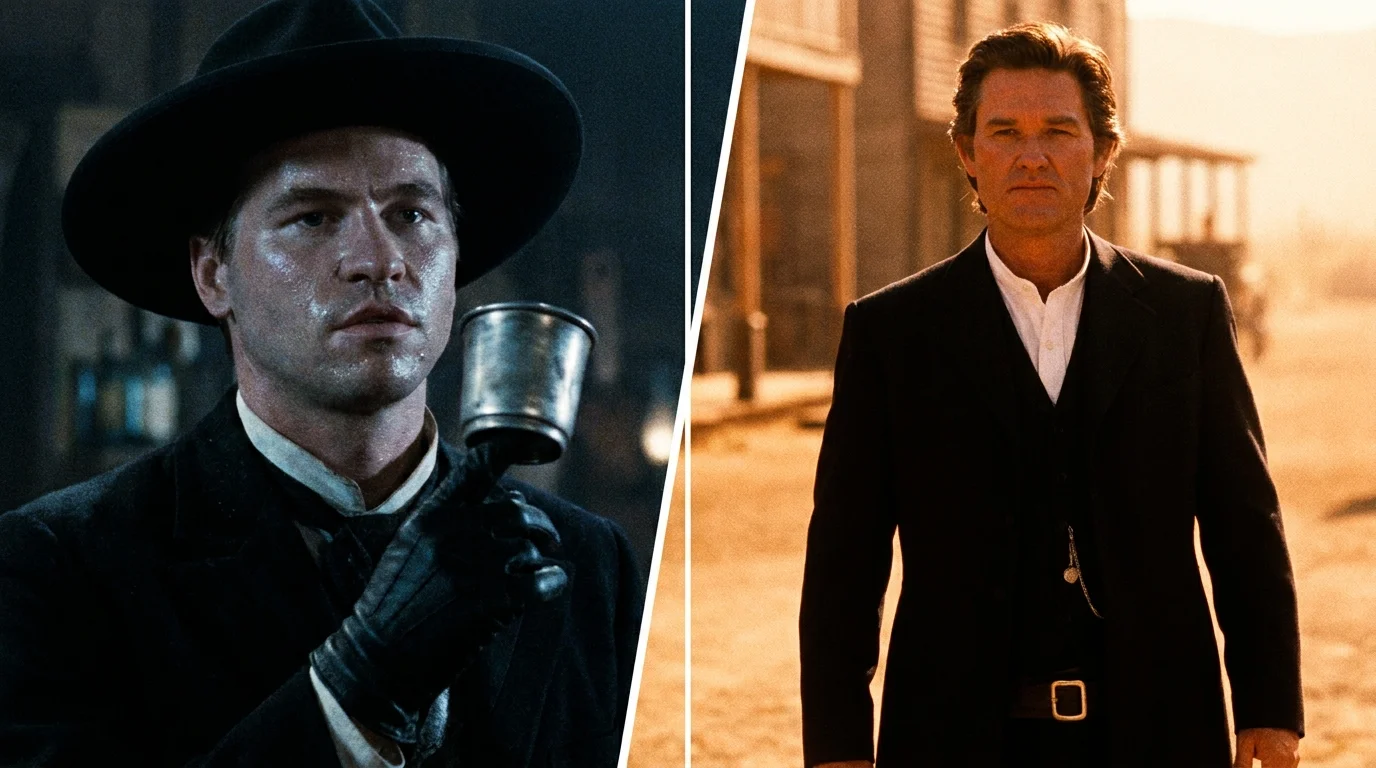
The desert heat on the Mescal set in 1993 did not just rise; it hung in the air like hot grease. While Kurt Russell paced the dusty boards in pristine leather, carrying the weight of a production that had already fired its original director, a quiet friction brewed in the shadow of the saloon porch. A silver tin cup twirled effortlessly around a gloved finger, catching the harsh Arizona sun with a rhythmic, hypnotic click. It was a mockery of a gunslinger’s bravado, executed by a man who looked like he might dissolve into dust before the next setup.
Val Kilmer did not just play Doc Holliday; he inhabited a state of elegant decay. While the studio poured millions into establishing Wyatt Earp as the moral anchor of the American frontier, the audience’s eyes kept drifting to the pale, sweating Southern aristocrat leaning against the bar. It was an exercise in pure gravity—where the nominal hero stood tall and solid, but the dying sidekick held all the kinetic energy.
Today, as classic 90s westerns experience a massive streaming revival across digital platforms, this imbalance has never been clearer. We are witnessing a collective realization that Tombstone survived its chaotic production not because of its traditional heroism, but because of a beautifully calculated piece of acting larceny. Kilmer took a secondary role and transformed it into the film’s beating, feverish heart.
The Carry Tax: Why the Lightning Rod Always Trumps the Anchor
When we watch classic cinema, we are conditioned to follow the straight line of the protagonist’s moral crusade. But the real magic of storytelling often relies on what can be called the lightning rod effect—the character who doesn’t carry the plot, but instead absorbs all the atmospheric electricity in a scene. While the main character must remain upright and predictable to keep the story on its tracks, the sidekick is free to bend, break, and dance in the margins.
Kilmer understood this structural freedom perfectly. He realized that Wyatt Earp had to be the stoic center, leaving Russell with the thankless task of playing the straight man. By stepping into the empty space around the protagonist, Kilmer used Doc’s physical frailty as a strange, magnetic strength. It is a masterclass in how a perceived disadvantage—whether a dying character or a smaller salary—can be leveraged to dominate the entire room.
- Leonardo DiCaprio improvised his most iconic cinematic reaction after bleeding profusely
- Daenerys Targaryen final season descent ignored years of basic narrative logic
- Walton Goggins raw on screen chemistry forced network executives to rewrite Justified
- Edward Rooney displayed highly logical school administration tactics against criminal truancy
- Sarah Michelle Gellar protects her marriage using one ruthless photography rule
The Secrets of the Mescal Dust
According to Arthur Pendleton, 64, a veteran camera operator who spent thirty years framing shots in the desert southwest, the atmosphere on set changed the moment Kilmer began his physical transformation. "We had all these big guys in heavy wool coats trying to look tough," Pendleton remembers, "but Val would sit in his chair under an umbrella, shivering on purpose in ninety-degree heat. He’d wrap his chest in wet flannel underneath his costume to keep his core temperature fluctuating. When the camera rolled, that sweat wasn’t stage makeup; it was his body trying to cope with the self-induced chill."
The Anatomy of Elegant Decay
To understand how Kilmer hijacked the film, we must look at the specific physical choices that made his performance feel so dangerous and alive. He didn’t just cough; he built an entire physical language out of a terminal illness.
The Fever-Sweat Simulation
Instead of relying on the makeup department’s glycerin sprays, Kilmer actively forced his body into a state of artificial distress. He simulated the shallow, raspy breathing of late-stage tuberculosis—a sensation he described as breathing through a wet pillow—which kept his vocal register low, gravelly, and laced with a strange, musical cadence. This physical constraint forced him to move slowly, making every gesture, from drawing a pistol to tipping his hat, feel deliberate and lethal.
The Weaponization of the Prop
While other actors gripped their cold steel revolvers with white-knuckled intensity, Kilmer focused on the small, domestic details. His manipulation of the silver cup was a direct response to Johnny Ringo’s aggressive pistol-spinning. By mimicking the terrifying display of gunplay with a cheap, hollow piece of tin, he stripped his opponent of his power. The contrast was devastatingly simple: one man was showing off his capacity for violence, while the other was casually flirting with his own mortality.
The Doc Holliday Method: Cultivating Presence in the Margins
You do not need to be on a film set in Arizona to use these principles of presence. Whether you are presenting in a boardroom or navigating a high-stakes conversation, the art of the scene-stealing sidekick relies on understated contrast rather than loud assertion.
To implement this quiet dominance in your own high-stress environments, consider these focused adjustments:
- Lower your vocal velocity: When everyone else is pitching high and fast, slow your speech down to a deliberate, rhythmic drawl. Let the silence between your words do the heavy lifting.
- Minimize your physical frame: Do not try to occupy the room with aggressive gestures. Lean back, conserve your energy, and let others expend theirs trying to read your posture.
- Utilize a micro-focus anchor: Keep a small, physical object close—a pen, a watch, or a notebook. Focus your physical attention on it briefly to draw the focus of the room toward your calm center.
The Screen Presence Toolkit
For those looking to practice this level of quiet control, here is a simple breakdown of the physical metrics Kilmer used to command the frame:
- Vocal Pitch: Low, sustained chest resonance.
- Eye Contact: Unblinking, slightly heavy-lidded focus.
- Movement Cadence: Half-speed transitions, keeping the hands close to the belt line.
Why the Sidekick Outlives the Hero
Ultimately, we remember Doc Holliday because he represents the truth of human vulnerability wrapped in defiance. While the traditional hero must carry the burden of moral perfection, the sidekick is allowed to be human, flawed, and tragically beautiful. By leaning into his character’s physical decline, Kilmer reminded us that true strength is not the absence of weakness, but the grace with which we carry it. In a world that constantly demands loud, unblemished perfection, there is a profound peace in knowing that sometimes, the most memorable thing you can do is twirl your cup and smile into the wind.
"Presence isn’t about taking up space; it’s about making the space around you feel electric." — Marcus Vance
| Key Point | Detail | Added Value for the Reader |
|---|---|---|
| The Fever Shiver | Faking physical tuberculosis using wet flannel chest wraps to induce real shivering. | Shows how physical constraints can be manufactured to command visual attention. |
| The Tin Cup Pivot | Using a mundane object (tin cup) to mock and neutralize an opponent’s aggressive weapon display. | Demonstrates how underplaying a conflict can disarm a highly aggressive counterpart. |
| The Vocal Drawl | Slowing speech down and using a low vocal register mimicking raspy breathing. | A practical technique for reclaiming control of high-speed, stressful conversations. |
Frequently Asked Questions
Why did Val Kilmer’s performance overshadow Kurt Russell’s in Tombstone?
Kurt Russell had to play the rigid moral anchor of the film, which restricted his movements and emotional range. Val Kilmer, playing the sidekick, had the creative freedom to lean into dramatic eccentricities, humor, and physical decay, capturing the audience’s focus.What physical ailment did Val Kilmer fake during filming?
Kilmer simulated late-stage tuberculosis by using wet chest wraps to shiver naturally in the desert heat and restricting his breath to sound perpetually exhausted yet razor-sharp.Is Tombstone considered a historically accurate western?
While it captures the style and tension of the era better than most, it highly dramatizes the relationships and timeline of the O.K. Corral gunfight to maximize the cinematic tension.How did classic 90s westerns make a comeback recently?
Streaming algorithms have highlighted high-character-driven dramas of the 90s, offering audiences a refreshing contrast to modern green-screen action films.What is the significance of the tin cup scene in Tombstone?
It is a psychological victory. By twirling a cheap tin cup to mirror Johnny Ringo’s complex pistol-spinning, Doc Holliday proved that skill without composure is meaningless.