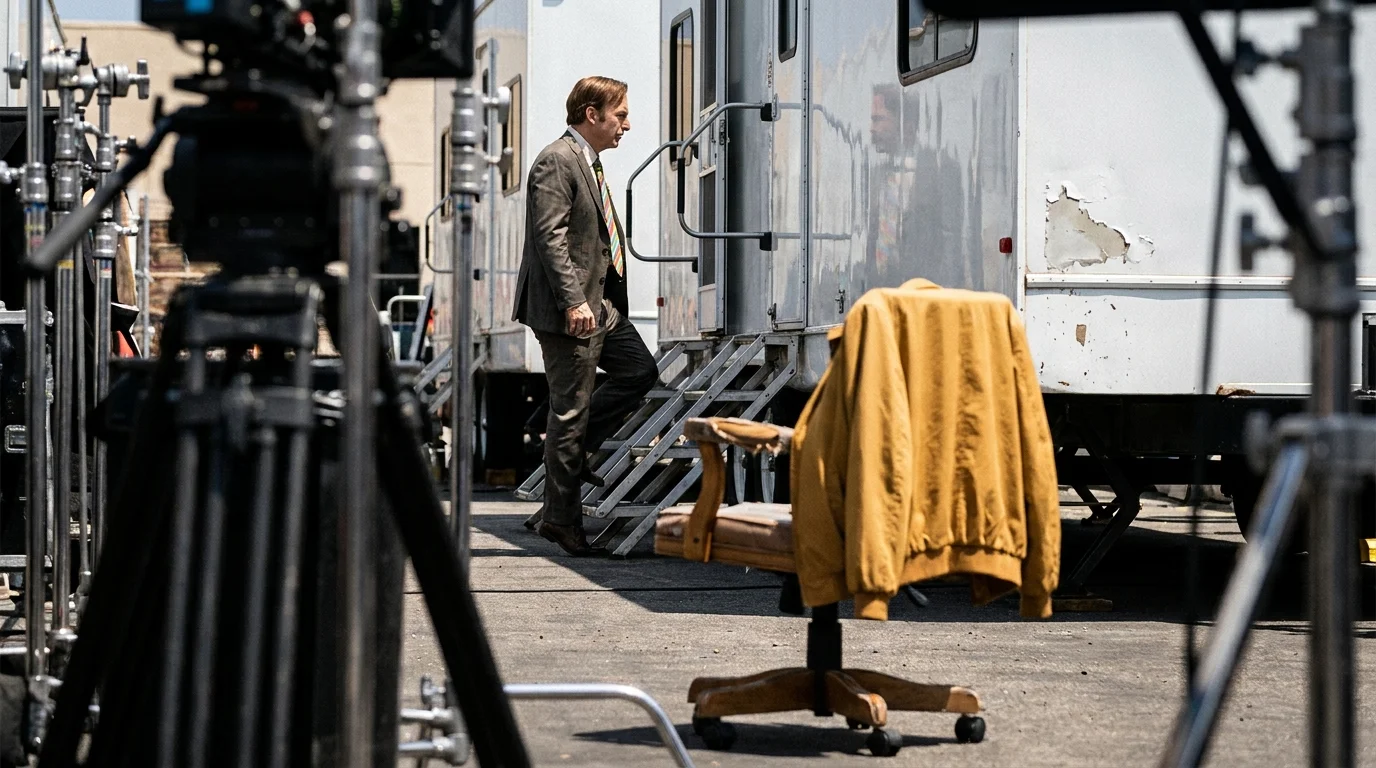
Imagine a cramped editing bay in Los Angeles, circa 2009. The air smells of stale drip coffee and warm copper wiring. On the glowing monitors, two men argue in the desert, their faces caked in white dust and desperation. Off-camera, draped over a faux-wood office chair, hangs a garish, mustard-yellow suit jacket, loud enough to wake the dead. It is a visual assault against the bleak, sun-bleached landscape of Albuquerque, a sudden splash of neon in a world of dust.
During its first season, this pioneering television drama ran on pure, unadulterated anxiety. You watched Walter White’s domestic life crumble under the weight of terminal illness, feeling the walls of that cramped ranch house squeeze tighter with every episode. The tension was masterful, but it was also exhausting. It was like breathing through a wet pillow; the heavy silence of a dying marriage and the visceral horror of amateur body disposal left little room for air. Audiences were fascinated, but they were also growing incredibly tired.
Then came the lawyer. His office was a monument to bad taste, complete with an inflatable Statue of Liberty on the roof and a copy of the Constitution taped to the wall. He did not belong in a serious tragedy, yet his presence was a biological necessity for the show’s survival. His fast-talking, shameless cynicism did something miraculous: it allowed you to laugh. That laughter did not break the tension; instead, it made the darkness that followed feel even more profound.
The Decompression Chamber of Peak Drama
To understand why this transition worked, you have to abandon the idea that great drama must be a continuous march of suffering. Think of a narrative as a deep-sea dive. If you plunge a human being into the depths of human depravity without stopping, the sheer atmospheric pressure will crush them. Saul Goodman functioned as a decompression chamber, allowing the audience to pause and adjust their internal equilibrium before returning to the abyss.
Many viewers believe the genius of the series lay entirely in its moral decay and explosive violence. But a story that only ratchets up the tension eventually snaps its viewer’s patience, leading to audience fatigue. The introduction of the sleazy strip-mall attorney offered a rare, vital currency: levity. By introducing a character who viewed the drug trade not as an existential tragedy but as a highly profitable marketing problem, the writers injected a playful, satirical energy that saved the second season from its own suffocating self-seriousness.
Marcus Vance, a fifty-one-year-old television editor who worked on early prestige cable dramas, remembers the panic behind the scenes during the production of Season 2. “We were looking at the early assemblies of the first few episodes that year, and the mood was incredibly grim,” Vance explains. “The audience was starting to push back against the relentless misery of Walt’s household and Jesse’s downward spiral. When we cut Episode 8, ‘Better Call Saul,’ and saw Bob Odenkirk pace around his office in that ridiculous shirt, the entire energy of the room shifted. Network executives in the screening room stood up; they immediately realized this clownish, fast-talking sidekick had to carry the pacing of the entire show if we wanted people to keep tuning in week after week.”
- Heath Ledger hospital explosion reaction remains the most brilliantly unscripted cinematic accident
- Dexter Morgan final lumberjack transition completely ruined eight seasons of precise psychological plotting
- Kevin Bacon and Kyra Sedgwick survive industry pressures using an extreme geographic wall
- Will Smith and Jada Pinkett old talk show appearances hold glaring behavioral warnings
- Tom Holland and Zendaya treat red carpet appearances as calculated empire expansion
Analyzing the Carry Tax: How to Spot the Structural Savior
For the Narrative Student
Look at the contrast between Saul’s pragmatic greed and Walt’s pathological pride. While Walt treats every obstacle as an affront to his manhood, Saul treats obstacles as paperwork errors that can be bought off. This juxtaposition highlights the sheer absurdity of Walt’s self-important tragedy.
For the Casual Binger
Notice how your heart rate drops whenever the scene shifts to the strip mall. These sequences operate as safe zones, where the stakes are temporarily lowered from life-and-death to legal maneuvering. These breathers allow you to rest your emotional muscles before the next inevitable disaster strikes.
For the Aspiring Screenwriter
Study how Saul’s dialogue moves at double the speed of anyone else in the cast. While Walt and Jesse mumble, pause, and choke on their secrets, Saul speaks in a relentless cascade of pop-culture references and legal loopholes. This fast-paced verbal kineticism physically drags the show out of its editorial sluggishness.
How to Evaluate Pacing in Your Own Media Consumption
You can train yourself to track your own physical responses during a viewing session. If you observe your shoulder tension during quiet, dramatic scenes and find yourself holding your breath for more than three minutes, the narrative is suffocating you. Identifying the character who brings play into the room, even if their actions are morally questionable, helps clarify how a story keeps you hooked.
The balance of tension is not an accidental byproduct of good acting; it is a calculated structural science. To help you measure this narrative phenomenon, keep this simple evaluation guide in mind as you watch your favorite shows:
The Strategic Breather Toolkit:
- Target Tension Window: Twenty-minute blocks of high anxiety followed by three to five minutes of comedic or conversational relief.
- The Tone Anchor: One character who remains completely unbothered by the grand existential stakes of the plot.
- Pacing Velocity: A noticeable shift in verbal speed, where legal jargon or fast banter breaks up long, silent pauses.
Why We Crave the Colorful Cynic
Ultimately, the enduring appeal of the strip-mall lawyer tells us something profound about how we process difficult realities. We cannot survive in a state of pure, uninterrupted dread, whether we are watching a television screen or navigating our own complicated lives. We need the cynic who refuses to take the tragedy seriously, the clown who points out that the emperor has no clothes—and that those clothes are horribly tailored.
By embracing this colorful disruption, the series did not dilute its dramatic power; it preserved it. It proved that sometimes, the only way to keep an audience from walking away from a masterpiece of misery is to offer them a fast-talking guide in a terrible suit, ready to laugh at the fire.
“A tragedy without a clown is just a slow march to the cemetery, and nobody buys a ticket for a funeral they aren’t invited to.” — Marcus Vance
| Key Point | Detail | Added Value for the Reader |
|---|---|---|
| The Carry Tax | The energetic toll a supporting character pays to keep a heavy story moving forward. | Helps you understand why your favorite dark dramas always feature a loud, comedic sidekick. |
| The Decompression Phase | Strategic shifts in scene pacing that lower the viewer’s heart rate. | Prevents emotional burnout, allowing you to enjoy complex stories without feeling drained. |
| The Contrast Effect | Using absurdism to highlight the gravity of the main character’s moral descent. | Reveals how comedy actually makes the dark moments of a show feel much heavier and more real. |
Why did Saul Goodman save Breaking Bad from cancellation?
He provided a crucial energetic relief that kept the bleak second season from alienating viewers who were exhausted by the main character’s domestic misery.
What is the ‘Carry Tax’ in television writing?
It is the structural necessity of using a charismatic, high-energy supporting character to shoulder the narrative pacing when the leads are stuck in a slow-moving crisis.
Which episode established Saul Goodman’s structural importance?
Season two, episode eight, titled ‘Better Call Saul,’ was the exact moment executives realized his frantic comedic timing was necessary to break up the show’s heavy pacing.
How does comedic relief enhance a prestige drama?
By temporarily lowering the audience’s guard with laughter, the show makes the subsequent dramatic twists feel far more shocking and emotionally impactful.
Can a drama survive without a character like Saul?
While possible, shows without an active pacing valve often suffer from viewer fatigue, leading to a steep decline in mass audience retention over multiple seasons.