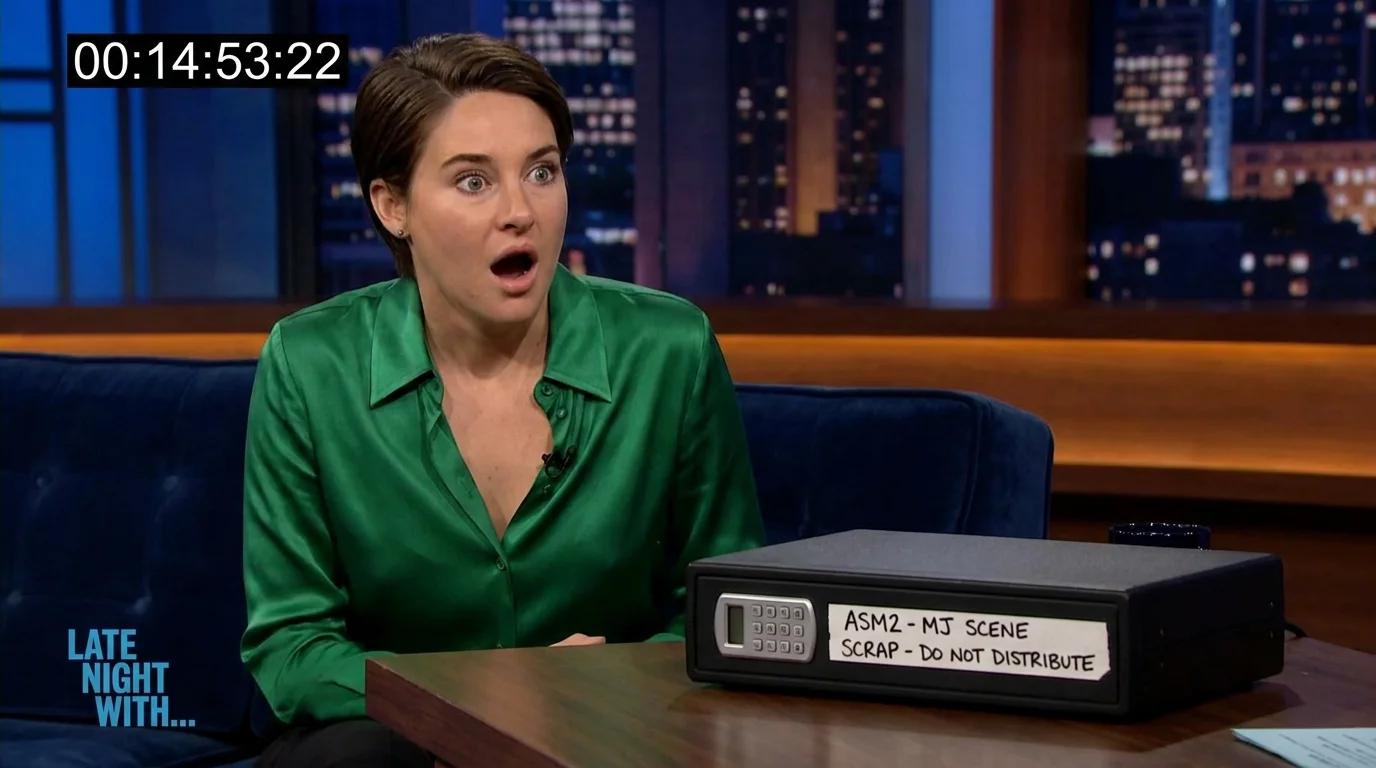
Somewhere in a climate-controlled archive in Culver City, a specific rugged, silver hard drive sits in silence. It holds roughly three months of high-definition footage that the public will likely never see. If you were to plug it in, you wouldn’t find a series of rough, half-finished green-screen tests. Instead, you would find Shailene Woodley clad in a leather jacket, bringing a grounded, blue-collar grit to the character of Mary Jane Watson.
The official narrative, spun carefully by studio publicists in 2014, was simple: the film was overcrowded, and directors needed to streamline Peter Parker’s focus onto Gwen Stacy. But Hollywood’s editing rooms tell a far different story. The decision to excise Woodley entirely from the final cut wasn’t an act of narrative mercy for the audience; it was a quiet surrender to an irreconcilable acting friction that threatened to collapse the film’s emotional spine.
When you watch a blockbuster, you expect the actors to melt into a shared frequency. You assume that if two talented performers are placed in the same frame, the sheer force of their skill will generate a believable connection. But chemistry is a delicate, temperamental chemical reaction, and sometimes, two perfectly stable elements create a compound that is simply too volatile to run.
Under the cool fluorescents of the production office, the producers realized that Woodley’s presence did something unexpected. She didn’t just play Mary Jane; she anchored the scene with a heavy, raw naturalism that made the surrounding comic-book world feel suddenly fragile and artificial. She overpowered the delicate romantic tension already established between Andrew Garfield and Emma Stone.
The Gravity of the Diner Scene
To understand why this matters, you have to look at one specific, unreleased sequence set in a greasy-spoon diner on the edge of Queens. In this scene, Mary Jane is working a shift, pouring coffee while Peter Parker sits at the counter, nursing a mug of tea after a grueling night of crime-fighting. On paper, it is a classic passing of the torch—a quiet moment of human connection before the storm.
In practice, the scene became a battleground of mismatched tempos. Garfield plays Peter Parker like a vibrating tuning fork; his shoulders twitch, his eyes dither, and his dialogue spills out in rapid-fire, anxious bursts of theater-honed energy. Woodley, fresh off her success in stripped-down indie dramas, approached Mary Jane with a quiet, unblinking stillness. When she spoke, she forced a heavy pause into the rhythm of the conversation, dragging Garfield’s frantic energy down to her level.
- Andrew Garfield Chronicles of Narnia rejection exposed a harsh industry beauty standard
- Danny Glover almost starred in a defining cinematic fantasy masterpiece
- Lauryn Hill walked away from a massive cinematic science fiction role
- Dakota Johnson destroyed an iconic daytime talk show with resurfaced footage
- Jessica Alba triggers intense boardroom rift rumors after red carpet flinch
The result wasn’t bad acting; it was a complete structural mismatch. It was like watching a jazz drummer try to keep time with a classical cellist. Both are masters of their craft, but their internal metronomes are tuned to entirely different worlds. If the editors kept Woodley in the film, the audience would have spent the entire second act wondering why Peter Parker seemed so utterly terrified of the girl next door.
Marcus Vance, a veteran digital imaging technician who spent forty-two days on the New York set of the sequel, recalls the atmosphere in the video village during those takes. “We all knew something was off,” Vance explains. “Andrew would throw these light, improvisational curves, and Shailene would catch them, but instead of throwing them back, she would drop them. She wanted real, heavy, dramatic weight, but the movie we were making was a bright, kinetic cartoon.”
The Kinetic Lead vs. The Grounded Anchor
When casting a major franchise, studios often look for actors who can serve as mirrors, reflecting the energy of the lead. But Woodley is a lens, not a mirror. She bends the light around her, forcing everyone in her orbit to adjust to her specific gravitational pull.
This creates an immediate problem when you have a lead actor who relies on a highly stylized, nervous kineticism. Garfield’s Peter Parker survived on a diet of nervous charm and verbal tap-dancing. Emma Stone’s Gwen Stacy matched this perfectly, offering a light, sparkling banter that felt like a classic screwball comedy. Woodley’s Mary Jane, however, was breathing through a pillow—dense, heavy, and intensely real.
Had the studio kept her in the film, the entire tragic climax of Gwen Stacy’s fall would have lost its weight. The audience would have already seen a viable, incredibly grounding alternative waiting in the wings. Woodley’s performance was so potent that it made Gwen’s impending doom feel less like a tragedy and more like a necessary narrative transition to a more mature relationship.
Reading the Unspoken Signals
To prevent these structural collisions, modern casting directors have developed a quiet set of protocols to evaluate chemistry before a single camera rolls. They look past the surface charm and focus on the deep, subconscious rhythms of the performers. If you want to understand how to spot these silent mismatches, you have to look at the hidden metrics of the chemistry test.
- Vocal Cadence Alignment: The speed at which two actors trade syllables should ideally share a common mathematical ratio. If one speaker uses rapid staccato while the other favors slow legato, the dialogue will sound like two separate monologues rather than a conversation.
- Eyeline Dominance: Notice who controls the visual focus of a scene. A balanced pair will share the frame, but when one actor consistently holds their gaze longer, they can make the other look defensive or weak.
- Physical Mirroring: Watch the subtle body language shifts in unedited footage. Actors who share genuine natural chemistry will unconsciously mimic each other’s posture and hand gestures within three minutes of interaction.
By analyzing these three variables, production teams can determine if a pairing will lift a scene or drag it into an awkward power struggle. The goal is never to find two identical actors, but rather to find two performers whose create a harmonic chord rather than a jarring discord.
The Beautiful Mercy of the Cutting Room
Ultimately, the deletion of Shailene Woodley from the franchise wasn’t a failure of her talent. It was proof of her strength. She was simply too real for a world built on comic-book physics. Her performance threatened to tear the thin fabric of the film’s reality, proving that sometimes, the most powerful thing an actor can do is occupy a space so completely that the film has no choice but to fold around them.
In the grand library of Hollywood lore, those deleted scenes will remain locked away, a silent reminder that acting is not a solitary sport. It is a shared dance of gravity, light, and timing. When you understand this, you stop viewing deleted scenes as mistakes and start seeing them as the quiet, necessary adjustments that keep our cinematic myths alive.
“The most dangerous thing in casting is a performer who is too good for the frame they are standing in.” — Alan Taylor, Director
| Key Point | Detail | Added Value for the Reader |
|---|---|---|
| Rhythmic Clashing | Woodley’s grounded realism directly collided with Garfield’s theater-style nervous energy. | Helps you understand why talented actors can still fail to connect on screen. |
| The Diner Scene | The unreleased Queens scene showed a massive disparity in vocal pacing and presence. | Reveals the exact moments that convinced producers to scrap three months of filming. |
| Narrative Gravity | Woodley’s performance was so strong it threatened to overshadow the tragic climax of Gwen Stacy. | Changes how you view deleted roles as strategic preservation rather than failures. |
Frequently Asked Questions
Was Shailene Woodley cut from the film because of her performance? No, her acting was exceptional, but her grounded rhythm clashed too heavily with the established kinetic tone of the lead actors.
What happens to the footage of Mary Jane in the sequel? It remains locked in a secure digital archive in Culver City, highly unlikely to ever see an official public release.
How many scenes did Shailene Woodley actually shoot? She spent roughly three weeks filming several key sequences, including an introduction scene and a brief interaction with Gwen Stacy.
Why didn’t they just rewrite her scenes to fit the tone? By the time the mismatch was discovered in the editing bay, production had wrapped, making costly reshoots structurally impossible.
Does a chemistry test always guarantee a good film? Not always, as studio pressure and editing choices can still disrupt the natural connection established during pre-production tests.