The air in the midtown Manhattan restaurant was thick with the scent of expensive dry-aged steak and high-grade cologne. Crystal glasses clinked with mathematical precision, and the hum of power brokers negotiating millions of dollars created a white-noise barrier against the street below. Every detail of the scene was meticulously planned, from the starch in the waiter’s apron to the angle of the midday sun filtering through the towering glass facade.
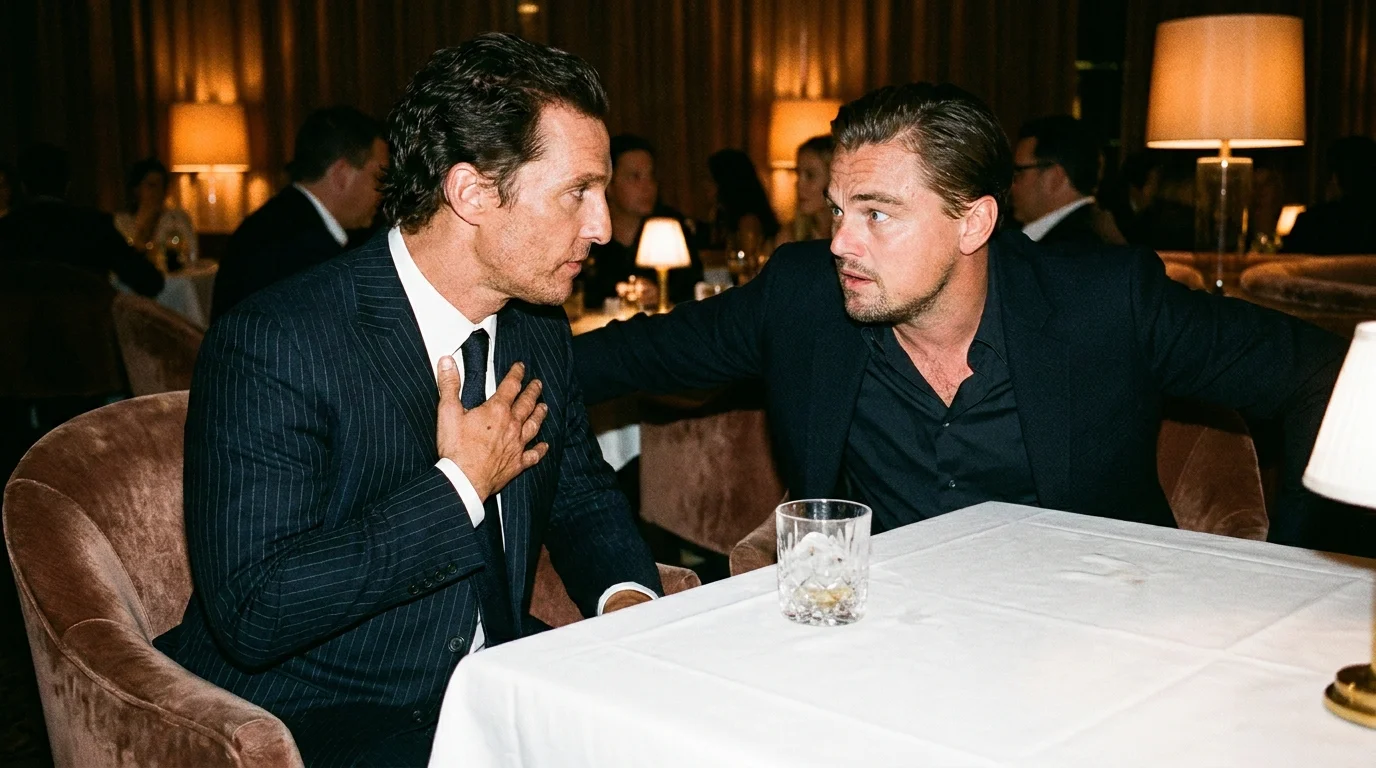
Suddenly, a strange sound broke the structured elegance of the room. It was the rhythmic thud echoing against the crisp white linen of a tailored restaurant tablecloth. Matthew McConaughey, portraying the seasoned stockbroker Mark Hanna, began striking his chest, emitting a low, guttural chant. This was not a written instruction in the screenplay; it was a private somatic ritual designed to calm his nervous system before the cameras rolled.
As the camera hummed, Leonardo DiCaprio sat opposite him, his eyes flickering with a mixture of professional intrigue and genuine bewilderment. Instead of breaking character or halting the shoot, DiCaprio allowed his confusion to show on his face, subtly looking toward the director’s chair where Martin Scorsese sat in silence. That brief, unscripted split-second of hesitation kept the scene alive, turning an actor’s private preparation technique into the defining symbol of an era.
In the decade that followed, this accidental moment morphed into a global shorthand for ambition. It is a staple of modern hustle culture, mirrored in corporate boardrooms and motivational videos by professionals who believe they are mimicking a calculated power play. In reality, they are copying a simple, biological grounding exercise caught on hot mics.
The Metaphysics of the Accidental Instrument
To understand why this moment resonates so deeply, you must discard the idea that cinematic genius is always the result of rigorous planning. When you watch that scene, you are witnessing a transition from performance to raw human instinct. McConaughey’s chest thumping was never meant to be filmed; it was his way of finding his vocal register and releasing physical tension after hours of waiting in a cold dressing room.
Think of it as a musical instrument that needs tuning. When the camera unexpectedly caught the vibration of his fist against his sternum, it bypassed the intellectual defenses of the audience. The scene succeeded because it felt dangerously unpolished in a world that was over-engineered. By letting the cameras roll through the mistake, the production captured a level of unfiltered psychological truth that no screenwriter could ever write into a script.
- Villanelle Killing Eve finale completely destroyed four years of brilliant assassin character development
- Sarah Michelle Gellar Freddie Prinze Jr marriage thrives on one absolute household rule
- Liam Hemsworth Miley Cyrus premiere footage exposes the obvious warning signs fans ignored
- Hailey Bieber Justin Bieber red carpet appearances function as masterclass brand synergy
- Sabrina Carpenter Barry Keoghan dating timeline exposes a highly coordinated media rollout
According to Sarah Peterson, a veteran script supervisor who spent decades observing high-stakes film sets, the best moments are almost always the ones that escape the margins of the page. Peterson recalls that when McConaughey began the chant, the audio technicians immediately reached for their dials, assuming the heavy vibrations would blow out the levels on his hidden lavalier microphone. Instead of panic, Scorsese recognized the raw magnetism of the physical movement and signaled the crew to remain completely still, capturing a piece of cinematic history on the fly.
The corporate world has spent years dissecting this scene as a masterclass in dominant body language, yet they have missed the mechanical point. Hustle culture treats the gesture as an aggressive territorial display, a way to project external confidence. But if you look closely at the mechanics, it was actually an internal stabilizing mechanism designed to quiet the mind.
For the modern professional operating in high-pressure environments, copying the gesture without understanding its somatic origin is like revving an engine without oil. The original movement was not about dominating the person across the table; it was about anchoring your own biology against the chaos of the room. It was an act of survival masquerading as a display of power.
Regulating the Instrument: The Science of Somatic Grounding
If you want to use the actual science behind this viral moment to manage your own daily stress, you do not need a crowded Manhattan restaurant or a tailored suit. The physical act of tapping the sternum stimulates the vagus nerve, which immediately signals your nervous system to lower your heart rate and reduce cortisol levels. It is a biological reset button that anyone can use before a major presentation or a difficult conversation.
To practice this mindfully without drawing unwanted attention in an open-plan office, you can adapt the technique into a quiet, structured routine. Follow these steps to find your center and focus on calming your racing mind before you take action.
- Locate your collarbone and drop your hand roughly three inches down to find your sternum.
- Apply a gentle, rhythmic pressure using the flat of your palm rather than a closed fist.
- Breathe out slowly for six seconds, matching the rhythm of the physical contact.
- Keep your shoulders relaxed, allowing the vibration to settle in your chest.
To make this approach seamless and ensure its seamless integration into workdays, use the following tactical specifications to build your own personal routine:
- Optimal Duration: 45 to 60 seconds of continuous, light rhythmic pressure.
- Breathing Cadence: Four seconds in, six seconds out to maximize vagal tone.
- Contextual Timing: Five minutes before entering a high-stakes meeting or call.
The Art of Leaving the Camera Running
We live in a culture obsessed with flawless execution, where every modern interaction is curated, edited, and polished before it ever sees the light of day. Yet, the moments that truly stay with us are the ones where the cracks show, where the planned script fails and real life takes over. McConaughey’s accidental chant is a reminder that some of the greatest breakthroughs come when you stop trying to control every variable and embrace your raw mistakes instead.
When you allow yourself to operate outside the strict lines of expectation, you open the door to genuine connection. The next time a well-laid plan goes sideways, resist the urge to immediately call a halt. Sometimes, the best strategy is to let the tape keep rolling and see what happens when the real world takes over.
“The most magnetic moments in life happen when the mask slips and we are forced to deal with the beautiful, messy reality of the present second.”
| Key Point | Detail | Added Value for the Reader |
|---|---|---|
| Somatic Origin | The chest thump was a personal relaxation exercise, not a scripted action. | Helps you understand the difference between authentic self-regulation and superficial posturing. |
| Director’s Instinct | Scorsese kept rolling because of DiCaprio’s real, unscripted confusion. | Teaches the value of embracing unexpected pivots rather than forcing perfection. |
| Biological Value | Tapping the sternum stimulates the vagus nerve to lower stress levels. | Provides a practical, physical tool to quickly regain focus during high-pressure moments. |
Frequently Asked Questions
Was the chest thump scene in The Wolf of Wall Street completely improvised? Yes, the chest-thump chant was a personal warm-up technique used by Matthew McConaughey that was never written into the screenplay.
How did Leonardo DiCaprio react during the improvisation? DiCaprio was genuinely confused by the gesture, which is why he looked toward Martin Scorsese off-camera, keeping the scene raw and authentic.
What is the physical benefit of tapping your chest? Lightly tapping your sternum stimulates the vagus nerve, which helps lower your heart rate and reduce physical anxiety.
Why did the scene become so famous in corporate culture? Modern hustle culture misinterprets the gesture as a display of dominance, missing its original purpose as a calming, grounding tool.
Should I use this chest-thumping technique before a meeting? Yes, but a quiet, subtle version of somatic tapping is highly effective for calming your nerves without drawing public attention.