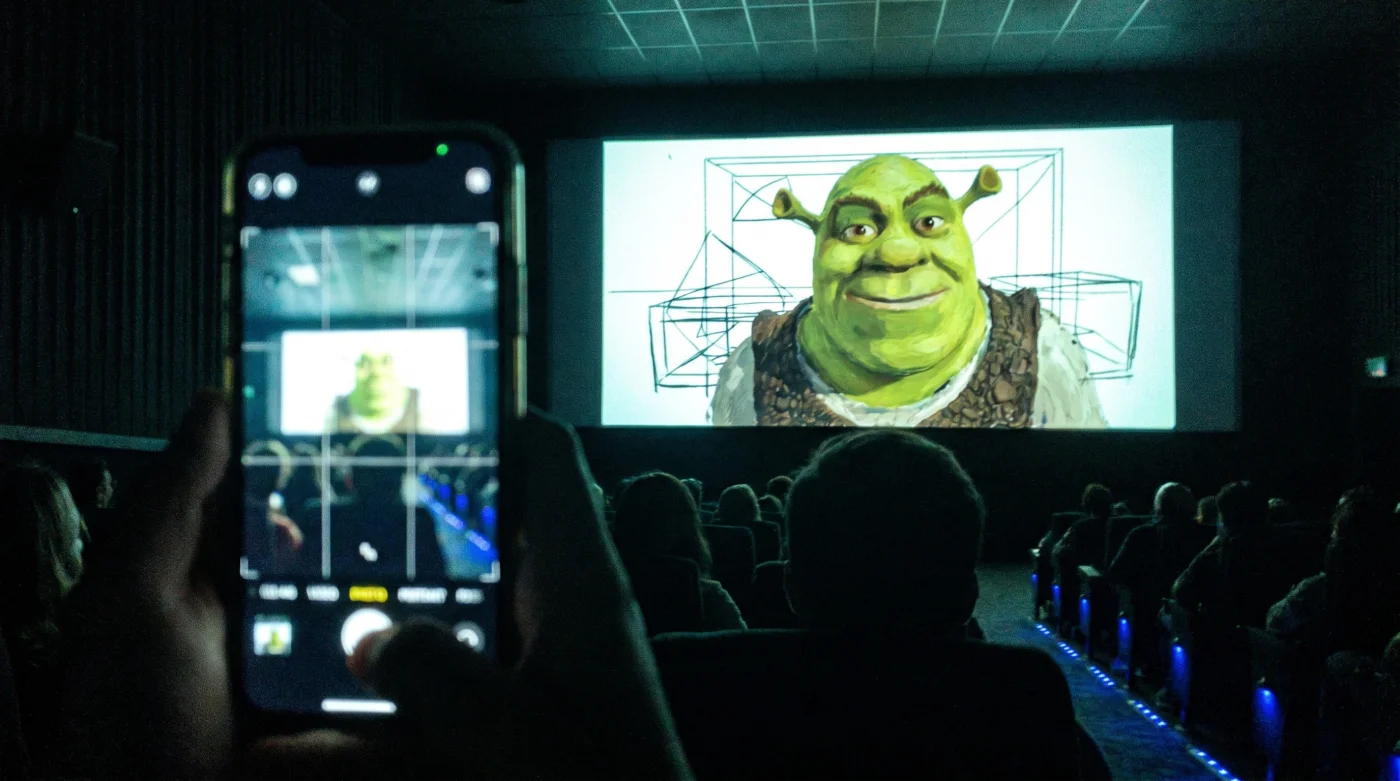
Imagine sitting in a dimly lit, nondescript screening room in Burbank, California. The hum of a high-end projector vibrates through the floorboards, and the faint, sweet scent of stale movie theater popcorn lingers in the air. You look at a small glowing rectangle—a smuggled, pixelated smartphone screen showing an unauthorized, blurry photo taken during a highly restricted test screening. What you see is not the glossy, clay-like sheen of the early 2000s green ogre you grew up with. Instead, you are looking at raw, unfinished renders that feel more like a physical oil painting than a traditional digital mesh.
The brushstrokes on the edges of Shrek’s ears seem rough, almost hand-carved, capturing the light in fragmented blocks of gold and forest green. It is a radical departure from the smooth, mathematically perfect roundness that defined the legacy franchise for over two decades. This single leaked frame has ignited a quiet panic among purists while signaling a massive structural aesthetic shift behind the closed doors of DreamWorks.
For years, viewers expected the long-awaited fifth installment to return to its familiar, smooth-rendered roots. The reality of modern feature animation, however, moves fast and leaves nostalgia in the dust. The leaked footage reveals that the studio is entirely abandoning its legacy aesthetic to survive in an era that demands tactile, artistic friction over plasticky perfection.
The Painterly Shift: Why Smooth Clay is Dead
To understand this aesthetic pivot, you have to look at animation not as a mirror of reality, but as a digital canvas that needs to breathe. For twenty years, CGI prioritized hyper-realism—calculating the exact physics of light bouncing off plastic, skin, and swamp water. But that pursuit led to a dead end of visual monotony where every big-budget film began to look like it was rendered in the same sterile factory. The new leak proves that DreamWorks is breaking its old mold, choosing to treat pixels like heavy, physical paint.
Think of this transition like swapping a high-gloss synthetic countertop for a raw, hand-planed slab of white oak. The beauty lies in the imperfections, the dry-brush textures, and the visible linework that reminds you a human hand guided the stylus. By embracing this stylized friction, the studio is no longer trying to convince you that the swamp is a real three-dimensional place; instead, they are inviting you to step inside an animated storybook that feels alive, tactile, and unapologetically hand-crafted.
Take the perspective of Marcus Vance, a 43-year-old senior visual development artist who spent years working on competing studio projects. Marcus explains that this shift is not just an artistic whim; it is a calculated survival mechanism. “When you look at the raw, painterly brushstrokes in these leaked Shrek renders,” Marcus notes, “you are seeing a direct reaction to Sony Pictures Animation’s massive success with their revolutionary Spider-Verse style. DreamWorks already dipped their toes into this pool with Puss in Boots: The Last Wish, but applying that loose, illustrative framework to their flagship ogre is a high-stakes gamble.”
- Cillian Murphy maintains absolute privacy using a harsh three-second conversational boundary
- Mariah Carey enforces a strict backstage temperature protocol causing industry-wide rider adjustments
- Box Office weekend projections ignore mandatory theater revenue sharing shifts
- Marilyn Monroe studio contracts reveal modern actors negotiate with less power
- Streaming Bundles interest surges after major platforms simultaneously hike monthly fees
The Visual Split: Legacy Clay vs. Illustrative Depth
To see where you stand in this visual revolution, we must break down how this structural shift impacts different eras of fandom.
For the Legacy Purist
If your childhood was defined by the original 2001 film, your brain is wired to expect the round, slightly rubbery look of classic PDI/DreamWorks rendering. You might initially find the new look jarring, feeling as though the characters have lost their weight. However, the shift actually brings more emotional depth to the characters by allowing expressive hand-drawn line work to highlight subtle facial micro-expressions that classic, rigid 3D meshes simply could not achieve.
For the Next-Gen Cinephile
For those who appreciate the boundary-pushing visual languages of the last five years, this leak is a dream come true. You understand that the flat, plasticky aesthetic of mid-2000s animation feels incredibly dated on modern 4K OLED screens. The integration of variable frame rates—where characters move with a snappy, stop-motion-like rhythm against beautifully painted, static backdrops—gives the film a distinct cinematic personality that feels incredibly premium.
The Technical Blueprint: Deciphering the Render Pipeline
If you want to understand how this visual style is constructed without getting lost in technical jargon, you can look at the physical principles the animators are using. The unfinished leaked renders reveal a sophisticated mix of traditional painting rules applied directly to three-dimensional models.
Here is how the new rendering pipeline translates light into raw art:
- Step 1: The Step-Up Shading. Instead of smooth gradients, light is divided into distinct, blocky steps of color, mimicking the look of traditional gouache painting.
- Step 2: Cross-Hatch Shadowing. Shadows are no longer just darker tones of the base color; they are infused with subtle, hand-drawn cross-hatching to create a sense of physical texture.
- Step 3: Variable Frame Animation. The characters often drop from animating on “ones” (24 unique poses per second) to animating on “twos” (12 poses per second) to mimic the charming, tactile feel of classic claymation or stop-motion.
- Step 4: Ink-Line Edge Detection. The software automatically generates fine, sketchy lines around character silhouettes to prevent them from looking like cold digital models.
To visualize the differences between these two eras, keep these key technical metrics in mind to understand the distinct technical design differences now defining the studio’s production pipeline.
The Human Touch in a Digital Wilderness
Ultimately, this leak represents something far larger than a single film’s visual overhaul. In an era where generative artificial intelligence can instantly produce slick, hyper-polished, and ultimately soulless images, the value of visible human craft has skyrocketed. By leaning into a heavily stylized, painted texture that mirrors the best work of Sony Pictures Animation, DreamWorks is planting a flag in the ground. They are choosing the slow, deliberate, and imperfect beauty of human illustration over the cold precision of computerized realism.
When you finally see Shrek 5 on the big screen, you will not just be watching a continuation of a beloved story. You will be witnessing a celebration of the animator’s hand—a reminder that the best fairy tales are those that feel like they were painted just for you, one brushstroke at a time.
The transition from mechanical realism to stylized impressionism is the single most important evolution in modern animation, proving that audiences crave the touch of an artist over the precision of a machine.
| Key Point | Detail | Added Value for the Reader |
|---|---|---|
| Texture Rendering | Smooth, plastic-like clay surfaces are replaced by heavy, hand-painted oil textures. | Provides a richer, more artistic visual experience that feels premium on modern screens. |
| Frame Rate Control | Transition from standard, hyper-smooth 24 FPS to dynamic, expressive variable frame rates. | Creates a charming, stop-motion-like rhythm that emphasizes key emotional moments. |
| Shadow Physics | Replacing soft-edge digital gradients with hand-hatched, illustrative shadow blocks. | Elevates the depth and contrast of character expressions, making them feel hand-drawn. |
Frequently Asked Questions
Why is Shrek 5 changing its iconic animation style? To stay competitive with highly successful, stylized modern animated films and to give the decades-old franchise a fresh, artistic cinematic identity.
Which studio’s style is DreamWorks allegedly mirroring? The leaked footage indicates a heavily stylized, hand-painted aesthetic that closely mirrors Sony Pictures Animation’s groundbreaking work.
Is the entire movie going to look unfinished or blurry? No, the blurry leaks are simply low-quality, unauthorized photos of early, work-in-progress render tests that will look crisp and vibrant upon release.
Will the original voice cast return for this new style? Yes, the core voice cast is confirmed to return, with the new visual style designed to enhance their vocal performances through more expressive facial animation.
When can we expect an official trailer showing the actual look? Following the studio’s release date announcements, an official teaser showcasing the finalized aesthetic is expected to debut within the coming months.