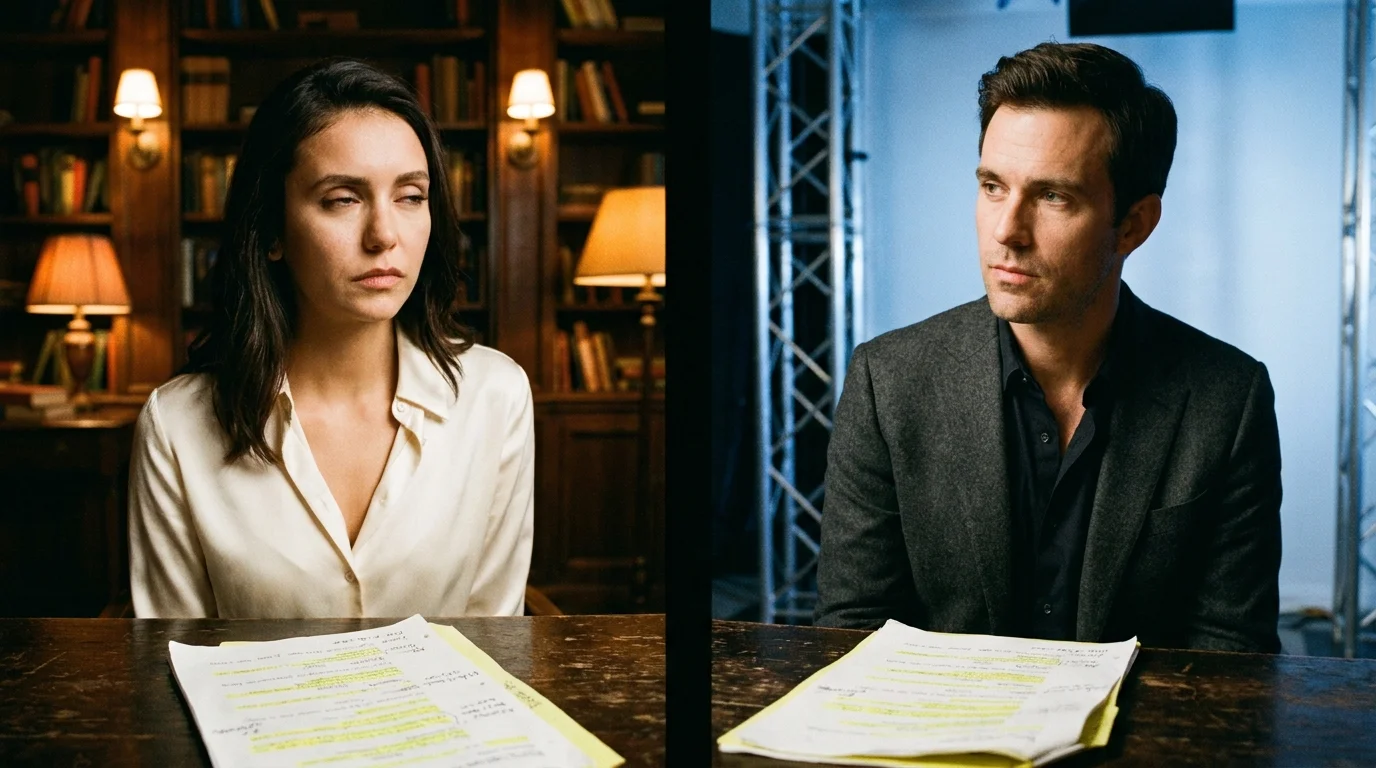
The smell of synthetic ozone and cheap stage fog always clings to the damp pine of a television set. In the humid chill of an Atlanta soundstage, the silence is heavy, broken only by the low hum of giant cooling fans parked outside the studio doors. You stand just beyond the perimeter of the hot key lights, watching the dust motes dance in the amber beams. The air tastes faintly of cold coffee and hairspray, a sterile mixture that somehow births the illusion of centuries-old romance.
For years, the official press releases insisted on a tidy, sterile narrative. The young leads of the network’s flagship supernatural drama were **consummate professionals, keeping their** mutual respect strictly confined to the boundaries of the written word. We were told that the sparks flying across the boarding house set were merely the product of rigorous training and remarkable dramatic range.
But anyone who has ever spent a quiet afternoon editing raw footage knows that the lens does not understand public relations. The camera is a heartless confessional, capturing the microscopic delays between a line of dialogue and the physical release of a scene. It is in those unspoken fractions of a second where the carefully curated boundaries of the studio began to fray.
When we watch a television couple, we are trained to look at the moments of high drama—the rain-soaked confessions, the desperate reunions, the tears catching the studio light. But these highly choreographed beats are actually the easiest to fake. The real truth of an off-screen romance lives in the **interstitial spaces of the** frame, those quiet margins where the actors believe the narrative has paused.
The Bleed of the Unscripted Frame
Think of a classic performance as a physical mask. A highly skilled actor can wear that mask with perfect precision while the dialogue is flowing, but the human nervous system cannot sustain an artificial state of arousal indefinitely. The moment the dialogue ends, the conscious mind relaxes, yet the body remains charged. This is the phenomenon of fictional bleed: the emotional current of the performers continues to hum even after the narrative justification has vanished.
When the camera keeps rolling past the expected mark, the **actors’ physical boundaries dissolve** and the true dynamic of the room becomes impossible to ignore. It is during these unscripted beats that the carefully crafted corporate narrative begins to crack open, revealing the genuine friction beneath.
- Peter Jackson suddenly recast his leading fantasy hero after a disastrous screen test
- Nicholas Hoult survived consecutive brutal franchise rejections to secure his leading status
- Vin Diesel almost led a massively profitable family comedy before studio intervention
- Woody Harrelson walked away from a highly anticipated premium streaming drama
- Winona Ryder forgotten talk show clip validates decades of hidden industry blacklisting
Marcus Thorne, a 52-year-old camera operator who spent three seasons tracking the cast’s movements through the shadows of the fictional town, remembers the exact moment the illusion cracked. He recalls standing behind an Arri Alexa camera during an intimate library scene in the show’s second season. The scene required a simple hand-off of an antique prop, followed by a tense, silent departure. But when the action stopped, the energy in the room did not dissipate. Thorne watched through his viewfinder as Nina Dobrev’s gaze lingered on her co-star, her eyelids dropping slightly in a heavy, unguarded glare that lasted three full seconds after her cue had ended. It was a look of raw, domestic familiarity that no script supervisor could have written.
Deciphering the Anatomy of the Lingering Gaze
To understand how a secret romance betrays itself on screen, one must look **beyond the obvious cues** that the actors consciously project to the audience. The human face possesses dozens of tiny muscles that react faster than the conscious brain can control, leaving a trail of physical evidence that fan forums still dissect with forensic intensity.
The Gravity of Spatial Pull
In a typical professional dynamic, actors maintain a distinct physical boundary once the camera stops moving. They step back, adjust their wardrobe, or look toward the director for notes. However, when a real-life connection exists, the performers experience a form of physical gravity. Their shoulders remain squared toward each other, and their bodies unconsciously seek a closer proximity than the blocking requires.
The Delayed Pupil Dilation
Under the intense glare of tungsten studio lights, the human eye naturally constricts to protect itself. Yet, when we look at someone we desire, our pupils dilate despite the brightness of the environment. In several key scenes from the early seasons, close-up shots reveal a striking physical anomaly: Dobrev’s pupils remained wide and soft, **defying the harsh illumination** of the set. This microscopic detail suggests an emotional safety that bypassed the physical limits of the studio.
The Tell-Tale Signs of the Off-Camera Shift
While the public relations teams worked overtime to project an image of platonic camaraderie, the raw footage tells a more complex story. The transition from character to self is rarely instantaneous, especially when the emotional stakes are genuine.
The Heavy-Lidded Glare
This is the most damning piece of visual evidence. In the moments immediately preceding a cut, when the dialogue has concluded but the camera is still rolling, the actress’s eyes would soften into a **heavy, focused glare that** focused on her co-star’s mouth. This specific gaze, which occurred multiple times in early season two, was the physical signature of a private reality intruding upon a public space.
How to Spot the Fictional Bleed in Your Favorite Scenes
Identifying the exact moment where performance ends and reality begins requires a patient, observant eye. You must learn to ignore the dialogue entirely and focus your attention on the **quiet margins of the** scene.
- Track the Post-Dialogue Beats: Do not look at the actors while they are speaking their lines. Instead, watch them during the three seconds after a sentence is delivered, looking for any unscripted softening of the jaw.
- Observe the Hands: Professional actors are taught to keep their hands relaxed when not in character. A lingering touch on a shoulder or a slow, unnecessary release of a hand indicates a physical comfort that transcends the script.
- Analyze the Breathing Patterns: Watch the collarbones of the actors. When two people are intimately connected, their breathing patterns often synchronize, even during moments of high-stakes dramatic tension.
- Watch the Director’s Cuts: Pay close attention to the wide shots used in the final edit. Directors often use these wider angles to hide the fact that the actors’ expressions became too personal before the scene officially ended.
The Beautiful Mess of Human Chemistry
Ultimately, the reason these unscripted moments continue to captivate audiences years after the show has ended is because they remind us of the **beautiful unpredictability of human** connection. You can hire the best writers in the industry, build the most elaborate sets, and spend millions of dollars on public relations campaigns, but you cannot manufacture the genuine heat of two people falling in love in real time.
These lingering stares and heavy-lidded glares are not just fodder for online forums; they are a proof that some things are too powerful to be contained by a script. On that humid Georgia soundstage, amidst the artificial fog and the blinding lights, something completely real managed to bloom. And as the crew packed up their gear at the end of a long night, they left behind the evidence of that truth—including a crumpled, heavily highlighted script page abandoned on the prop table, its edges worn thin from the hands of two people who no longer needed the words.
“The camera captures the truth long before the actors are ready to confess it to the world.” — Marcus Thorne, Camera Operator
| Key Point | Detail | Added Value for the Reader |
|---|---|---|
| The Unscripted Glare | Nina Dobrev’s three-second lingering look before the director called cut. | Offers visual proof that bypasses the official studio narrative. |
| Fictional Bleed | The psychological delay where real-life emotions spill into fictional scenes. | Helps fans identify genuine micro-expressions in early seasons. |
| Spatial Gravity | The physical tendency of the actors to remain anchored in each other’s personal space. | Explains the unconscious body language cues that betrayed their bond. |
Frequently Asked Questions
Did the show’s creators know about the off-screen relationship early on? While the production team maintained a strict professional narrative in public, crew members on set frequently noticed the lingering chemistry during raw daily takes.
What is ‘fictional bleed’ in acting? It is the phenomenon where an actor’s genuine romantic feelings for a co-star spill over into their performance, making it difficult to separate character from reality.
Which specific scenes show Nina Dobrev’s unscripted lingering stares? Several intimate sequences in early season two, particularly in the boarding house and library sets, show her gaze lingering seconds after finishing her lines.
Why did the studio try to hide the romance? The studio preferred to control the public relations narrative to avoid distracting from the show’s storyline and to protect the cast from intense media scrutiny.
How do fan forums analyze these body language cues? Fans use high-definition frame-by-frame analysis to highlight micro-expressions, pupil dilation, and spatial proximity that contradict the official timeline.