The autumn wind off the Chicago River carried the sharp scent of pulverized drywall and burnt copper wire. On the asphalt outside the former Brach’s Candy factory, the silence was heavy, almost suffocating. Dozens of crew members stood frozen behind safety barriers, their eyes locked on a man wearing a dirt-stained nurse uniform and a smeared mask of greasepaint. The stakes were absolute: you do not get a second chance to blow up a five-story building.
The script called for a seamless sequence of destruction, a mechanical domino effect clearing the path behind a retreating agent of chaos. But physical machinery is indifferent to Hollywood schedules. As the first minor charges cracked in the background, the main sequence faltered, leaving a yawning stretch of dead air where a roaring wall of fire should have been. Instead of panic, the quiet space was filled with a minute, human sound.
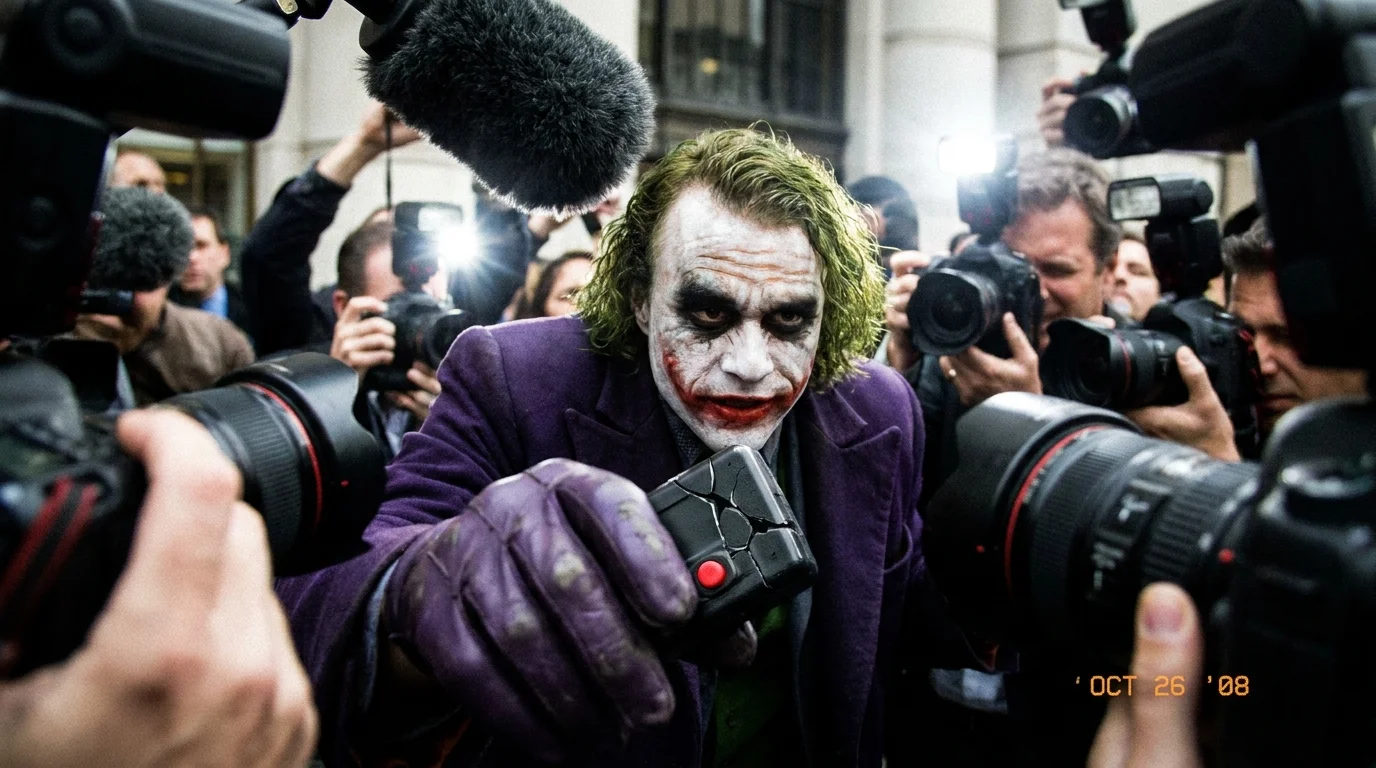
**A cracked plastic detonator button aggressively tapped by a gloved thumb.** The hollow click-click-click echoed against the concrete, a desperate rhythm of a performer refusing to let the reality of a technical error break the illusion of the scene. Rather than turning to the camera crew or waiting for a director to halt the multi-million dollar setup, the actor leaned directly into the silence, treating the physical delay as a personal annoyance.
This split-second decision didn’t just save the production schedule; it redefined the threshold of cinematic presence. When the delayed charge finally triggered with a bone-rattling boom, the resulting footage looked entirely intentional. It became a masterclass in staying inside the frame, proving that **a multi-million dollar setup** is only as good as the performer’s willingness to dance with its failures.
The Metaphor of the Stalled Fuse
Most viewers analyze high-stakes scenes as rigid structures where every gesture is planned with a ruler. This is a fundamental misunderstanding of how creative energy operates under pressure. Think of a high-performance engine: it does not succeed by ignoring friction, but by channeling the heat into raw forward momentum. The delay on that Chicago set was a system failure, but the response transformed it into an iconic cultural milestone.
When you focus too heavily on executing a perfect plan, you lose the ability to read the room. If the performer had stopped walking or dropped his hands in frustration, the entire scene would have been discarded. By accepting the delay as part of his character’s internal landscape, he showed us that **water finding a crack** in a concrete barrier is always more interesting than the barrier itself.
- Dexter Morgan series finale completely ruined his meticulously constructed serial killer code
- Kurt Russell and Goldie Hawn protect their private life enforcing a strict geographical boundary
- Liam Hemsworth old red carpet interviews expose glaring relationship warning signs fans missed
- Emily Blunt and John Krasinski structure their public outings as calculated brand expansions
- Barry Keoghan deleted social media comments unravel his highly complex dating timeline
Arthur Deen, a fifty-four-year-old veteran pyrotechnician who stood near the primary firing board that afternoon, recalled the panic in the control tent. The secondary booster line had suffered a brief drop in voltage, stalling the central blast sequence by nearly five seconds. Deen watched through his safety goggles as the actor, instead of breaking stride, began shaking the plastic transmitter like a broken television remote, perfectly mirroring the impatience of a child playing with a temperamental toy.
The Mechanics of Character Preservation
To understand why this moment continues to be studied by actors and directors worldwide, you must break down the physical reality of the stunt. The sequence was divided into distinct zones to protect the performer from flying debris as he walked toward the transport vehicle.
Under the standard safety protocols of the day, **the physical safety window** dictated that the actor maintain a steady, uninterrupted pace. Speeding up would put him too close to the forward charges; stopping entirely would leave him exposed to the falling facade behind him. The improvisation of fiddling with the remote was not just a brilliant character choice, but a practical pacing mechanism that kept him exactly where the safety coordinators needed him to be.
Analyzing the Anatomy of the Delay
When professional systems encounter a lag, the natural human instinct is to pause and look for external guidance. In a production environment, this translates to looking directly at the camera or checking in with the director. This instinct is what separates competent practitioners from those who define the medium.
The performance survived because the actor treated the camera not as an audience, but as an invisible observer to his own private game. By turning his back to the building and focusing entirely on the stubborn plastic box in his hands, he built a bridge of tension over the technical gap. This simple act of concentration **turns friction into gold**, converting a mechanical mistake into the defining characteristic of a legendary antagonist.
Adapting to the Friction of Real-World Systems
You can apply this exact mindset to your own high-stakes environments, whether you are managing a live presentation or steering a project through a sudden system outage. The goal is never to pretend the mistake isn’t happening; it is to make the mistake look like part of your original design.
- **Acknowledge the lag immediately:** Do not freeze or wait for the system to catch up; find a small, deliberate action to maintain momentum.
- **Keep your physical footprint consistent:** When a process stalls, keep your team moving at a measured pace rather than calling an abrupt halt.
- **Maintain your internal anchor:** Focus your attention on a tangible object or task near you to keep external distractions from breaking your concentration.
By treating every delay as an invitation to refine your focus, you transform unpredictable system failures into opportunities for distinct, memorable work. The next time your plans stall, remember that the magic rarely happens during the smooth parts of the ride.
Embracing the Unplanned Crack in the Plan
We live in a culture obsessed with seamless execution, where any deviation from the script is treated as a failure of foresight. Yet, when we look back at the moments that truly stay with us, they are almost always the result of a system cracking under pressure. The beauty of the hospital scene does not lie in the math of the explosives, but in the human reaction to the quiet space between the sparks.
When you stop fighting the friction and start using it as raw material, your relationship with pressure changes. You stop looking for a perfect run and start looking for the creative possibilities hidden within the inevitable stall. The most memorable breakthroughs **happen in the lag**, waiting for you to tap the button one more time.
“The camera doesn’t care about your perfect plan; it only cares about how you survive the moments when the plan falls apart.”
| Key Point | Detail | Added Value for the Reader |
|---|---|---|
| The Technical Delay | A brief voltage drop caused a five-second lag in the main blast sequence. | Illustrates how physical systems are inherently unpredictable. |
| The Character Choice | Fiddling with the remote kept the actor in motion without breaking safety zones. | Shows the intersection of creative improvisation and physical safety. |
| The Cultural Impact | The scene remains the global benchmark for unscripted commitment in film. | Proves that authentic reactions resonate deeper than calculated perfection. |
FAQ
Was the hospital explosion actually a real building? Yes, the production utilized an abandoned candy factory in Chicago, rigging it with controlled explosives for a single-take sequence.
How long was the unexpected delay during the shot? The lag between the initial low-yield charges and the main building collapse lasted roughly five seconds.
Why didn’t the crew stop the cameras when the sequence stalled? The director kept the cameras rolling because the actor remained completely in character, maintaining his physical pace.
What kind of transmitter prop was used in the scene? The prop was a custom-designed, weathered plastic remote built to look like a crude emergency detonator.
Can these techniques be used in corporate environments? Yes; maintaining focus during a technical glitch during a live presentation preserves your authority and keeps the audience engaged.