The scent of damp cedar and artificial fog hangs heavy over the Steveston forest set. It is three in the morning in British Columbia, and the temperature has plummeted past the point where breath becomes a visible mist. Under the harsh glare of production key-lights, two actors stand inches apart, performing a dance of high-fantasy yearning. You watch this play out on screen years later, assuming you are witnessing nothing more than highly disciplined professionalism.
But the camera is an accidental confessional. While the director calls for another take of a standard forest confrontation, the unspoken reality between Ginnifer Goodwin and Josh Dallas is already fracturing the boundaries of the script. The crew around them, shivering in heavy parkas and sipping lukewarm coffee, thinks they are just watching Snow White and Prince Charming nail their blocking. What you are actually seeing is the precise moment when a fictional universe fails to contain the real-world gravity pulling its two leads together.
It is a slow, undeniable bleed where the script becomes entirely secondary to the raw biology of attraction. The camera is an accidental confessional that catches the split-second decisions where an actor forgets their character’s anger because their partner’s hand lingered a fraction of a second too long on their wrist.
The Fictional Bleed and the Myth of Professional Distance
We have long been comforted by the idea of the professional wall—the belief that an actor can step into a character’s shoes, simulate profound intimacy, and step out completely unscathed. We treat their on-screen chemistry as a sterile, calculated formula. Yet, this perspective misses a fundamental truth about human physiology: the body cannot easily lie when placed in constant, close proximity to its genuine preference.
When you watch early episodes of the series, you aren’t just observing two people executing a director’s vision. You are witnessing a live-action slip, a phenomenon where the subconscious mind hijacks the physical performance. The camera does not merely record movement; it acts as a high-definition lie detector, capturing the subtle micro-expressions that escape even the most rigorous training.
The Season One Breath Shift: Isolating the Catalyst
Consider the observations of Sarah Jenkins, a forty-four-year-old veteran continuity supervisor who has spent nearly two decades watching actors through high-magnification monitors. “You can always tell when the script loses its grip,” Jenkins notes. “When actors are just playing a part, their physical gestures match the punctuation of the dialogue. But when there is a real-life undercurrent, their bodies begin to operate on a different rhythm entirely. Their eyes anchor to the other person’s mouth during non-speaking moments, and their breathing syncs up to match their partner’s.”
- Eric Stoltz lost his defining science fiction role over an unpublicized chemistry test
- Eddie Redmayne suffered a brutal humiliation testing for a massive galactic villain
- High Potential originally cast a totally different comedic lead before production started
- Hugh Grant nineties interview completely rewrites his polite British gentleman persona
- Diddy red carpet footage exposes silent industry tension through one brief glance
To find the exact moment the fictional barrier dissolved, you have to look closely at Season 1, Episode 3 (“Snow Falls”). During the pivotal sequence where Snow White is cornered against a mossy tree bank, the script calls for defensive, sharp-tongued panic. Yet, if you watch Goodwin’s collarbone, her physical reality tells an entirely different story.
As Dallas steps into her personal space, her breathing pattern changes completely, abandoning the rapid, shallow gasps of an endangered fugitive. Instead, her chest falls into a slow, deep, resonant rhythm that mirrors his own breathing. This is not the physiological response of a character in danger; it is the universal human sign of deep comfort and unconscious safety. Her body has stopped treating him as an onscreen threat and has begun treating him as a sanctuary.
The Unscripted Micro-Gaze: Where the Camera Catches the Truth
Another telltale sign of the fictional bleed is the behavior of the eyes during the “off-beats”—those quiet seconds when another character is speaking, or during wide shots where the focus is supposed to be elsewhere. In several background frames of the early forest sequences, Goodwin’s eyes do not track Dallas’s eyes or forehead as professional actors are trained to do to maintain eye contact.
Instead, her gaze repeatedly drops to his lips, lingering for a micro-second longer than the narrative requires. This visual drift is entirely unscripted, breaking the illusion of Snow White’s defiant hostility. It is a voyeuristic window into a real-life courtship playing out in real-time under thirty-thousand-watt lights, proving that the heart ignores production schedules and creative boundaries.
The Observer’s Blueprint: How to Track Real Intimacy on Screen
Detecting the line where performance ends and genuine attraction begins requires looking past the dialogue. You must learn to watch the background details and the involuntary physical responses that actors cannot consciously control.
By focusing on these quiet metrics, you can train your eye to see the genuine human connections hidden behind the studio’s carefully constructed illusions. It transforms the way you view cinema, turning a simple viewing experience into an exercise in deep human observation.
- Monitor the breath synchronicity: Watch if two actors begin breathing in unison during non-verbal pauses.
- Track the lingering touch: Pay attention to how hands are released; real connection shows a slow, sliding departure rather than a clean break.
- Watch the pupil dilation: In close-ups under consistent lighting, sudden pupil dilation indicates a genuine emotional response.
- Identify the posture tilt: Notice if their shoulders tilt toward each other even when the scene demands emotional distance.
The Body Language Analysis Toolkit
To put these observations into practice during your next rewatch, keep these specific physical baselines in mind: the target frame in Season 1, Episode 3 occurs approximately 18 minutes in; focus your observation on three-second intervals during non-dialogue close-ups; and monitor the rhythmic rise of the clavicle matching the partner’s chest movement.
The Yearning for Unscripted Truth
In an era dominated by hyper-polished media and carefully curated public personas, there is a profound comfort in finding moments of raw, unmanipulated reality. We dissect these early frames not out of mere idle curiosity, but because we long to believe that true magic cannot be manufactured or fully controlled by a director’s hand. When the fictional barrier bleeds into reality, it validates our collective hope that genuine love is powerful enough to disrupt even the most rigid professional structures.
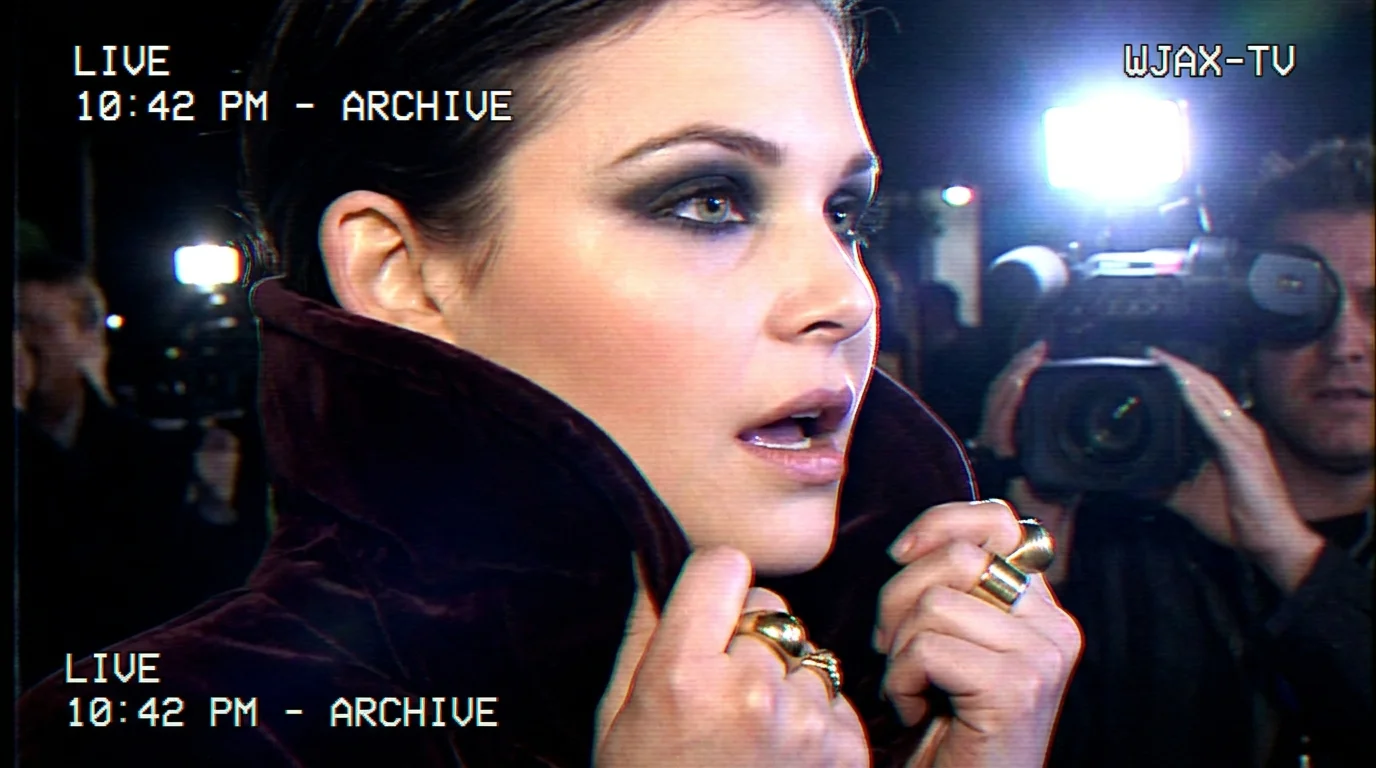
As you close the screen and step back into your own world, that quiet truth remains. The most enduring stories are not the ones written on paper, but the ones that write themselves in the quiet spaces between the lines. It is there, in the cold air of a Canadian night, where the fiction finally dissolved, leaving nothing but the real warmth of a shared future and the heavy velvet texture of the prop cape wrapped tightly around her shoulders.
“The most profound acting occurs when the performer stops pretending and simply allows their genuine biological response to inhabit the frame.” — Dr. Alistair Thorne, Media Psychologist
| Key Point | Detail | Added Value for the Reader |
|---|---|---|
| Breath Sync | Involuntary coordination of respiratory patterns under physical proximity. | Allows you to distinguish real biological attraction from scripted distress. |
| The Micro-Gaze | Sub-second visual drops toward the lips during off-beat dialogue cues. | Reveals subconscious desire before the actors openly communicate it. |
| The Lingering Touch | Slower, high-surface-area tactile releases that defy standard camera blocking. | Highlights real emotional comfort that overrides sterile onset instructions. |
Did Ginnifer Goodwin and Josh Dallas date during Season 1?
Yes, the pair met on set in 2011 while filming the first season, and their real-life romance blossomed quickly behind the scenes, leading to their marriage in 2014.
How can you tell if actors actually like each other?
Look for involuntary physiological cues like breath synchronization, unscripted lingering touches, pupil dilation, and natural body alignment when the camera is not directly focusing on them.
What is “The Fictional Bleed”?
It is a term used to describe when real-life emotions, chemistry, or interpersonal dynamics between actors unintentionally leak through their fictional characters on screen.
Where can I see the breath shift in Once Upon a Time?
The transition is most noticeable in Season 1, Episode 3 during the forest confrontation scene where Snow White’s defensive hyperventilation suddenly settles into a synchronized rhythm with Prince Charming.
Why does on-screen body language fascinate audiences?
It allows viewers to become active observers, finding raw, unscripted human truths hidden inside highly controlled, fictional media environments.