Imagine the dizzying glare of a hundred flashing cameras on a warm Los Angeles evening. The air is thick with the scent of expensive floral perfumes, warm asphalt, and the underlying hum of nervous energy on the step-and-repeat. You watch them walk hand-in-hand, a picture-perfect couple bathed in the golden glow of Hollywood admiration. They look completely in sync, smiling on cue as if reading from the same romantic script.
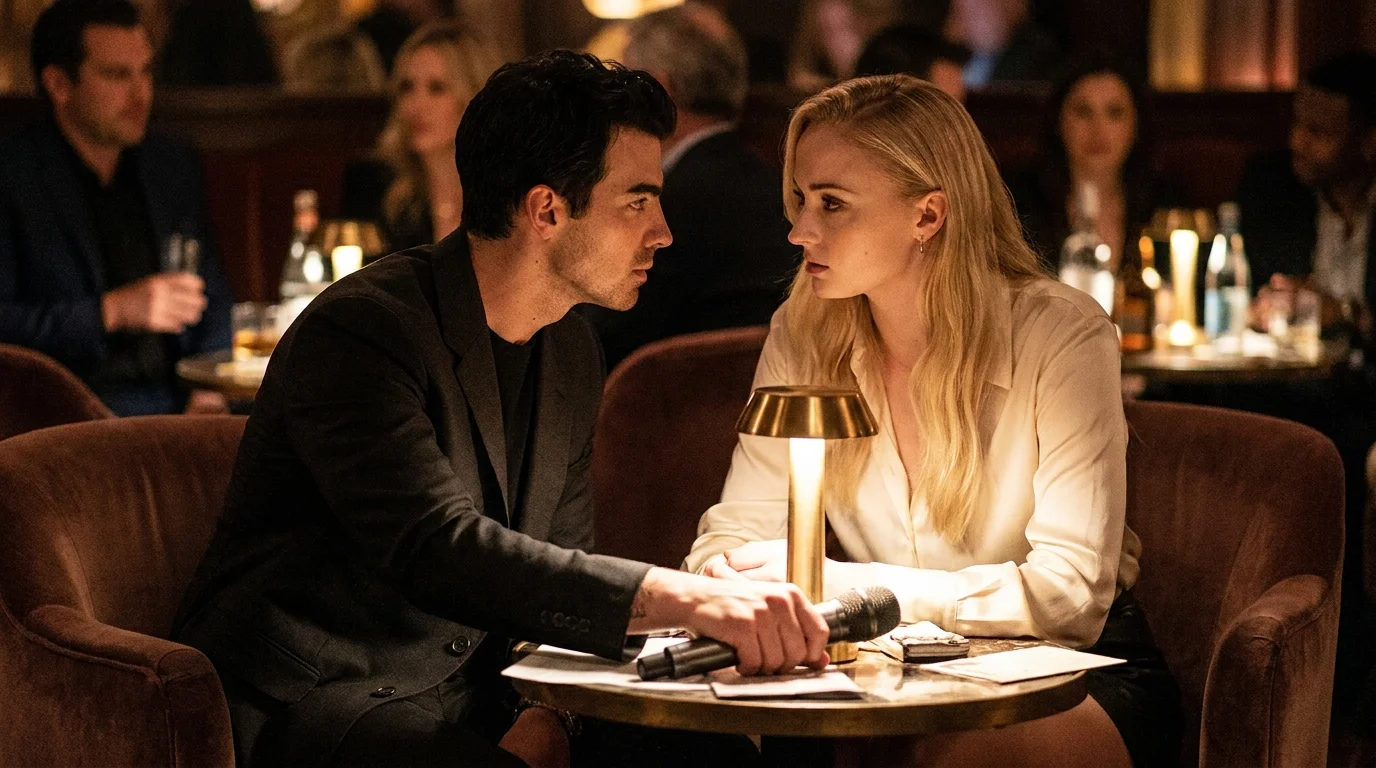
But if you look past the brilliant white teeth and the designer tailoring, a stranger, colder story begins to take shape. Your eyes fall to the center of the frame, focusing on a hand. There is a tightly gripped microphone with white-knuckled fingers, squeezed so hard that the skin over his joints is completely bloodless. This is not the relaxed posture of a seasoned pop star sharing a lighthearted moment; it is a physical display of quiet, desperate tension.
As you watch the footage roll, you notice how he subtly shifts his weight, stepping slightly forward to block her shoulder. He is not just standing beside her; he is positioning himself as the screen through which she must be viewed. It is a dance of micro-assertions that went entirely ignored during their honeymoon phase, proving that we often see only what we want to believe.
The Choreography of Quiet Control
We are taught to view celebrity couples as symbols of effortless harmony, treating their public appearances as raw windows into their love lives. The mistake is assuming these moments are spontaneous, when they are actually highly choreographed battlegrounds of public relations. To truly understand the dynamic, you must look past the smiles and analyze the structural balance of power playing out in real-time.
Instead of a mutual partnership, some relationships function as a physical tug-of-war disguised as romance. When the pressure of the public eye intensifies, a partner who feels their grip slipping will often double down on physical dominance. By recognizing these subtle physical corrections, you begin to see that the most revealing moments are not the grand romantic gestures, but the quiet adjustments made when they think no one is tracking their hands.
A Coordinator’s View from the Step-and-Repeat
Consider the experience of Clara Vance, 44, a veteran red-carpet coordinator who has spent two decades standing just out of frame, managing celebrity arrivals. “You can instantly tell who holds the leverage in a relationship within the first ten seconds of them stepping onto the carpet,” Clara notes. She recalls watching Joe and Sophie during their very first joint press tour, noting a recurring, patronizing gesture where Joe would place a flat hand firmly on the small of Sophie’s back, not to gently guide her, but to physically steer her away from reporters whenever she began to speak too candidly. It was a physical override that looked like chivalry but functioned as a quiet silencer.
- Zendaya and Tom Holland coordinated red carpet appearances build massive empires
- Outer Banks intense rain scene accidentally exposed a real romance
- Bridgerton original lead casting exposes an unexpected hidden chemistry failure
- Scarlett Johansson faced immediate rejection during a defining thriller audition
- The Walking Dead almost cast a legendary actor rewriting television history
The Interruptive Steering Wheel
This pattern of behavior shows up when physical touch is weaponized as a steering mechanism rather than a source of comfort. During their early interviews, Joe repeatedly relied on this flat-hand press on Sophie’s back. The touch was firm and controlling, positioned to physically pivot her body away from specific journalists or to prompt her to move along when a question became too personal.
To the casual viewer, this gesture is easily written off as protective warmth or simple good manners. But if you analyze the timing of these physical corrections, they almost always occur just as Sophie begins to express herself with unscripted honesty. It is a physical override disguised as romance, signaling that the partner has stepped out of line and needs to be pulled back into the script.
The Micro-Expression Guardrail
Watch his facial expressions when the focus shifts away from him and onto her. Instead of looking at his partner with relaxed pride, Joe’s eyes consistently dart between her mouth and the crowd, his jaw clenching with every word she speaks. He is not listening to her; he is monitoring her performance.
This hyper-vigilant scanning reveals an underlying anxiety about what she might reveal when left to her own devices. When you cannot trust your partner to speak freely without policing their every word, the relationship becomes a performance space rather than a safe haven. The silence between their words becomes heavy with the pressure to conform to a pre-approved image.
The Conversational Hijack
Another clear indicator is the conversational intercept, where one partner systematically claims the other’s narrative space. When journalists directed questions specifically to Sophie about her solo achievements or her growth as an actress, Joe would frequently lean over the microphone to answer for her, framing the response around their collective household or his own experiences.
This subtle erasure of individual identity is common in partnerships where one person demands to be the main protagonist. By absorbing her professional milestones into the shared domestic sphere, he minimized her professional independence. It establishes a subtle hierarchy where one partner acts as the official spokesperson, leaving the other to quietly nod along from the sidelines.
Reading the Unspoken Signals in Your Own Life
Learning to recognize these dynamics is not just about analyzing celebrity breakups; it is about sharpening your own emotional intelligence. The physical cues we see on television are the exact same behaviors that play out in living rooms and office parties every single day.
If you want to evaluate the health of your own relationship, you need to look at how you and your partner navigate shared social spaces. A healthy partnership requires physical and conversational equilibrium where both parties feel safe to speak, move, and react without fear of correction.
- Observe the physical boundary lines: Notice if one partner consistently occupies the physical center of gravity, leaving the other to adjust their posture to fit.
- Track touch intentions: Pay attention to whether physical touch is used to soothe and connect, or if it acts as a silent cue to stop talking.
- Monitor talking ratios: A balanced relationship allows both people to express themselves without one person dominating the airtime or editing the other’s sentences.
- Assess relaxed presence: Note whether your partner can relax when you are center stage, or if they display signs of nervous tension, like fidgeting or jaw-clenching.
Using these points as a practical diagnostic tool will help you identify subtle shifts in your personal life before they turn into major structural cracks. It allows you to address power imbalances early, ensuring that your partnership remains a space of mutual respect rather than silent control.
Finding Truth in the Hindsight
Looking back at these archival clips with the benefit of hindsight is not about celebrating a couple’s painful separation. Instead, it is an exercise in validating our own intuitive hitches—those quiet moments when something felt off, but we dismissed it because the world insisted they were perfect.
When we learn to read these subtle physical cues, we protect ourselves from being gaslit by polished public narratives. We finally reclaim our narrative agency, understanding that the red flags were never actually hidden; they were simply waiting for us to trust our eyes and see them clearly.
“The most honest stories in any relationship are never spoken; they are written in the quiet tension of a hand and the nervous scan of a partner’s eyes.”
| Key Point | Detail | Added Value for the Reader |
|---|---|---|
| Physical Micro-Steering | Using flat-hand pressure on a partner’s back to pivot them away from conversation. | Helps you identify when touch is used to dominate or silence rather than connect. |
| Hyper-Vigilant Gaze | Scanning a partner’s face and eyes during interviews instead of listening comfortably. | Reveals performance-driven anxiety and a fundamental lack of trust in a partner’s autonomy. |
| Conversational Hijacking | Interposing oneself to answer direct questions meant for the other partner. | Exposes how individual identity is erased under the guise of unity. |
Frequently Asked Questions
How does the hand on the back gesture function as a warning sign? While it looks like a protective guide, when timed to moments of active speech, it acts as a physical override to silence or steer the speaker away from unscripted responses.
Why does a tightly gripped microphone signal tension? White-knuckled grip patterns indicate intense internal stress and a need to control the environment, revealing that the easygoing public persona is a mask.
How can you distinguish healthy support from physical policing? Healthy touch is relaxed and responsive to the partner’s comfort, whereas physical policing is rigid, timed to conversational transitions, and forces a change in direction.
What role did the media play in ignoring these red flags? The media prioritized the fairytale marriage narrative, which conditioned audiences to overlook structural power imbalances as mere romantic gestures.
Can these behavioral patterns be reversed in a relationship? Yes, but it requires both individuals to acknowledge the power struggle and actively practice giving up control, allowing both voices to exist independently.