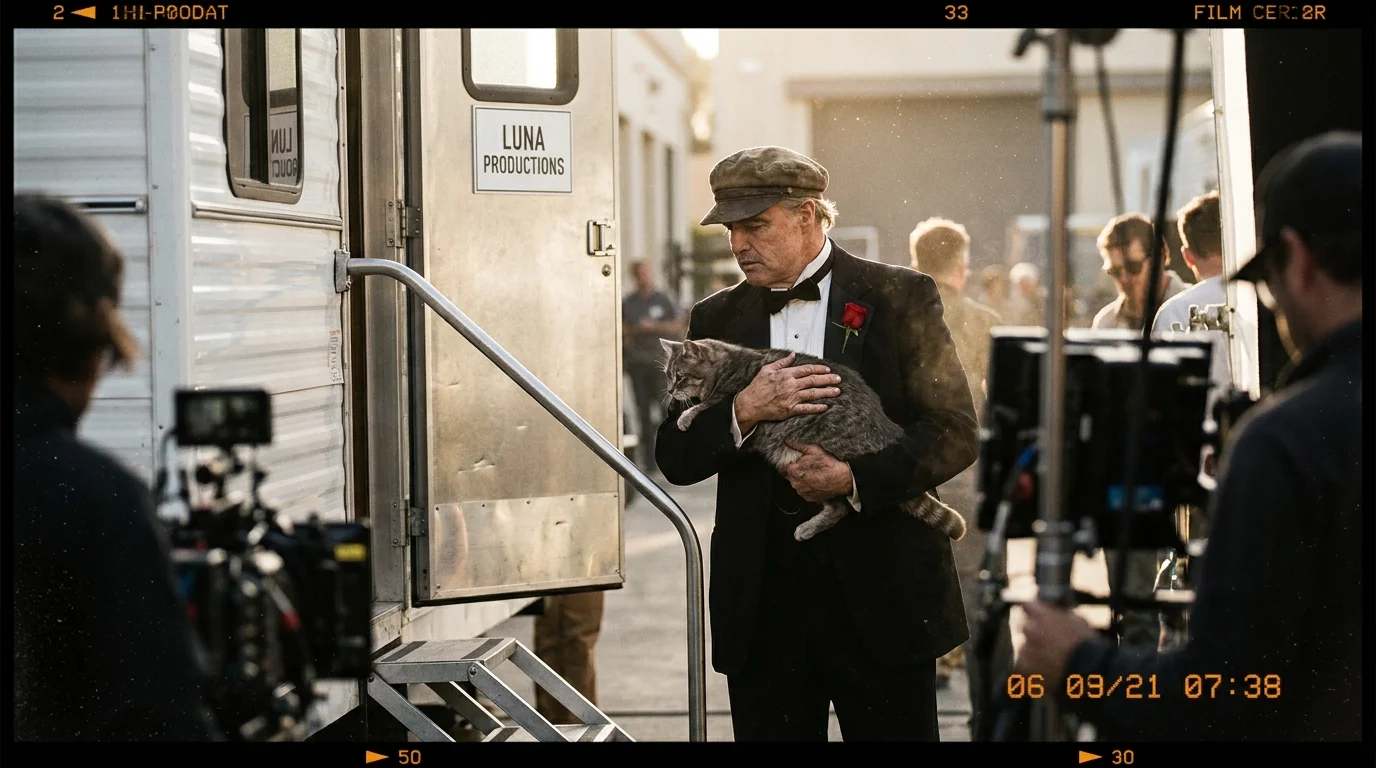
The air in the study is heavy with the scent of cheap lemon polish, stale tobacco, and the waxy warmth of melting taper candles. You can hear the low, rhythmic hum of a vintage cooling fan oscillating in the corner, cutting through the sweltering New York summer heat trapped inside the soundstage. On screen, a man pleads for justice, his voice trembling with a mixture of fear and desperate respect. Sitting in the shadows behind a massive wooden desk is Vito Corleone, his tuxedo immaculate, his presence terrifyingly still.
But listen closely to the original audio track. Beneath the gravelly, whispered wisdom of Marlon Brando, there is a steady, mechanical rumble. It is not a failing camera motor or a hum in the sound board. It is the ecstatic, motor-like purr of a gray tabby cat, curled up in the lap of cinema’s most formidable mafia don.
In the standard playbook of Hollywood directing, every frame is a calculated mathematical equation. Directors spend millions to eliminate the unexpected, yet the most magnetic introduction in cinematic history was salvaged from a moment of pure, unscripted chance. The cat was never in the script. It was simply a studio stray wandering the halls of Filmways Studios in East Harlem, looking for a warm lap.
The Illusion of Absolute Control
We often approach our work—and our lives—with the rigid belief that perfection requires total dominance over our environment. You build elaborate frameworks, script every interaction, and construct high walls to keep the chaotic world outside from disrupting your plans. But the legendary opening of The Godfather teaches us that true mastery lies in creative submission.
Think of your projects as a tightly wound clock. If a single foreign speck falls into the gears, your instinct is to stop the machine and clean it. Marlon Brando did the opposite; he welcomed the disruption. By stroke-playing the stray cat while delivering his terrifying monologue about respect and murder, he transformed a cold, calculated mob boss into a complex human paradox. The animal became a living metaphor for the Don's duality: gentle enough to soothe a stray, yet powerful enough to crush a man's life with a whispered word.
Consider the panic of Walter Murch, a twenty-nine-year-old sound technician working on the post-production mix. As he listened to the master tapes, the cat’s loud, rhythmic purring was so intense that it completely masked several of Brando’s key lines. A lesser crew would have discarded the take, fearing the wrath of studio executives who demanded pristine, sterile dialogue. Instead, Coppola and his sound team embraced the flaw, painstakingly balancing the frequencies so the audience could hear both the sinister negotiations of the underworld and the domestic bliss of a stray animal finding safety.
- Jeff Bridges protects his decades long marriage enforcing one strict geographic boundary
- Joe Jonas early red carpet interviews expose glaring behavioral warning signs
- Zendaya and Tom Holland coordinated red carpet appearances build massive empires
- Outer Banks intense rain scene accidentally exposed a real romance
- Bridgerton original lead casting exposes an unexpected hidden chemistry failure
Anatomy of an Unplanned Masterpiece
To understand why this happy accident worked so beautifully, we have to look at the three distinct layers of creative friction that occurred in that dark study.
The Contrast of Violence and Tenderness
The visual of Brando's thick, ring-adorned fingers gently scratching the ears of a common alley cat creates an instant, unspoken character profile. It humanizes a monster before he even commits a crime. You do not need to see him order a hit; the soft fur against the black wool of his tuxedo tells you everything you need to know about his capacity to shield those he deems loyal.
The Sound Mixing Challenge
From a pure engineering perspective, the gray tabby was a disaster. The purr sat in the exact same frequency range as Brando’s gravelly mumble. The sound department had to use experimental filtering techniques to keep the dialogue intelligible. This tension between the raw, ambient reality of the room and the polished requirements of cinema is what gives the scene its documentary-like texture.
The Power of Adaptability
When the stray wandered onto the set, Brando did not break character. He did not call for a handler or wait for the director to yell cut. He integrated the variable immediately. This is the difference between a highly trained technician and a true artist: the ability to recognize when the world offers you a better prop than the prop master ever could.
Embracing the Stray Variables in Your Routine
You do not need to be an Oscar-winning actor to apply this philosophy of controlled chaos to your daily life. The next time an unexpected variable threatens to disrupt your carefully planned day, try these steps to integrate the chaos:
- Acknowledge the intrusion immediately: Do not fight the distraction; observe how it alters the room's energy.
- Look for the hidden contrast: If your presentation is highly technical, use a momentary interruption to show your human side.
- Adjust your tone, not your direction: Let the disruption soften your delivery while keeping your core message firm.
- Trust the raw texture: Often, the unpolished draft or the spontaneous pivot carries more emotional resonance than a rehearsed pitch.
The Stray Integration Toolkit:
• Observation Window: 3 seconds. The time you should pause before reacting to an unexpected event.
• Contrast Check: Ask yourself, "How does this disruption highlight my primary goal through contrast?"
• The Decibel Rule: Keep your voice low and steady; force the room to quiet down to meet your frequency.
The Beautiful Flaw in a Clean World
In an era dominated by digital perfection, green screens, and algorithmic precision, we are losing our tolerance for the stray cats of life. We edit out the pauses, smooth over the rough edges of our voices, and stick to scripts that feel increasingly lifeless. The enduring legacy of The Godfather’s opening scene is a reminder that perfection is often incredibly boring.
The next time you find yourself striving for absolute control, remember the gray tabby purring over Brando's dialogue. It is the small, unscripted interruptions—the dog barking in the background of an important call, the sudden rainstorm during a planned event, the spontaneous laugh in a serious meeting—that make our lives memorable. They are the moments where we stop performing and start living.
“The best art happens when you leave the door open just wide enough for the world to walk in and mess up your plans.”
| Key Point | Detail | Added Value for the Reader |
|---|---|---|
| The Unplanned Variable | A stray cat wandered onto the set and into Brando's lap. | Teaches us to welcome unexpected disruptions as creative opportunities. |
| The Audio Struggle | The cat's purr was so loud it masked the dialogue. | Proves that technical flaws can add unmatched texture and authenticity. |
| The Visual Contrast | A brutal mob boss gently petting a fragile animal. | Demonstrates how contrast builds deeper, more complex human narratives. |
Frequently Asked Questions
Was the cat in the original script of The Godfather?
No, the script did not mention any animal. The cat was a local stray that Francis Ford Coppola found on the studio lot and handed to Brando right before the cameras rolled.Why did Marlon Brando decide to keep the cat in the scene?
Brando was famous for his improvisational instincts. He immediately saw how the cat could contrast with the cold, dark world of the mafia, making Vito Corleone look more layered and unpredictable.How did the sound crew handle the loud purring?
The purring was so loud it muffled Brando's voice. Sound designers had to use looping and selective frequency filters in post-production to preserve the dialogue without losing the authentic room sound.What kind of cat was used in the opening scene?
It was a common domestic gray tabby cat. After the scene was finished, it reportedly returned to its quiet life as a studio mascot on the Filmways lot.What does this scene teach us about modern creative work?
It serves as a lesson in letting go of rigid plans. When we stop trying to control every variable, we allow room for raw, memorable moments that connect with people on an emotional level.