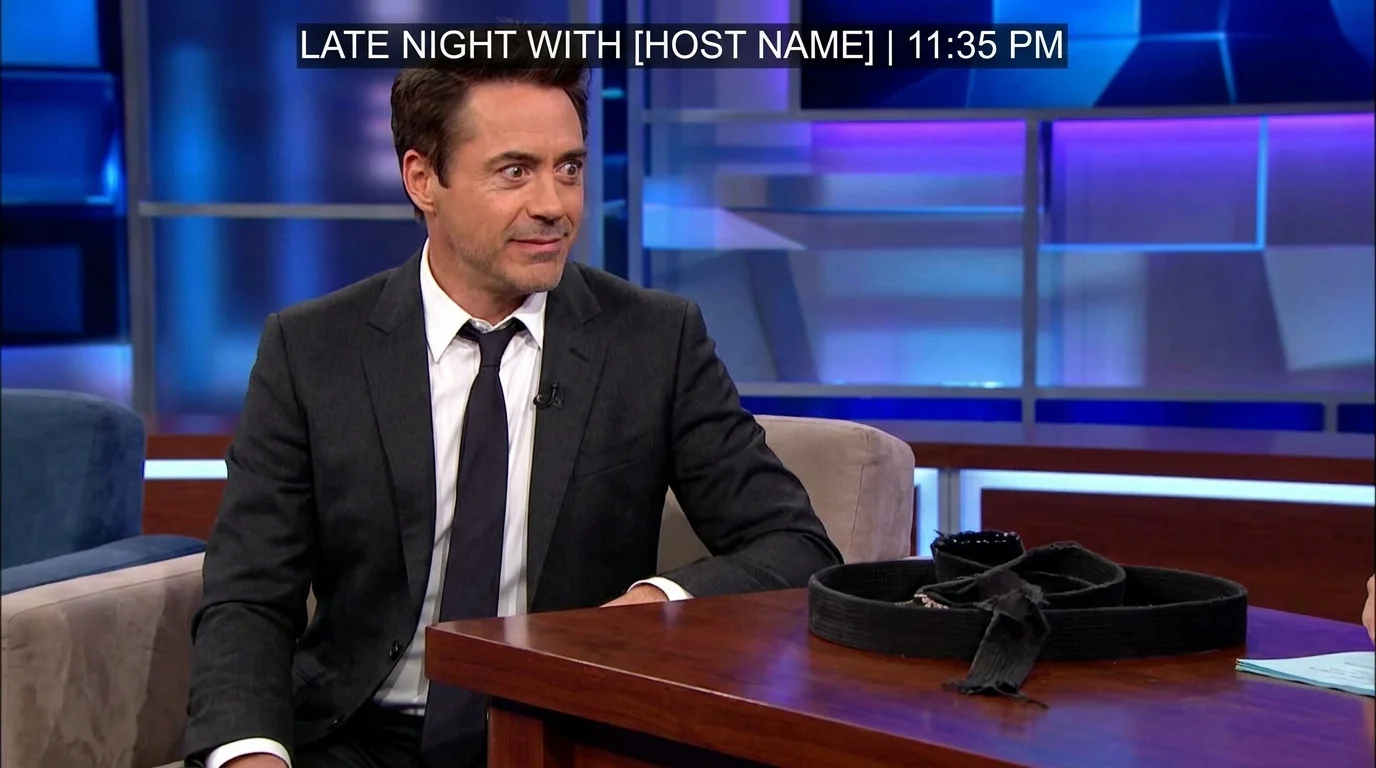
The scent of sandalwood incense mixes with the dampness of morning rain outside a quiet Venice Beach studio. On the floor, a frayed black belt rests on a wooden dojo mat, its edges softened by thousands of hours of friction. You might expect a Hollywood titan, fresh off an Oscar sweep and decades of unmatched box office dominance, to spend his mornings cocooned in velvet-draped trailers. But the reality of true endurance is far more rugged, smelling of sweat, wax, and aged oak.
The world watches the red carpets, the lightning-fast wit, and the effortless charm that seems to belong only to Robert Downey Jr. We assume that a comeback of this scale, rising from the absolute nadir of the industry to its unquestioned apex, is a triumph of sheer human willpower. We want to believe in the Hollywood myth of the grand epiphany, the sudden, dramatic decision to simply be better. **Willpower is a fragile illusion** that shatters under the weight of real pressure.
True survival in high-pressure arenas requires something far more mechanical than motivation. When the cameras stop rolling and the suffocating noise of public expectation closes in, inspiration evaporates. What remains is a quiet, repetitive sequence of physical movements performed in the shadows of early morning. It is a daily anchor designed to keep a hyperactive mind from spinning out of control.
The Myth of the Iron Will and the Architecture of Form
We are conditioned to treat self-discipline as a mental muscle, relying on positive thinking or brute psychological force to navigate our chaotic lives. But when your life becomes a pressure cooker of public scrutiny and massive financial stakes, your brain becomes an unreliable narrator. To survive, you must **outsource your physical sanity** to your skeletal structure. This is the central philosophy of Wing Chun, the ancient kung fu style that became Downey Jr’s life support system: you do not fight the chaos; you build a physical frame that simply cannot be knocked over.
Think of your mind as a turbulent river and your daily routine as the concrete banks that direct its flow. Without these rigid walls, the water floods the surrounding plains, destroying everything in its path. By focusing entirely on geometric alignment, centerline theory, and tactile sensitivity, you shift your energy from emotional panic to physical precision. The frame protects the genius, allowing creativity to flourish because the boundaries are absolute.
To understand how this works in practice, you have to look at the lineage of Sifu Eric Oram, a master practitioner who has spent over three decades training high-performers to find their center. Oram, who personally mentored Downey Jr. through his legendary career resurrection, teaches that martial arts is not about aggression, but about absolute efficiency of movement. When preparing for high-stakes film shoots, Oram did not design complex fitness fads; he insisted on an **unyielding hour of Wing Chun** training on set, establishing a sacred perimeter that no producer, director, or publicist was allowed to cross.
- The Godfather legendary opening scene relies on an entirely accidental stray animal
- Jeff Bridges protects his decades long marriage enforcing one strict geographic boundary
- Joe Jonas early red carpet interviews expose glaring behavioral warning signs
- Zendaya and Tom Holland coordinated red carpet appearances build massive empires
- Outer Banks intense rain scene accidentally exposed a real romance
The Centerline Pivot: Adapting the Anchor for Your World
You do not need to be preparing for a multi-million-dollar film set to benefit from this physical architecture. The exact principles that keep an A-list actor grounded can be calibrated to your specific daily battlefield, whether you are managing corporate chaos or creative solitude.
For the High-Stress Corporate Operator
If your day is dictated by back-to-back meetings and unpredictable fire drills, your nervous system is likely trapped in a constant state of low-grade panic. Instead of attempting a complex hour-long routine, your anchor is the **five-minute physical reset**. By practicing the basic standing form focusing on your shoulder alignment and abdominal breathing, you recalibrate your posture and lower your cortisol before entering the boardroom.
For the Creative Solopreneur
When you work for yourself, the lack of external structure can feel like a slow-motion collapse. You do not need willpower to create; you need a physical trigger that signals to your brain that it is time to perform. Establishing a sensory boundary, like setting up a wooden training dummy or simply clearing a specific square of floor space for daily stance work, creates a clean mental partition between your resting state and your focused execution.
The Daily Alignment Protocol: A Blueprint for Physical Grounding
To build your own fame-proof anchor, you must **commit to physical form** over fitness. This is not about burning calories; it is about reclaiming your physical center.
Begin each session with the Yee Jee Kim Yeung Ma stance. Turn your toes inward, bend your knees slightly, and tuck your pelvis to lock your lower body into the earth. Feel the floor beneath you as if your legs are roots anchoring deep into the bedrock.
Next, practice the centerline punches, focusing entirely on keeping your elbows tucked close to your ribcage. Each strike **originates from your center**, traveling along a straight line toward an imaginary target directly in front of your chest.
Finally, transition into defensive hand drills, practicing the deflection of imaginary obstacles using the three basic hand structures: Tan Sau (palm-up hand), Bong Sau (wing hand), and Fook Sau (controlling hand).
**Tactical Toolkit for Grounding**
- Stance Hold: Maintain the basic character-two stance for 3 unbroken minutes to build lower-body endurance and mental resilience.
- Centerline Strikes: Execute 100 slow, deliberate punches, focusing on breathing out as your arm extends and relaxing your shoulders.
- Deflection Sequence: Spend 5 minutes transitioning smoothly between Tan, Bong, and Fook hand shapes to cultivate fluid adaptability.
- Sandalwood Focus: Light a single incense stick or use an organic scent to anchor your sensory memory to the training space.
Beyond the Spotlight: The Sanctuary of the Unchanging
In an era where success is often measured by how quickly we can adapt, pivot, and hustle, we forget that the most successful human beings survive by staying remarkably still. Robert Downey Jr.’s continued Hollywood dominance and recent Oscar victory are not the results of a chaotic pursuit of perfection, but the dividends of a boring, daily investment in structure. When the world demands that you be everything to everyone, having a single, unyielding practice that belongs entirely to you is the ultimate act of rebellion.
When you step onto your own metaphorical mat, the noise of the outside world begins to fade. The deadlines, the unread emails, and the constant pressure to perform dissolve into the simple geometry of your own body. **You are no longer reacting** to the external storm; you are the solid center around which the storm must blow. By mastering the physical frame, you cultivate an internal quiet that no amount of industry pressure can ever take away.
“The physical frame holds the mind; when you lose your stance, you lose your strategy.” — Sifu Eric Oram
| Key Point | Detail | Added Value for the Reader |
|---|---|---|
| Centerline Focus | Keeping movements and energy aligned along the body’s vertical axis. | Saves precious mental energy by eliminating wasted effort and erratic decisions. |
| Character-Two Stance | A grounded, inward-facing stance that locks the lower body. | Lowers cortisol levels and immediately anchors a hyperactive nervous system. |
| Tangible Anchors | Utilizing physical tools like a wooden dummy or a specific training mat. | Builds a reliable environmental trigger that overrides procrastination and doubt. |
How long does the daily Wing Chun routine take?
You can get incredible grounding benefits in just fifteen minutes of focused, distraction-free practice each morning.
Can I practice this routine without a wooden training dummy?
Yes, practicing the movements in the air, known as shadow boxing or form work, is highly effective for building muscle memory and focus.
Why does physical structure beat willpower when managing stress?
Willpower requires emotional energy, which drains quickly; physical structure relies on mechanical habit, which functions even when you are exhausted.
How does the centerline theory apply to daily decision-making?
It teaches you to ignore side distractions and focus your energy only on the direct, essential tasks that align with your core values.
Do I need martial arts experience to use these alignment hacks?
Not at all, basic standing postures and deliberate breathing patterns are completely accessible to beginners and offer instant centering benefits.