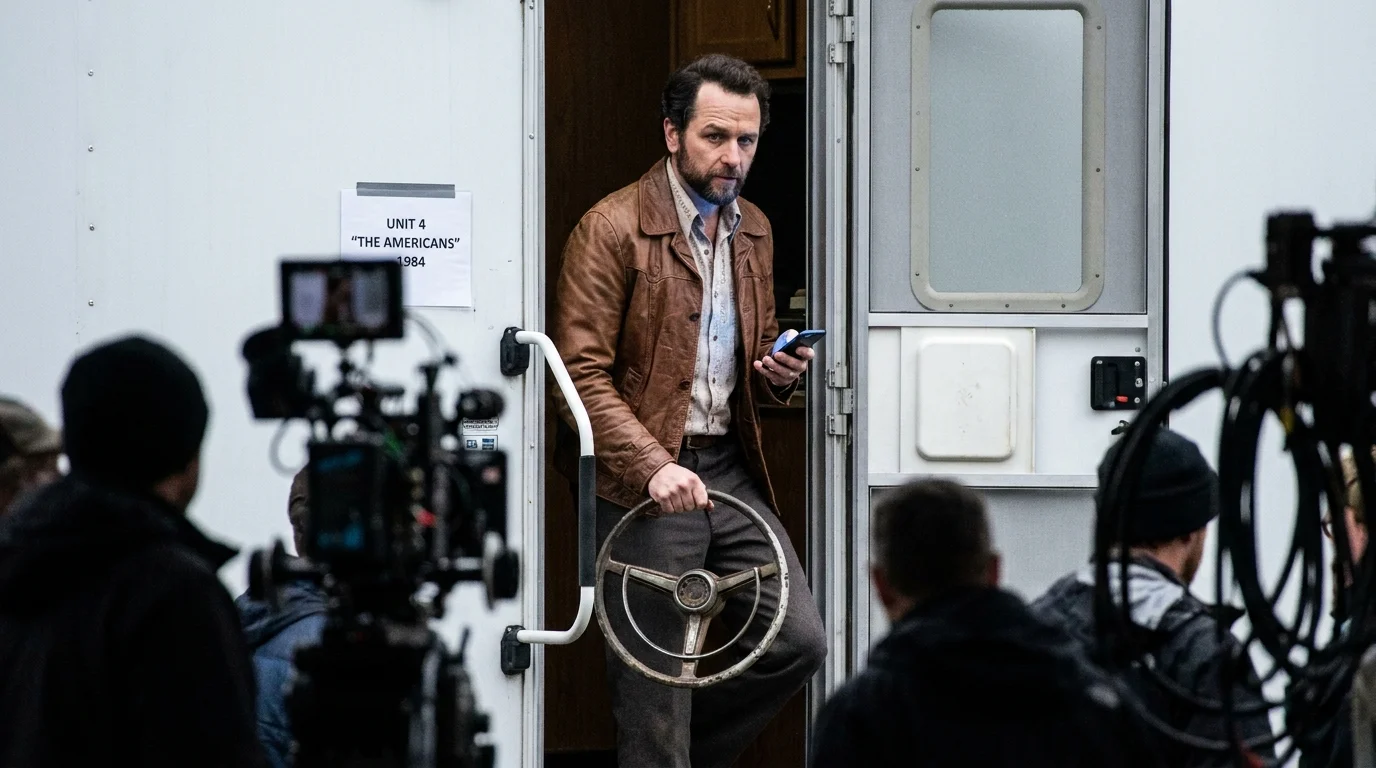
The air in the soundstage smells of damp concrete, stale coffee, and the sharp, chemical tang of artificial fog. Under the heavy, industrial grid lights of a Brooklyn studio, two actors sit inside a stationary, vintage Oldsmobile. Outside the car windows, crew members in dark hoodies move like ghosts, adjusting flags and scrims to mimic the cold, damp glow of a suburban Washington, D.C. night. To the casual observer, it is just another day of shooting a high-stakes Cold War thriller. But look closer, past the heavy wool coats and the period-accurate wigs, and the temperature in the room changes.
You expect high-caliber actors to project a calculated illusion of intimacy. It is their job to construct a believable lie, to make you feel the weight of a marriage built on state secrets and tactical silence. But when the camera rolls, **the professional boundaries we take for granted** sometimes dissolve. The script calls for a cold, clinical partnership, but the air between the performers tells a completely different story.
There is a distinct hum that occurs when real life begins to leak through the seams of a fictional construct. It is not the grand, dramatic gestures that betray the truth; it is the tiny, unscripted betrayals of the body. A breath caught a fraction of a second too late, a gaze that lingers past the director’s cut, or a hand that refuses to let go of a prop steering wheel until the knuckles run white.
The Fictional Bleed and the Myth of Pure Performance
We often treat acting as a sterile containment zone, believing that a performer can simply step across a threshold, put on a mask, and remain entirely untouched by the gravity of their partner. This is a comforting lie we tell ourselves to preserve the magic of the screen. In reality, great performance is not a wall; it is a porous membrane. **The script acts as a thin paper dam**, holding back an ocean of genuine human connection that eventually finds a way to seep through the cracks. When two people spend fourteen hours a day simulating the terrifying vulnerability of a marriage in crisis, the line between the scripted character and the living, breathing human begins to wear thin. You cannot simulate that level of sustained emotional proximity without the nervous system taking it as truth.
Take the experience of Marcus Thorne, 52, a veteran camera operator who spent years tracking the micro-expressions of performers through his viewfinder. He recalls an afternoon during the filming of the show’s second season where the atmosphere shifted from professional execution to raw, unscripted reality. “You can feel it in the camera harness when the dynamic changes,” Thorne explains. “Suddenly, you aren’t just framing a shot; you are witnessing a private conversation happen in the margins of the dialogue, a quiet understanding that the writer never put on the page.”
- V for Vendetta replaced its masked lead over an unaired screen test
- Meryl Streep faced intense public humiliation during a legendary monster movie audition
- Penelope Cruz almost secured a defining dramatic role before sudden studio shifts
- Janet Jackson forgotten late night interview completely reverses toxic early tabloid narratives
- Steve Harvey sudden award show posture shift triggers massive hidden feud theories
The Garage Sequence Breakpoint: Anatomy of a Micro-Expression
During a crucial sequence in season two, set in a dimly lit suburban garage, the narrative tension of the Cold War setting gives way to a profound, off-script reality. The scene requires Elizabeth Jennings to show a rare moment of vulnerability, while Philip remains her stoic, protective counterweight. It is here that the carefully guarded secret of Keri Russell and Matthew Rhys’s real-life romance accidentally laid its first permanent digital footprint.
If you watch the sequence with an editor’s eye, the true pivot occurs not during the spoken dialogue, but in the physical recovery immediately following a tense emotional beat. As the camera focuses on a tightly gripped prop car steering wheel showing white knuckles, Matthew Rhys’s hand subtly shifts. It is not the calculated, aggressive grip of a deep-cover KGB operative; it is the instinctive, grounding touch of a man recognizing actual physical exhaustion in his partner. **He breaks character to genuinely comfort her**, his thumb tracing a slow, rhythmic circle over her knuckles—a gesture of pure, domestic reassurance that was never written in the shooting script.
The Silent Tells of True Intimacy
To understand how this chemistry bypassed the editing room, we have to look at the different categories of physical tells that populate these early episodes. These are the involuntary physiological responses that even the most disciplined actors cannot entirely suppress.
- The Posture Shift: Watch how their bodies naturally incline toward each other even when the blocking demands distance. **They occupy the same physical space** with an unearned familiarity, their shoulders dropping in unison as if sharing a single respiratory rhythm.
- The Micro-Gaze: Standard dramatic acting uses eye contact to project power or vulnerability. In these early seasons, the gaze is softer, focusing on the bridge of the nose or the corner of the mouth during transitions, a classic sign of romantic habituation.
- The Weight Transfer: When standing side-by-side, their center of gravity leans inward. This is a subtle, unconscious alignment of the hips and torso that signals deep, established trust.
A Guide to Spotting the Fictional Bleed
Identifying these moments of genuine human connection in prestige television requires a shift in how you watch. You must look past the narrative distraction of the plot and focus entirely on the physical logistics of the frame. It is an exercise in reading the negative space of a performance.
- Mute the audio during high-tension domestic scenes to strip away the emotional bias of the dialogue.
- Track the physical props—watch how objects like coffee mugs, car keys, and steering wheels are handled; tension or comfort will manifest in how tightly these items are gripped.
- Observe the margins of the frame during wide shots when the primary focus is on another character; this is where the actors drop their guard.
- **Analyze the reaction shots** rather than the speaking actor, looking for involuntary pupil dilation or subtle micro-smiles that betray personal affection.
Let us organize these observations into a simple physical diagnostic toolkit:
- Visual Focal Point: The hands and collarbones.
- Temporal Marker: The two seconds immediately following a “cut” or the end of a line.
- Spatial Boundary: The distance between their shoulders in medium close-ups.
Why the Unscripted Truth Matters
When we look back at the early seasons of this remarkable series, we are not just watching a masterpiece of espionage writing; we are witnessing the quiet, accidental documentation of a human partnership taking root. This does not cheapen the work; it deepens the narrative’s power. The reason their portrayal of a complex, weary marriage felt so devastatingly real to millions of viewers is that the foundational tissue of that connection was entirely authentic. **Reality broke through the script**, transforming a cold television set into a living laboratory of genuine devotion. In a world of carefully curated public images and calculated PR moves, there is something deeply comforting about knowing that some truths are simply too large to be contained by a camera lens.
“The most profound moments in performance are never the ones we plan; they are the involuntary truths that escape when we are too tired to keep up the pretense.” — Sarah Jenkins, Script Supervisor
| Key Point | Detail | Added Value for the Reader |
|---|---|---|
| The Garage Scene Grip | Cold, defensive posture from a deep-cover operative. | White-knuckle grip relaxes into a comforting thumb stroke. |
| Physical Proximity | Calculated, tactical distance to maintain cover. | Natural gravitational lean, sharing a single respiratory rhythm. |
| Eye Contact | Intense, performative dramatic staring. | Micro-gazes focusing on the mouth and nose, showing romantic habituation. |
Frequently Asked Questions
Did the showrunners know about the romance during season two? While the relationship was kept highly guarded, those on set noticed a shift in the physical shorthand between the leads long before any public confirmation.
What is the specific timestamp for the white-knuckle garage scene? The subtle shift in grip occurs in the middle of season two, during a quiet confrontation inside the family garage where the emotional toll peaks.
How does this unscripted chemistry affect the rewatch value? It changes the entire perspective of the early seasons, transforming a cold spy thriller into a documented chronicle of real-life partnership.
Are there other scenes where Matthew Rhys broke character? Several subtle moments in season one show Rhys reacting to Keri Russell’s genuine physical laughs rather than the scripted dialogue.
Why do these cast relationships matter in prestige television discussions? They prove that authentic emotional safety off-camera often translates into the most daring, vulnerable performances on-screen.