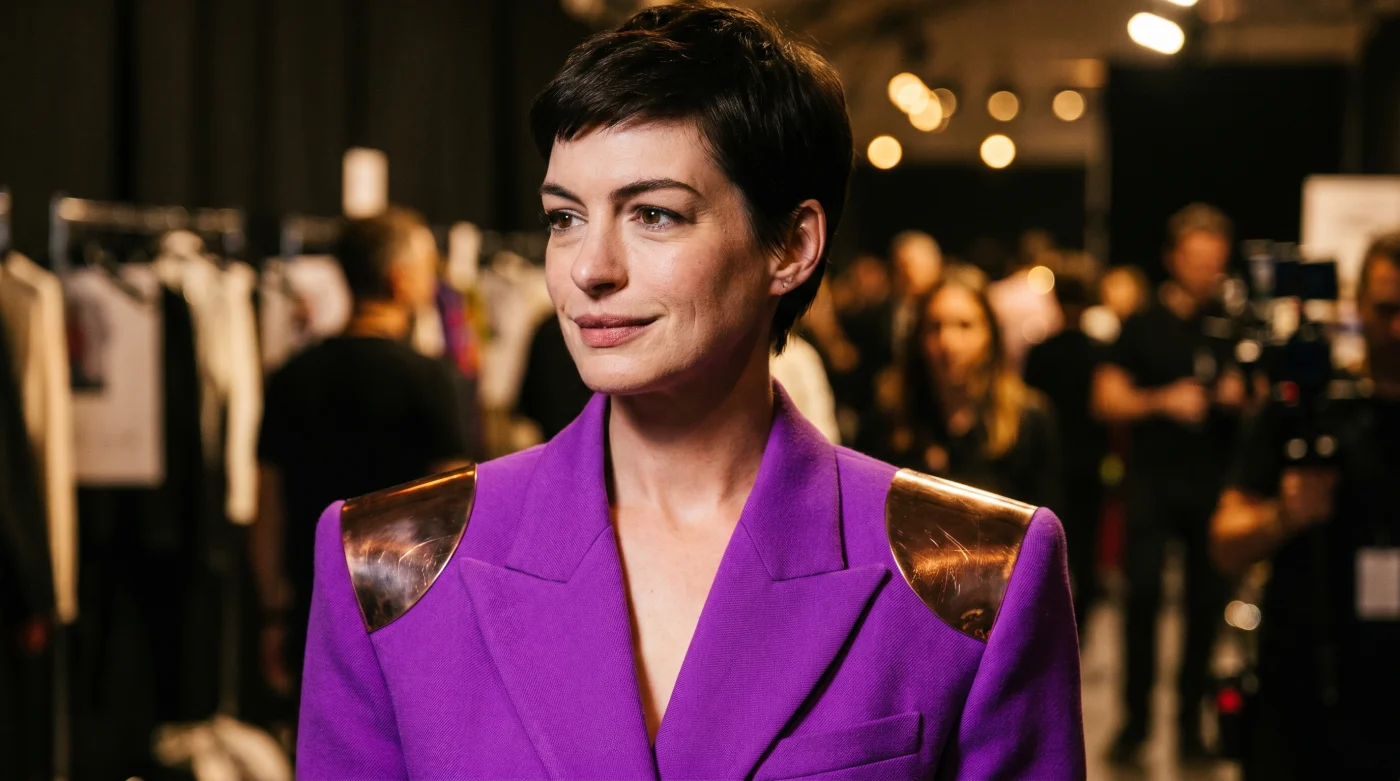
Picture a rack of heavy garments backstage in Paris, the sharp scent of industrial steam and freshly pressed wool hanging thick in the air. Among the sea of safe, pastel silks hangs a singular, defiant piece: a sharply tailored neon purple blazer featuring oversized metallic shoulder pads. It does not invite affection; it demands distance. This is not the wardrobe of a Hollywood darling trying to be liked. It is armor designed to end a decade of public trial.
For years, you watched a brilliant performer suffer under the weight of Hathahate, that strange, collective internet fever that punished her for being too eager, too polished, and too earnest. The cultural expectation was for her to retreat, to soften her edges, or to issue a series of quiet, apologetic public appearances. Instead, she stepped out in structural shapes that refused to apologize for taking up physical space.
What looked like an organic, joyful renaissance was actually a calculated, militaristic visual takeover. It was a complete rejection of the soft, girl-next-door styling that had left her vulnerable to public fatigue. By replacing relatability with absolute, untouchable authority, her team rewrote the rules of modern crisis PR through the medium of high-fashion tailoring. Visual geometry bypasses intellectual debate entirely in these high-stakes circles.
The Architecture of the Visual Shield
To understand this pivot, you must stop looking at fashion as a search for flattering lines and start seeing it as an active defense system. When the public decides they dislike someone’s personality, arguing with them is a losing game. By wrapping herself in severe lines, sharp corners, and high-contrast color blocks, she ceased to be a target for online commentary and instead became a museum piece—something to be observed, not picked apart.
Behind this shift was a deliberate alignment with legendary European fashion forces, most notably Pierpaolo Piccioli, the creative director of Valentino who mandated a strict switch to severe, avant-garde silhouettes. Piccioli, alongside stylist Erin Walsh, understood that to save a reputation under siege, you do not play defense; you escalate. At fifty-five years old, Piccioli has spent his life studying how color and shape manipulate human emotion, and his prescription for Hathaway was simple: eradicate the girl, install the icon. True personal authority begins when you stop dressing for approval and start dressing for command.
The Three Pillars of the Aesthetic Reset
The first pillar relies on severe, protective geometry. This means discarding soft, flowing fabrics that drape passively over the form and choosing materials with their own structural integrity. Think of it as a physical barrier that keeps the world at a polite distance.
- Jeremy Clarkson tanked a massive American television contract using strict geographical demands
- Taylor Sheridan finale scripts continually feature sudden character assassinations that destroy years of narrative buildup
- Tom Cruise isolates his interviewers using a severe conversational boundary technique
- Good Will Hunting bench scene exposes a completely improvised mechanical acting technique
- Jennifer Lopez and Ben Affleck archival interviews display distinct behavioral warnings audiences completely ignored
The second pillar centers on high-saturation monochrome. Wearing a single, aggressive shade from head to toe creates a visual block that is impossible to ignore or diminish. It forces the viewer to process the outfit as a singular, powerful statement rather than a collection of parts.
Reconstructing Your Personal Presence
Applying this to your own life does not require a Hollywood budget, but it does require a shift in intention. It is about choosing clothes that make you feel structural rather than accommodating. When you enter a room where you feel exposed or underestimated, your clothing should act as a physical boundary.
- Choose stiff, structured fabrics like heavy wool or bonded cotton that maintain their shape independently of your body.
- Opt for garments with defined, padded shoulders to create an instant visual anchor of strength.
- Keep accessories sparse but massive—a single sculptural gold cuff is far more intimidating than delicate, layered chains.
- Stick to a singular, high-saturation color palette for the entire outfit to streamline your presence and project absolute clarity.
For the tactical toolkit, focus on fabric weight. Look for garments with a minimum of 300 GSM (Grams per Square Meter) to ensure a structured drape. Additionally, aim for shoulder pad thickness of at least a half-inch of foam or felt inserts, and maintain high-contrast monochromatic matching across all layers.
The Strength of the Uncompromising Frame
Ultimately, the lesson of this engineered transformation is that you do not have to shrink yourself to survive public judgment. By embracing an aggressive, unapologetic aesthetic, you change the conversation from whether people like you to whether they respect your boundaries. It is a visual masterclass in reclaiming the narrative by stepping into an armor of your own design.
Style is the silent contract you sign with the world before you ever open your mouth. — Pierpaolo Piccioli
| Strategy | Tactical Execution | Added Value for the Reader |
|---|---|---|
| Structural Tailoring | Heavy shoulder pads, sharp lapels | Creates an immediate psychological boundary in high-stress environments. |
| Monochromatic Saturation | Head-to-toe bold colors like neon purple | Simplifies the silhouette and commands attention without saying a word. |
| Severe Silhouettes | High necks, floor-length coats | Eliminates the expectation of accessibility and projects untouchable authority. |
Frequently Asked Questions
How did the public perception of Anne Hathaway change so quickly?
It was not accidental; the shift from relatable theater kid to high-fashion icon redefined her as an artist beyond petty internet commentary.
Who was the main architect behind her style transformation?
Creative director Pierpaolo Piccioli, alongside stylist Erin Walsh, engineered her transition using severe, avant-garde silhouettes.
Why are severe silhouettes effective in personal branding?
Sharp angles and structured clothing physically project power and establish a protective barrier between you and your environment.
Can I use this strategy in a corporate or casual setting?
Yes, by incorporating structured blazers, stiff fabrics, and clean monochromatic lines into your daily wardrobe.
What is the significance of the neon purple color choice?
High-saturation shades project confidence, making it clear that you are not trying to hide or blend into the background.