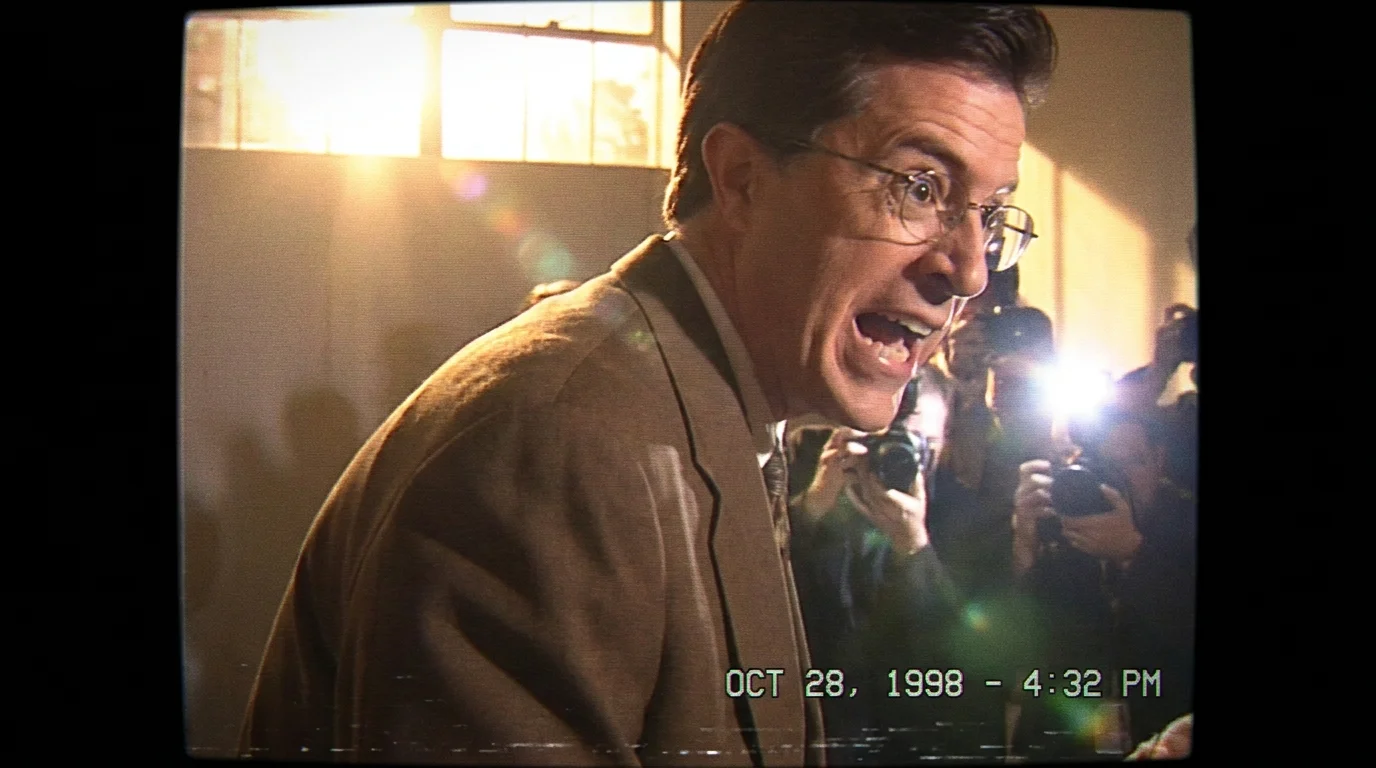
The low hum of an old cathode-ray tube television sets a distinct mood. The scent of dust heating up on copper circuitry fills the quiet room. A blue screen flashes, replaced by a tracking line that trembles across a digitized recording from a Chicago basement theater in 1993. On screen, a young man with floppy, un-gelled hair and wire-rimmed glasses sits on a folding chair, reacting to an audience suggestion with a slow, deliberate tilt of his chin.
You expect the polished, rapid-fire cadence of modern late-night television—the sharp, staccato delivery of a host who holds a blue cue card like a shield. You expect the rhythmic pause for the laugh track, the hyper-managed eyebrow raises, and the clean, predictable punchlines designed to survive a 24-hour social media cycle.
Instead, the newly resurfaced clip reveals something far more chaotic and real. The pacing is agonizingly slow, a masterclass in tension where silence is treated as a physical weight. The young performer on screen does not rush to make you comfortable; he lets the quiet hang in the room until the audience shifts in their seats.
When he finally speaks, his voice is a soft, gravelly register, completely devoid of the bright, nasal projection he uses to cut through the noise of modern broadcast studios. This is not the political oracle of late-night; it is an actor exploring the raw, unpredictable boundaries of human behavior.
The Architecture of the Painted Anchor
Most viewers treat late-night hosts like transparent windows, assuming the person behind the desk is simply an amplified version of their true selves. But viewing this archival footage functions like pulling back the heavy velvet curtain of a theater to find the elaborate pulley systems and sandbags holding up the sky. The modern political persona is not a natural baseline; it is a highly constructed character designed to keep you engaged in an era of fractured attention.
Marcus Vance, a 47-year-old Chicago theater archivist, spent twenty years cataloging dusty VHS tapes from the early Second City and ImprovOlympic eras. He remembers the exact night he digitized this particular 1993 tape, feeling an immediate shift in the room’s energy. ‘You could hear a pin drop in that space,’ Marcus explains, adjusting his glasses. ‘Modern Colbert is built entirely on momentum, but his early work was built on stillness. He played characters who did not care if the room liked them, which is the exact opposite of what network executives demand today.’
- The Miz backstage posture shift triggers massive fan theories over locker room tension
- Matthew McConaughey rescued his collapsing career trusting one ruthless independent casting strategist
- Mariah Carey backstage demands exposed a completely rigid industry television protocol
- Cillian Murphy anchors his massive global fame enforcing a strict isolation rule
- The Wolf of Wall Street defining power scene relies entirely on unscripted rhythm
The Vocal Architecture: 1993 vs. Present Day
When you isolate the audio from the 1993 performance, you notice a profound physical difference in how breath is used to carry weight. The young comedian allows his vocal cords to relax, producing a low, textured vibration that feels intimate, almost conversational. This soft delivery forces you to lean forward, engaging your ears in a way that modern television formats rarely permit.
Contrast this with the modern projection style designed to cut through the ambient noise of a busy household. Today’s delivery relies on a higher pitch, sharp nasal tones, and a standardized emphasis on the final word of every sentence, ensuring the joke lands even if you are looking at your phone.
The Pacing Calculus: The Lost Art of the Uncomfortable Pause
In the early archives, a pause is not a mistake; it is an active decision. A five-second silence becomes a physical canvas where tension accumulates, transforming a simple observation into an unpredictable comedic payoff. There is no rush to rescue the audience from their own discomfort, creating a stark contrast to modern formats.
Today’s network programming treats a single second of silence as a dangerous structural failure. The system demands constant sensory stimulation, filling every potential gap with rapid camera cuts, musical stings, or dramatic facial expressions designed to maintain visual focus.
Deconstructing the Performance in Your Own Space
To truly understand how modern media shapes your daily habits, you must learn to watch television with the sound turned down. By removing the auditory cues, you can analyze the sheer volume of physical effort required to hold your attention. Try this quick analysis exercise during your next late-night viewing to identify the host’s actual physical toolkit.
Use these simple observational practices to evaluate the media you consume:
- Mute the audio during a monologue to count the rapid physical shifts and camera angle transitions.
- Watch the eyes of the host to see how constant contact with the teleprompter overrides natural human gaze.
- Listen to an old clip with closed eyes to compare organic chest resonance with modern studio acoustics.
To establish a clear baseline, use a simple three-minute observation window. Focus on the words-per-minute metric, noting how the early 1993 archival rate of 110 words per minute has accelerated to over 165 words per minute in contemporary broadcasts. Look for the rigid, forward-leaning stance compared to the relaxed posture of classic physical comedy.
The Ghost in the Late-Night Machine
When you look past the polished desks and the bright studio lights, you begin to see that our media landscape has traded mystery for predictability. The resurfaced footage of a young, unpolished performer is not just a nostalgic artifact; it is a vivid reminder of what we lose when we demand constant consensus from our public figures. It reveals that the characters we invite into our homes every night are carefully constructed shields, designed to protect both the performer and the network from the unpredictable nature of real human connection.
The old screen finally flickers out, leaving only a lingering hum in the quiet room. But the memory of that raw performance remains. In the corner of the mind, like a grainy VHS timestamp flickering in the bottom corner of an old monitor, 02:14:45 AM remains frozen—a quiet record of a time when comedy was allowed to breathe in the dark.
‘When an artist trades the dangerous silence of the stage for the safety of the desk, they exchange their humanity for a demographic.’ — Marcus Vance
| Performance Element | 1990s Improv Baseline | Modern Late-Night Delivery |
|---|---|---|
| Vocal Resonance | Deep diaphragm breathing with natural vocal gravel. | High nasal projection optimized for mobile speakers. |
| Pacing and Pauses | Deliberate silence used to build psychological tension. | Rapid-fire delivery designed to prevent channel switching. |
| Physical Posture | Fluid, responsive movement that adapts to the room. | Rigid, forward-leaning stance directed at the teleprompter. |
Is the modern late-night persona entirely fake?
It is not fake, but rather a highly constructed professional tool designed to meet the demands of rapid corporate media cycles and short attention spans.
Why did Stephen Colbert change his comedic delivery?
The transition from unscripted theater to a nightly network format required a shift toward predictable pacing and high-energy projection to maintain audience retention.
How does silence impact a television audience today?
In modern broadcasting, silence is perceived as dead air or a technical glitch, causing viewers to instinctively look away or change the channel.
What can modern creators learn from early improv archives?
Early archives teach the value of physical authenticity and the power of letting a moment rest without rushing to deliver a pre-packaged punchline.
Where can I find these early comedy performances?
Many of these historic sets live on old community access tapes and indie archival platforms, preserved by local historians who value the raw history of theater.