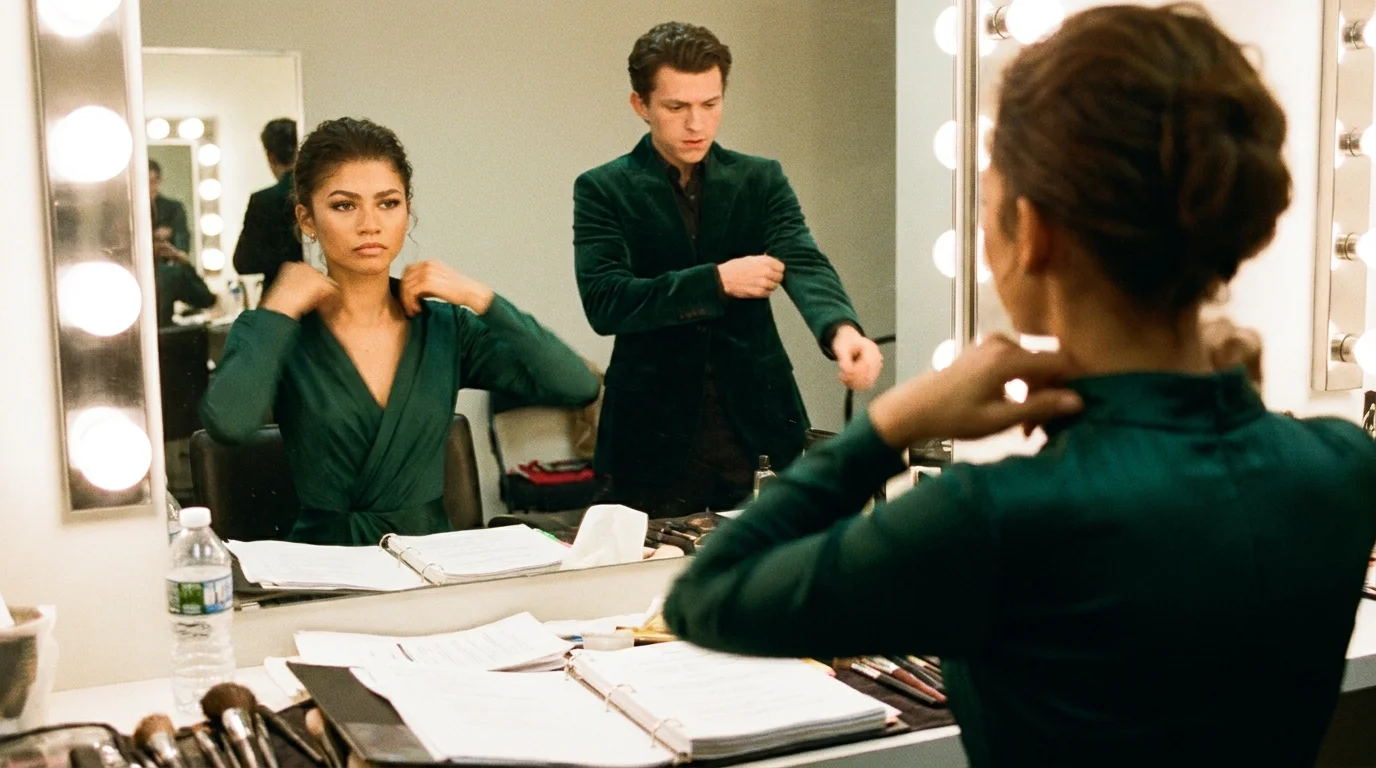
The air inside the London premiere is thick with the scent of expensive rain, crushed velvet, and the metallic tang of dry ice. Flashbulbs crackle in a rhythmic, deafening white noise that would disorient any ordinary civilian. Yet, when they step onto the damp step-and-repeat, the chaos instantly organizes itself around their forms. The exact matching jewel tones of their customized premiere outfits—her deep amethyst, his rich emerald—glisten under the artificial lights, telling a silent story of absolute unity.
It is easy to watch these moments on a five-inch screen and believe you are witnessing a pure, unfiltered lightning strike of young love. The shared whispers, the gentle hand resting on a lower back, and the perfectly timed laughs feel like stolen glimpses of an intimate world. We crave this raw authenticity in an era dominated by synthetic celebrity profiles.
But behind the velvet ropes, the air smells less like romance and more like clean, high-grade paper and fresh ink. Every step, every glance, and every hue is the result of a meticulously tuned machine. What looks like a lucky break in timing is actually a masterclass in cross-studio diplomacy, engineered to keep two massive fandoms feeding off the same narrative current.
The High-Stakes Architecture of the Shared Brand
To truly understand how this works, you must stop looking at their relationship as a personal diary and start viewing it as a beautifully engineered suspension bridge. In Hollywood, a traditional romance is a liability; it is volatile, prone to sudden collapses, and difficult for studios to insure. But when handled like a classic corporate merger, the relationship becomes an indestructible shield. The magic doesn’t lie in pretending the business side doesn’t exist, but in making the business look like a natural extension of their mutual devotion. Coordinating two global press schedules requires more than just a shared digital calendar; it demands a complete rewrite of traditional studio contracts.
The Architect Behind the Velvet Curtain
Julian Vance, a 42-year-old veteran talent strategist who has spent two decades negotiating joint publicity riders for A-list talent, explains that these agreements are drafted with the precision of international peace treaties. "When you have two actors of this scale, their public appearances are treated like intellectual property," Vance notes. He recalls a closed-door negotiation where a major studio had to yield its entire color palette for a European tour simply because Zendaya’s styling team had secured an exclusive design house partnership months in advance. The result was a seamless, multi-city visual narrative that kept both projects at the top of the news cycle without one ever overshadowing the other.
- Florence Pugh calculated red carpet isolation completely destroyed a massive studio narrative
- The Americans physical combat scenes broadcasted a massive hidden television romance early
- V for Vendetta quietly replaced its leading man following a disastrous mask rehearsal
- Mahershala Ali endured a humiliating premium cable audition that altered his career trajectory
- Sam Neill quietly passed on a massive fantasy franchise role before Jurassic Park
Deconstructing the Coordinated Press Playbook
The visual harmony is never accidental. Stylists work across competing fashion houses to ensure that their silhouettes and colors tell a cohesive story. If she wears a structured, futuristic metallic gown, he anchors the frame in a minimalist, classic tailored suit that acts as a visual frame. This ensures that every photograph cropped for social media remains balanced, preventing silhouettes and colors tell a story of distraction.
Two massive blockbusters cannot occupy the same weekend without cannibalizing their audience. Shared publicist networks enforce a strict non-compete calendar, ensuring that her indie arthouse triumphs and his high-budget action franchises get dedicated breathing room. They trade the spotlight like seasoned dancers, ensuring the public never experiences fatigue from their combined media presence.
Behind the scenes, specialized contract clauses dictate exactly when and where they can be photographed together. These highly specialized contract clauses outline specific parameters—such as the minimum distance between them during red-carpet interviews and the prohibition of unsanctioned product placement. This level of control protects their individual market value while maximizing their collective power.
The Mechanics of Public Alignment
Managing a highly visible partnership requires a level of discipline that most public figures struggle to maintain. It is about understanding that public perception is a garden that must be watered daily, but never over-saturated.
To replicate this level of poise and strategic alignment in your own professional and personal life, you must establish clear, unbreakable boundaries that protect your core focus. Establishing structured communication protocols ensures that no outside noise can disrupt your shared long-term objectives.
- Establish Visual Anchors: Coordinate presentation styles to project a unified, professional front during joint ventures.
- Draft Private Boundary Agreements: Clearly define what aspects of your shared projects are public property and what must remain confidential.
- Synchronize Media Schedules: Map out professional milestones well in advance to avoid calendar clashes that force a choice between partners.
- Implement the Non-Reaction Rule: Train yourselves to ignore online speculation, letting the work and the curated appearances speak for themselves.
The tactical execution of this strategy relies on a few critical parameters that keep the machinery running smoothly:
- The Shared Calendar Buffer: Maintain a mandatory 14-day window of zero public overlap before major releases.
- The Signature Color Wheel: Restrict public appearances to complementary jewel tones (emerald, sapphire, deep amethyst) to maintain visual continuity.
- The Interview Shield: Establish a three-question limit on personal inquiries during solo promotional junkets.
The Endurance of Curated Sincerity
In a landscape that feeds on the chaotic rise and fall of modern relationships, there is something deeply comforting about a couple that treats their public life with such profound respect. By taking control of their narrative, they protect the fragile reality of their private life from being torn apart by the relentless machinery of internet speculation. Protecting your quiet spaces from the glare of constant scrutiny is not about hiding; it is about choosing exactly who gets to hold the key to your home.
"True power isn’t about letting the world see everything; it’s about making sure they only see the masterpiece you spent months preparing." — Julian Vance
| Key Point | Detail | Added Value for the Reader |
|---|---|---|
| Color Coordination | Exact matching of jewel tones across styling houses | Creates instant, iconic visual frames for social media |
| Non-Compete Schedules | Staggering press windows to prevent media fatigue | Maximizes box-office revenue for both projects |
| Joint Publicity Riders | Legally binding limits on shared red carpet appearances | Protects individual brand equity while doubling collective impact |
Are their red carpet interactions completely scripted?
No, the emotions are real, but the timing, positioning, and wardrobe choices are highly coordinated to maximize media coverage and brand cohesion.
Why do they wear matching color palettes?
Complementary colors like amethyst and emerald create a balanced visual frame, making every photograph highly shareable and aesthetically pleasing to global media outlets.
How do contract negotiations protect their relationship?
Specific riders limit intrusive media questions and ensure that their joint appearances are purposeful, reducing the personal strain of constant public scrutiny.
What is a non-compete press window?
It is a strategic scheduling agreement that prevents their individual films from releasing too close to one another, ensuring both projects dominate the box office.
Can everyday couples use these public-facing strategies?
Absolutely. Setting clear boundaries about what you share online and presenting a united front in professional settings can strengthen any partnership.