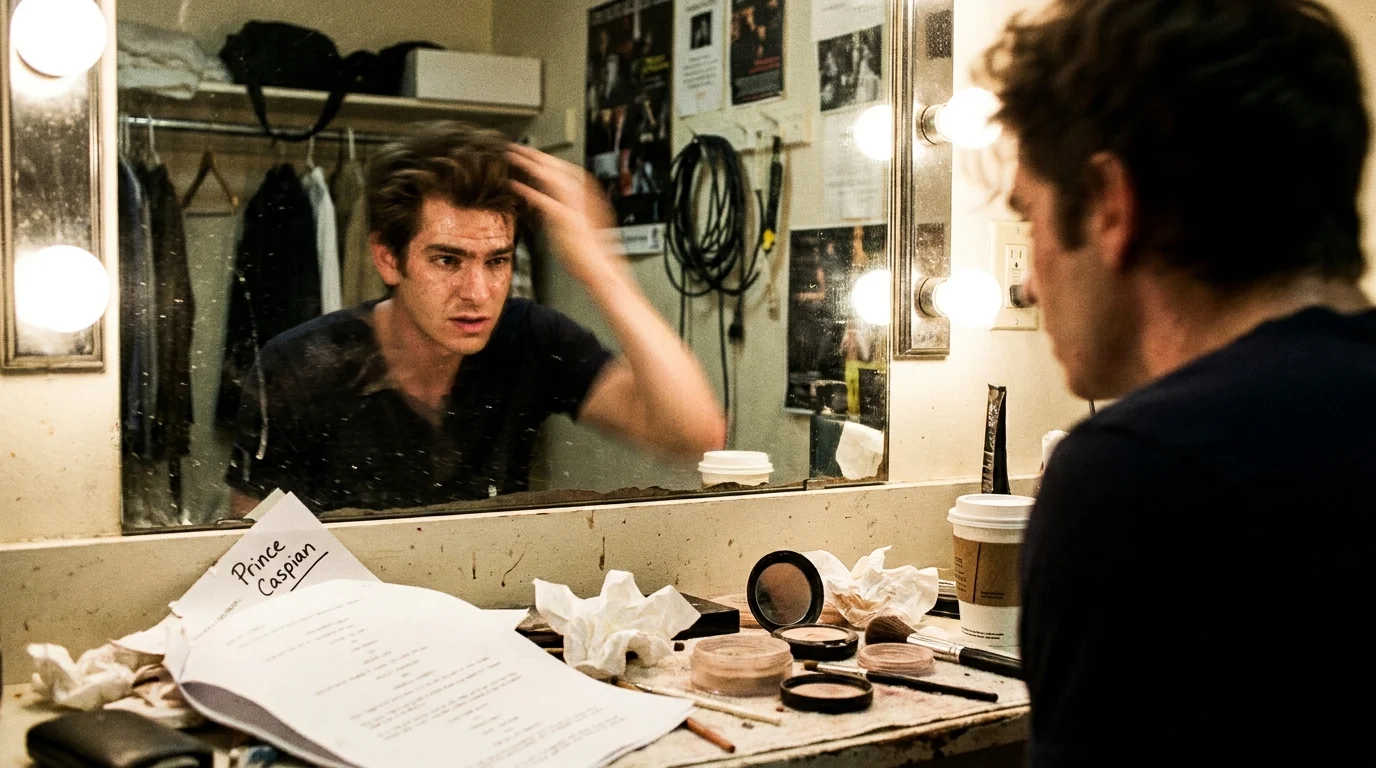
The air in the London casting office smelled of stale instant coffee and wet umbrellas. Outside, a grey Soho drizzle slicked the cobblestones, while inside, a dozen young men with high cheekbones sat on plastic chairs, nursing the same quiet desperation. You could hear the faint, rhythmic thud of a stapler from behind the heavy oak door. It was 2007, and the fantasy gold rush was in full swing. Every British actor under twenty-five with a mop of curly hair was vying to be Prince Caspian in Disney’s massive Chronicles of Narnia sequel.
Among them sat a twenty-something Andrew Garfield. His sweater was slightly too large, his neck unusually long, his eyes wide with the nervous energy of someone who had spent his rent money on a headshot. He had memorized the sides, found the noble cadence of a mythical royal, and poured his raw theater training into the cold reading. In his mind, this was the moment that would redefine his entire path.
But the decision-makers weren’t looking at his dramatic range. After weeks of waiting by a landline, the feedback finally trickled down from the casting directors to his agent. The words were simple, devoid of malice, and incredibly brutal: “He’s just not handsome enough.”
The Mirage of the Effortless Ascent
It is easy to look at a movie star’s trajectory and assume it is a straight line drawn by fate. We imagine that talent of that caliber operates like a magnet, effortlessly pulling opportunities out of the ether. But the casting room is not a meritocracy; it is a factory floor where human faces are treated as raw materials. When Disney rejected Garfield, they were applying a rigid, corporate stencil to a shape that refused to fit.
This rejection operates like a structural pillar in a building: sometimes a support beam must fail before the architect understands how to balance the weight of the entire house. For Garfield, the feedback acted as an unexpected mirror. Instead of trying to smooth over his unconventional features to fit the smooth, unblemished mold of a Disney prince, he realized he had to lean into the very oddities that made him different.
Marcus Vance, a fifty-one-year-old veteran talent manager who operated out of Soho during the mid-2000s fantasy boom, remembers the quiet fallout of that decision. “In those days, studio executives wanted porcelain perfection,” Vance says. “They wanted actors who looked like they were sculpted from marble, not boys who looked like they had just walked out of a rainy independent theater. When Andrew lost Narnia, it felt like a death sentence for his commercial prospects. But it actually saved him from the golden cage of teen-idol status.”
- Sam Neill almost secured a defining blockbuster spy role before studio intervention
- Megan Fox forgotten talk show interview instantly shatters years of harsh criticism
- Rachael Ray home cooking clips spark intense fan speculation over subtle tremors
- Pamela Anderson trusted one radical stylist to execute her makeup free comeback
- Pedro Pascal handles late career superstardom trusting one rigid daily grounding habit
Deconstructing the Aesthetic Trap
To understand how this rejection reshaped his career, you must examine the two distinct paths that open up when a major door is slammed shut.
For the actor who refuses to be sanitized, the independent film world offers a different kind of currency. Garfield immediately pivoted away from high-fantasy auditions, focusing instead on gritty, character-driven scripts where unpolished vulnerability was a virtue. This shift led him directly to Boy A, a haunting drama that proved his capacity to carry complex, heavy narratives without relying on a polished Disney smile.
When Hollywood eventually came calling again, it was on entirely different terms. He did not audition to play the flawless hero; instead, he targeted roles where a certain physical awkwardness was baked into the script. His Peter Parker was not a stoic savior, but a twitchy, grieving teenager who hid behind a mask—a performance that breathed life into the franchise precisely because he didn’t look like a traditional, chisel-jawed action figure.
Navigating the Anatomy of Rejection
When you encounter a professional wall that seems entirely based on factors outside your control, the natural instinct is to change yourself to fit the mold. Instead, you must learn to treat the rejection as diagnostic data rather than a personal verdict.
To implement this shift in your own creative or professional life, consider these deliberate steps:
- Isolate the feedback: Separate aesthetic or superficial criticism from your core technical ability.
- Audit your environment: Identify if you are presenting your work to spaces that value conformity over texture.
- Reclaim your narrative: Double down on the specific traits that the gatekeepers labeled as flaws.
Our tactical toolkit for processing professional rejection helps keep your long-term focus intact:
- The 48-Hour Rule: Allow yourself exactly two days to feel the sting of the loss before analyzing the feedback.
- The Portfolio Pivot: Replace three projects in your portfolio that seek to please everyone with one that polarizes.
- The Script Cleanse: Physically discard the remnants of the failed attempt to signal a clean break to your subconscious.
The Freedom of the Imperfect Frame
Ultimately, the roles we lose are just as defining as the ones we keep. Had Garfield landed the role of Prince Caspian, he would have been bound to a multi-film contract, his face plastered on plastic lunchboxes and video game covers. He would have spent his most formative years navigating the highly sanitized waters of studio family films, perhaps never finding the space to explore the dark, neurotic corners of his talent.
In the end, the casting director’s harsh words did not break his career; they liberated it. On that rainy afternoon in London, after the final rejection call was made, the young actor didn’t wait around to plead his case. He walked out of the waiting room, leaving behind the actual torn script pages of Prince Caspian scattered across the floor—a pile of crumpled paper that marked the exact moment he stopped trying to be a prince, and started becoming an artist.
“The moment you stop trying to fit into the industry’s template is the moment you force the industry to build a new one around you.”
| Key Point | Detail | Added Value for the Reader |
|---|---|---|
| The Narnia Rejection | Passed over for Prince Caspian because he wasn’t “handsome enough.” | Demonstrates that even top-tier talent faces superficial gatekeeping. |
| The Indie Pivot | Focused on raw dramas like Boy A and Never Let Me Go. | Shows how reclaiming your niche builds authentic authority. |
| The Spider-Man Legacy | Leaned into physical awkwardness to redefine Peter Parker. | Proves that your perceived flaws can become your greatest USP. |
Frequently Asked Questions
Was Andrew Garfield actually rejected for Prince Caspian? Yes, he auditioned extensively for the role before being told he was not considered handsome enough by the casting team.
Who ended up getting the role instead of Garfield? The role of Prince Caspian was ultimately given to Ben Barnes, who fit the classic, symmetrical aesthetic the studio wanted.
How did this rejection influence his role in Spider-Man? It encouraged him to embrace his natural, lanky, and awkward physical traits, which became central to his portrayal of Peter Parker.
Why is aesthetic feedback common in Hollywood casting? Studios often prioritize familiar, safe visual archetypes to guarantee international appeal for massive franchise budgets.
How can I apply this career shift to my own professional life? Use superficial rejections to pivot toward environments that value your unique traits rather than trying to force yourself into rigid templates.