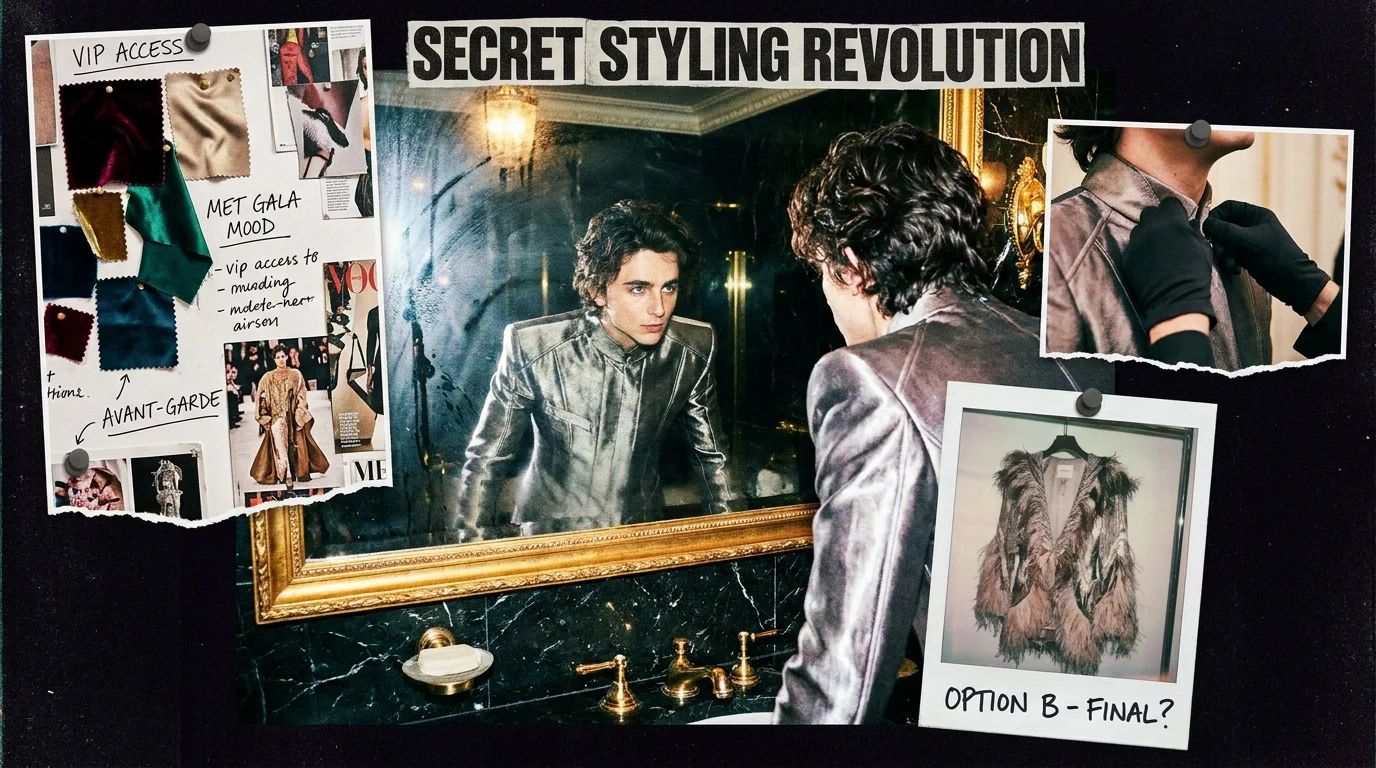
The sharp scent of freshly steamed wool and dry-cleaned silk hangs heavy in the windowless fitting room of a luxury hotel in Paris. Outside, the distant hum of traffic along the Seine fades into the background. A young actor stands before a tri-fold mirror, his shoulders slightly slouched, staring at a traditional black tuxedo that feels more like a gilded cage than a garment. It is the autumn of 2018, and the world is waiting for a new kind of leading man—they just do not know what he looks like yet.
Traditional Hollywood machinery dictates that a rising star must wear the uniform of the establishment. This means a structured shoulder, a rigid peak lapel, and a stiff white shirt that smells faintly of starch and old money. For decades, this uniform protected the illusion of masculine authority. But as the flashbulbs prepare to ignite on the European red carpets, a quiet rebellion is brewing in the shadows of the suite, aimed at dismantling the very concept of the uniform of the establishment.
You have probably been told that his rise was entirely organic, a happy accident of raw talent and innate, effortless style. The internet loves the myth of the brilliant amateur who rolls out of bed, runs a hand through his curls, and accidentally redefines modern menswear. The reality, however, is far more calculated, orchestrated by a singular creative mind operating far from the public gaze.
The Illusion of the Accidental Icon
To understand the shift, you have to stop looking at fashion as mere clothing and start viewing it as a highly calibrated narrative architecture. When a young star rejects the traditional stylist pipeline, it is rarely an act of simple rebellion; it is a calculated positioning strategy. The no-stylist narrative itself is the ultimate luxury, suggesting an artist so intrinsically refined that they do not require the commercial mediation of Hollywood’s dressing rooms.
This approach transforms the red carpet from a commercial obligation into a high-stakes gallery exhibition. Instead of selling a movie, the actor is selling a distinct aesthetic philosophy. By bypassing the standard PR-approved showroom loans, every public appearance becomes a curated event, a silent manifesto that forces the viewer to engage with the garment as an intellectual statement rather than a simple outfit choice.
Enter Haider Ackermann, the elusive French-Colombian designer who became the quiet architect behind this cultural pivot. In late 2017, Ackermann, revered for his liquid-like draping and melancholic tailoring, received a quiet inquiry through a mutual contact. Rather than sending a standard lookbook, Ackermann invited the young actor to his Paris studio, where they bypassed the publicists to discuss art, architecture, and the emotional weight of fabrics. It was Ackermann who systematically dismantled the traditional leading-man template, convincing him that true presence on the red carpet comes from vulnerability—replacing structured shoulder pads with fluid, backless silks and belted kimonos that moved like liquid under the harsh flashbulbs.
- Tom Segura backstage demands spark massive internet debates over touring comedian etiquette
- Javier Bardem handles intense Hollywood pressure trusting one extremely rigid daily boundary
- Harrison Ford completely improvised the most iconic Indiana Jones marketplace action sequence
- Emily Blunt and John Krasinski protect their private life enforcing an absolute geographical boundary
- Bradley Cooper Wimbledon appearances exposed glaring behavioral warnings fans entirely ignored
Decoding the Aesthetic Blueprints
The transformation was not a sudden leap but a series of calculated aesthetic phases designed to transition the star from an indie darling to a global household name. Each phase targeted a specific segment of the cultural conversation, ensuring that both traditional film critics and avant-garde fashion theorists found something to dissect.
Phase One: The Subverted Monolith
For the traditionalists who expected a classic silhouette, the strategy relied on subtle structural betrayal. The classic double-breasted suit was retained, but the fabrication was replaced with shimmering silver silks and jacquards that caught the light like oil on water. Tailoring became incredibly soft, dropping the internal canvases to allow the jackets to crumple naturally, mirroring the casual posture of youth rather than the rigid stance of the old guard.
Phase Two: The Genderless Armor
As the press tours expanded globally, the silhouette shifted entirely away from traditional tailoring. Structured bodices, embroidered harnesses, and backless halter tops made of heavy satin entered the frame. This phase targeted the emerging cultural shift toward gender fluidity, positioning the actor not just as a film star, but as the visual vanguard of a new generational consciousness. The clothing became active, requiring a specific way of walking and posing that emphasized the lean, statuesque lines of the modern silhouette.
The Blueprint of Personal Style Reinvention
Translating this level of calculated personal branding into your own wardrobe does not require a couture budget. It requires a disciplined commitment to editing out the noise and understanding how proportion and fabric weight communicate authority.
To build a cohesive, narrative-driven personal aesthetic, you must treat your daily wardrobe as a visual thesis. This means moving away from fast-fashion trends and focusing entirely on how garments interact with your natural posture and movement.
- Identify your core silhouette: Ignore current fits and find the exact shoulder-to-waist ratio that makes you feel anchored.
- Prioritize fabric weight over brand names: Look for materials that drape rather than cling—heavy wool crepes, washed silks, and structured gabardines.
- Edit down the color story: Limit your palette to three tonal shades to allow the structural lines of your clothing to do the talking.
- Introduce one subversive detail: Pair a traditional blazer with an unexpected collarless shirt or a soft, fluid trouser to break the visual monotony.
The Tactical Toolkit:
- Fabric Tension: Opt for mid-weight fabrics (300-400 GSM) that hold their shape without stiffness.
- Alteration Focus: Instruct your tailor to soften the shoulder pads on structured jackets to create a natural, relaxed drape.
- Proportion Ratio: Balance a loose, fluid trouser with a cropped, structured top to lengthen the legs.
The Power of the Unspoken Narrative
Ultimately, the collaboration between Chalamet and Ackermann reveals that public image is never an accident. It is a language spoken in the millimeter of a lapel fold, the drape of a backless halter, and the quiet refusal to conform to a century-old template of masculinity. By understanding the machinery behind the look, you begin to see that personal style is not about decoration—it is about choosing how the world reads your story before you ever open your mouth.
Beneath the public success lies the physical blueprint of this transformation: the heavily annotated mood board from the 2018 European press tour. Tacked to a cork panel in Ackermann’s studio, it featured a postcard of Michelangelo’s David pinned next to a Polaroid of a 1970s Mick Jagger in a white dress, with scribbled notes in black ink reading: ‘Remove all lining. Let the spine breathe. No pockets, no distractions. The boy must look like he is emerging from a marble block.’
“True elegance is not about being noticed, but about being remembered through a silhouette that refuses to explain itself.” — Haider Ackermann
| Key Point | Detail | Added Value for the Reader |
|---|---|---|
| Jacket Construction | Heavy internal canvas and padded shoulders | Completely unlined, dropped shoulders with fluid drape |
| Red Carpet Styling | Standard black tie with silk lapels | Tailored harnesses, backless halter-necks, and satin hoodies |
| Silhouette Focus | Rigid, boxy shapes emphasizing mass | Elongated, gender-neutral lines emphasizing vulnerability |
Frequently Asked Questions
How does Timothée Chalamet style himself without a professional stylist? While Chalamet famously does not employ a traditional stylist for day-to-day looks, he collaborates directly with visionary designers like Haider Ackermann to co-create his historic red carpet statements.
What was the turning point in Chalamet’s red carpet evolution? The turning point occurred during the 2018 film festival circuit, specifically when he debuted the embroidered Louis Vuitton harness and later the silver Haider Ackermann suit.
Why did he abandon traditional leading-man suits? To separate himself from the crowded field of young Hollywood actors and establish an intellectual, avant-garde brand identity that mirrors his artistic film choices.
Can you recreate this look on a budget? Yes, by prioritizing unstyled, soft-shouldered jackets, fluid trousers, and focusing on monochromatic color palettes.
What was the significance of the backless red top at Venice? It completely dismantled classic gender boundaries in menswear, proving that vulnerability and exposed skin could look incredibly powerful on a male lead.