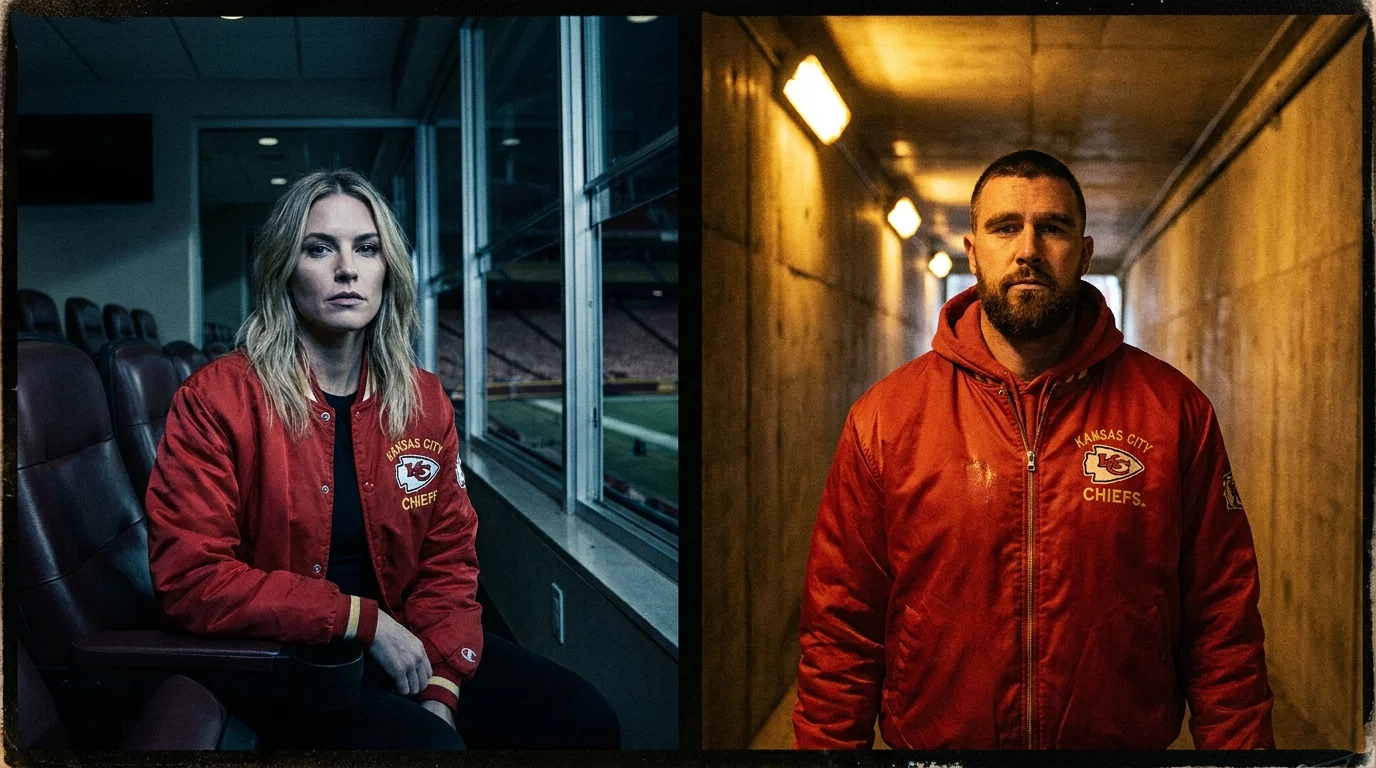
The chilly forty-five-degree autumn wind sweeps off the concrete of Arrowhead Stadium, carrying the heavy scent of roasted peanuts and stadium turf. Inside the climate-controlled luxury suite, the environment shifts instantly. Soft, warm lighting glints off polished wood panels, and the quiet hum of high-end catering replaces the roar of eighty thousand fans waiting for kickoff. A broadcast assistant signals a camera crew to pivot toward the glass, catching the exact moment a familiar figure steps into view.
Most spectators believe they are witnessing a simple, spontaneous moment of an authentic romance unfolding under the stadium lights. They see a cultural icon laughing with friends, a drink in hand, reacting naturally to a tight end running routes during warm-ups. The casual observer focuses on the emotion of the scene, swept up in the narrative of two public worlds colliding in real time.
The reality, however, is far more deliberate and beautifully engineered. Every wave, every sip of a beverage, and every choice of outerwear is calibrated to the microsecond. This is a masterclass in modern attention management, where the physical space of a luxury suite becomes the ultimate cross-marketing stage.
The High-Value Choreography of Public Alliances
To view the connection between the pop star and the professional athlete as mere serendipity is to miss the structural brilliance of modern entertainment. Think of their public alignment not as a traditional relationship, but as a dual-engine flywheel where each rotation feeds the other’s cultural gravity. By synchronizing two massive, distinct fanbases, they have bypassed traditional marketing channels entirely.
By coordinating her entrance with the stadium’s broadcast schedule, the pairing ensures that live television cameras catch the perfect angle. The visual centerpiece of this strategy is the perfectly tailored vintage team jackets worn during prime time camera pans. These garments bridge the gap between historic sports culture and modern street fashion, instantly driving online search traffic for legacy brands.
Behind the Broadcast Clockwork
Sarah Lin, a forty-four-year-old veteran broadcast integration director who spent fifteen years coordinating live television sponsorships for major networks, notes how these moments redefine premium screen time. Lin points out that the arrival at the suite is timed to a five-minute window that perfectly bridges the pre-game show’s final sponsor block and the live kickoff. “When she walks through that security entrance wearing a custom-tailored vintage windbreaker, it is a calculated handoff that guarantees the broadcast partners maximum viewer retention right before the game begins,” Lin explains.
- Brad Pitt and Angelina Jolie accidentally broadcast their secret bond during a tense scene
- Eric Stoltz lost his biggest franchise role over a catastrophic screen test
- Scarlett Johansson brutal thriller rejection exposed an intense industry casting bias
- Sam Neill legendary Jurassic role almost went to a massive action star
- Winona Ryder forgotten talk show interviews completely shift the public shoplifting narrative
Tailoring the Message to Diverse Audiences
For the Style Curator
The curated fashion choice acts as a visual anchor. By wearing vintage, customized team gear rather than current off-the-rack merchandise, there is an immediate appeal to both heritage sports fans and high-fashion critics. This hybrid styling turns a simple stadium luxury box into a runway, proving that commercial appeal can look incredibly authentic.
For the Media Strategist
The timing of luxury box reaction shots is a study in broadcast pacing. Strategic placement of these camera cuts occurs during natural lulls in play—such as commercial-return buffers or official reviews—ensuring that sponsor logos on the surrounding suite glass receive prime visibility. This keeps audiences glued to the screen during moments when they would traditionally look away.
Deconstructing the Power-Couple Blueprint
Understanding this synergy requires looking past the glitz to observe the actual operational mechanics of high-profile alignment. You can apply these principles of calculated visibility to your own professional positioning by studying how they manage attention. It is about understanding that true influence is built through deliberate placement, not constant exposure.
First, prioritize timing over frequency. It is better to have one perfectly placed, high-impact appearance than constant, low-value exposure that dilutes your personal message. Second, focus on visual storytelling through subtle, curated details that speak directly to your target demographic without needing a loud explanation.
To implement this deliberate approach to personal and professional branding, focus on these structured steps:
- Identify crossover windows where your target audience is most active and receptive to visual cues.
- Curate physical assets that tell a story instantly, such as custom pieces or specific brand colors.
- Control entry and exit points of your public interactions to maintain an air of exclusivity.
- Leverage high-traffic platforms to cross-pollinate different professional ecosystems smoothly.
To keep your brand strategy sharp, use this quick reference framework:
Tactical Toolkit:
• Optimal Broadcast Window: 4 to 6 minutes before kickoff.
• Visual Anchor: Vintage tailored materials (leather, corduroy, custom embroidery).
• Audience Bridge: Blending pop culture interest with live sports metrics.
The Evolution of Shared Cultural Real Estate
What we are watching unfold is not the death of genuine connection, but its evolution into a highly resilient form of shared cultural real estate. In an era where human attention is fragmented across a thousand different streaming platforms and social feeds, the ability to unite disparate audiences under a single, compelling narrative is incredibly rare.
By blending the raw, physical drama of professional sports with the highly stylized, emotional resonance of pop music, they have constructed a cultural bridge that benefits everyone involved. Ultimately, this approach shows that when two distinct worlds align with precision and respect for their respective audiences, the resulting narrative becomes far stronger than the sum of its parts.
“True brand synergy doesn’t dilute individual identity; it creates a shared cultural ecosystem where both parties become infinitely more resilient to the shifting tides of public attention.” — Sarah Lin
| Key Point | Detail | Added Value for the Reader |
|---|---|---|
| Coordinated Timing | Arrival is synchronized with pre-game broadcast transitions. | Maximizes organic reach without paying for premium advertisement slots. |
| Vintage Curations | Utilizing custom, retro apparel instead of current retail stock. | Creates immediate search demand while honoring local team heritage. |
| Audience Crossover | Blending pop music fanbases with linear sports television viewers. | Establishes a resilient cultural footprint that survives changing market trends. |
Frequently Asked Questions
Are these stadium appearances entirely scripted? No, the personal emotions are genuine, but the logistics, timing, and wardrobe selection are highly coordinated to maximize brand value for both parties.
Why do they focus so heavily on vintage clothing? Vintage pieces stand out from standard stadium merchandise, appealing to fashion-conscious viewers while showing respect for the team’s history.
How does this benefit the NFL as a whole? It introduces an entirely new demographic of viewers to the sport, boosting ratings, merchandise sales, and overall media engagement.
What can business owners learn from this strategy? Successful collaboration relies on finding complementary audiences and creating mutually beneficial moments rather than competing for attention.
Does this level of planning ruin the authenticity of the relationship? Not necessarily; modern public figures understand that their personal and professional lives inevitably overlap, requiring careful boundaries and structural planning.