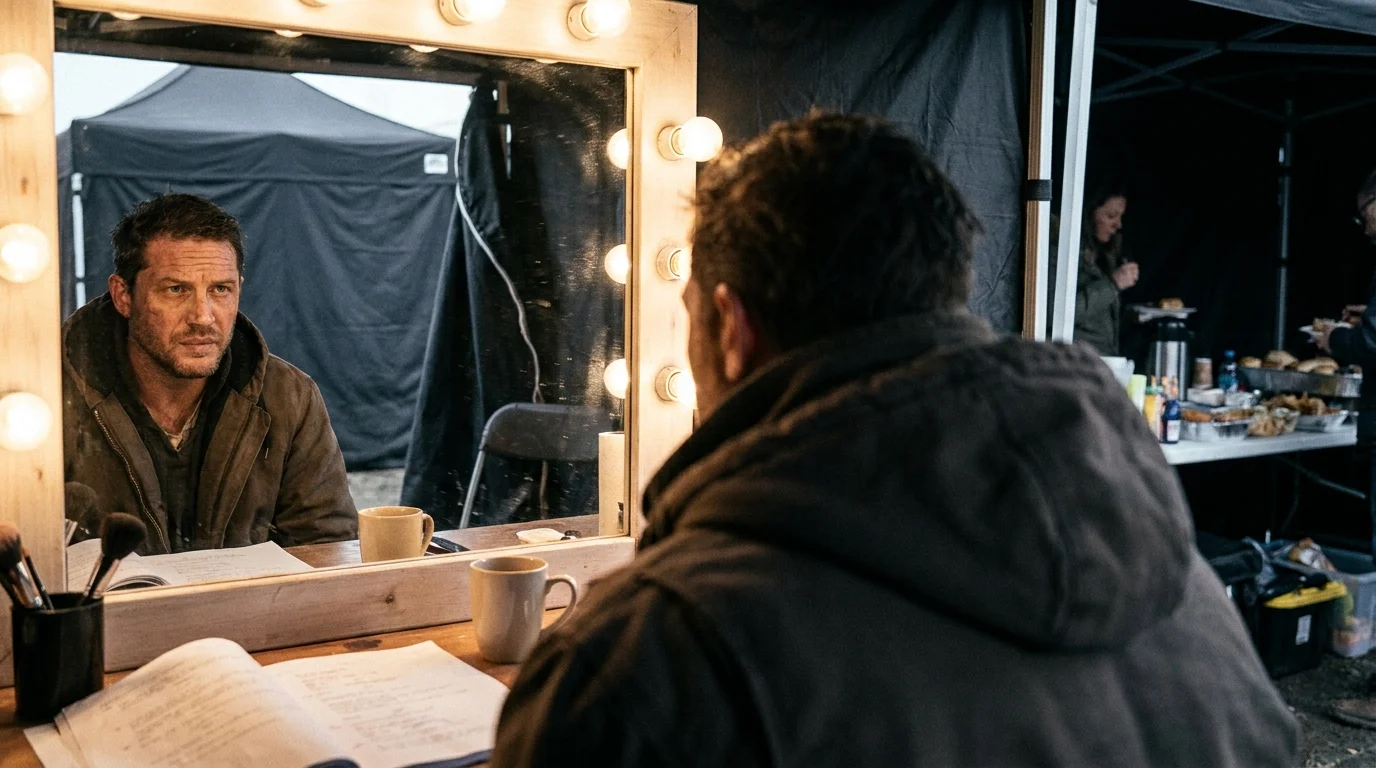
The desert sun beats down on a dry lake bed outside of Los Angeles, turning the fine alkaline dust into a choking haze that settles on camera lenses and teeth alike. Near the edge of the camp, the hum of a diesel generator competes with the clatter of catering pans. Yet, just ten feet behind the buzzing craft service table sits an anomaly: a heavy, blacked-out canvas isolation tent, completely silent and absorbing the heat like a dark monolith.
Inside that structure, far from the casual banter of crew members grabbing their third cups of black coffee, sits an actor preparing to lose his mind on camera. This is not the spontaneous, lightning-in-a-bottle genius you often read about in glittering magazine profiles. This is raw survival engineered through meticulous, frustrating physical boundaries that grind the gears of a standard production crew to a painful halt.
To the crew members carrying eighty-pound cables through the sand, the rules governing this black tent feel less like artistic preparation and more like an active diplomatic hazard. The most polarizing boundary is simple but absolute: a strict eye-contact ban when the actor emerges from his dark canvas cocoon to walk to the camera mark.
Decoding the Friction of Extreme Method Boundaries
It is easy to dismiss these backstage protocols as ego run amok, a classic tale of a Hollywood heavy demanding the world bend to his whims. But when you look closer at the mechanics of modern film production, a different picture emerges. The actor is essentially operating like a deep-sea diver in a pressurized suit; if they open the faceplate to chat about yesterday’s football game or the quality of the breakfast burritos, the internal atmosphere escapes instantly. What looks like elitist isolation is actually a desperate containment strategy designed to keep a performance from evaporating before the director yells action.
Standard film sets run on a currency of casual camaraderie, where grips, makeup artists, and coordinators exchange quick nods to ease the fourteen-hour workday. When a star introduces an unyielding barrier to this social flow, it creates a palpable energetic drag. You are suddenly forced to navigate a workspace where looking the wrong way can disrupt a multi-million-dollar sequence, turning a collective creative effort into a tense walk on eggshells.
Marcus Vance, a forty-seven-year-old veteran key grip who has spent over two decades rigging lights on harsh, remote locations, remembers the initial shockwave this setup caused among his team. “We are used to moving fast, yelling cues, and keeping the energy light to survive the heat,” Vance explains while reflecting on the production. “When you place a blacked-out structure in the middle of our workspace and tell thirty grown men they cannot look the lead actor in the eye, it splits the set in half. Half the crew thinks it is a joke, while the other half gets incredibly defensive. But once you see the first take, you realize that heavy silence is the only way he gets to that terrifying, broken place the script demands.”
- Brendan Fraser survives intense industry exile trusting one strict creative rule
- Robin Williams completely improvised the most emotional scene in cinematic history
- Sarah Michelle Gellar protects her marriage enforcing a brutal technology ban
- Will Smith awkward red carpet behavior telegraphed an impending marital crisis
- Keri Russell accidental scene reactions broadcasted a deeply guarded cast romance
The Isolation Zone: Logistics Under Pressure
For the production coordinators and location managers, accommodating a physical isolation tent right next to the active shooting zone is a logistical puzzle. Usually, actors retreat to their multi-million dollar trailers parked hundreds of yards away in the “base camp.” But when an actor demands immediate proximity to the camera to prevent their emotional momentum from draining during a long walk, standard spatial layouts collapse. The tent must be placed directly in the line of fire, requiring dedicated power lines, quiet portable air units, and a security guard whose sole job is to keep eager background actors from wandering too close.
This creates an immediate spatial bottleneck where crew members must squeeze past the silent zone to perform their basic duties. The physical proximity of intense silence next to the loud, mechanical reality of a film set creates a bizarre, pressure-cooker environment where everyone is hyper-aware of their own footsteps.
The No-Contact Mandate: Protecting the Narrative Frame
For the camera operators and makeup artists who must interact with the performer, the eye-contact ban is the most challenging boundary to respect. In normal human interaction, eye contact is how we build trust and signal safety. By stripping away this fundamental social cue, the actor creates a deliberate void, forcing a cold distance that keeps their character’s raw edge from softening. If a makeup touch-up must happen, it is performed in complete silence, with eyes focused strictly on the skin, treating the actor’s face like a canvas rather than a conversational partner.
This strict rule forces the creative crew to shift their entire communication style. Hand gestures, quiet whispers to the assistant director, and stepping back into the shadows become the default setting. It is an exhausting way to work, but it ensures that when the camera rolls, the actor is not carrying the friendly warmth of a crew member’s smile into a scene of bleak, violent survival.
Adapting High-Intensity Workflows to Your Creative Space
You do not need a desert film set or a blacked-out canvas tent to benefit from the psychology of radical isolation. When you are tackling a high-stakes project that requires deep emotional or cognitive focus, the casual interruptions of your daily environment can be fatal to your flow. By establishing your own version of these strict physical boundaries, you protect your creative energy from bleeding out into minor daily distractions.
To implement this level of deep focus without alienating your colleagues or family, you must build clear, predictable signals that communicate your unavailability. Clear physical boundaries prevent the need for awkward, defensive confrontations later. Use these practical steps to construct your own functional isolation zone:
- Set up a visual anchor in your workspace, such as a specific desk lamp or a closed-door sign, that clearly signals you are in deep-focus mode.
- Establish an absolute digital boundary by turning off all non-emergency notifications and scheduling specific blocks for communication.
- Use noise-isolating tools to create a reliable auditory barrier between your mind and the ambient noise of your household or office.
- Communicate your focus windows ahead of time to your team so they know exactly when you will emerge and be available for collaboration.
To help you structure this transition, utilize this simple framework for protecting your focus during critical tasks:
The Tactical Focus Toolkit
- The Visual Boundary: A physical object or sign placed at your workspace entrance to signal zero-interruption status.
- The Deep Block: A strict 90-minute window where you do not look at incoming emails or direct messages.
- The Sensory Buffer: Ambient white noise played at a consistent 60 decibels to mask surrounding clutter.
The True Cost of Creative Preservation
At the heart of this backstage friction lies a fundamental truth about high-performance work: great output requires fierce protection. The polarization of a film crew is not necessarily a sign of a toxic environment, but rather the natural heat generated when two opposing, necessary forces meet. One force is the machine of production, which must run on time, on budget, and with mechanical predictability. The other force is the human spirit of performance, which is erratic, vulnerable, and deeply sensitive to its surroundings.
When you learn to view these extreme demands not as diva antics, but as defensive armor, your perspective shifts. It reminds you that protecting your own focus and mental peace is a personal responsibility, even if it makes those around you temporarily uncomfortable. By setting firm, unyielding boundaries, you preserve the very best of your creative energy for the moments when it matters most, leaving the noise of the world outside your own black canvas tent.
“The boundary between raw focus and professional courtesy is where the most memorable work is born, even if it requires a little friction to keep it alive.” — Marcus Vance, Key Grip
| Key Point | Detail | Added Value for the Reader |
|---|---|---|
| The Isolation Tent | A physical blacked-out structure placed directly on set to keep the actor in character. | Demonstrates the need for close-proximity recovery zones in high-stress work. |
| The Eye-Contact Ban | A strict rule preventing crew members from making direct eye contact during transitions. | Highlights how eliminating casual social cues protects deep, internal focus. |
| Set Polarization | The friction created between logistics-focused crew and the performance-focused actor. | Shows that creative tension is often a byproduct of necessary boundaries, not ego. |
How does an isolation tent actually help a performance?
It acts as a sensory deprivation chamber, cutting out the thousands of micro-distractions on a busy film set and allowing the actor to maintain a highly specific emotional baseline without interruption.
Is an eye-contact ban common on major movie sets?
While not standard for every actor, it is a recognized technique used by intense character actors to avoid breaking character or shifting back into comfortable, polite social habits between takes.
How do crew members adapt to these strict actor demands?
Crews rely on highly organized protocols, clear hand signals, and pre-planned physical pathways to ensure the work gets done safely without stepping into the actor’s designated quiet zones.
Does this kind of method acting cause permanent tension on set?
It can create temporary polarization, but most professional crews respect the boundaries once they see the quality of the final footage and understand the practical reasons behind the demands.
Can I use these isolation techniques in a normal office setting?
Yes, by establishing clear visual boundaries, using noise-canceling headphones, and setting pre-announced “no-distraction” blocks, you can mimic this high-intensity focus in any standard workspace.