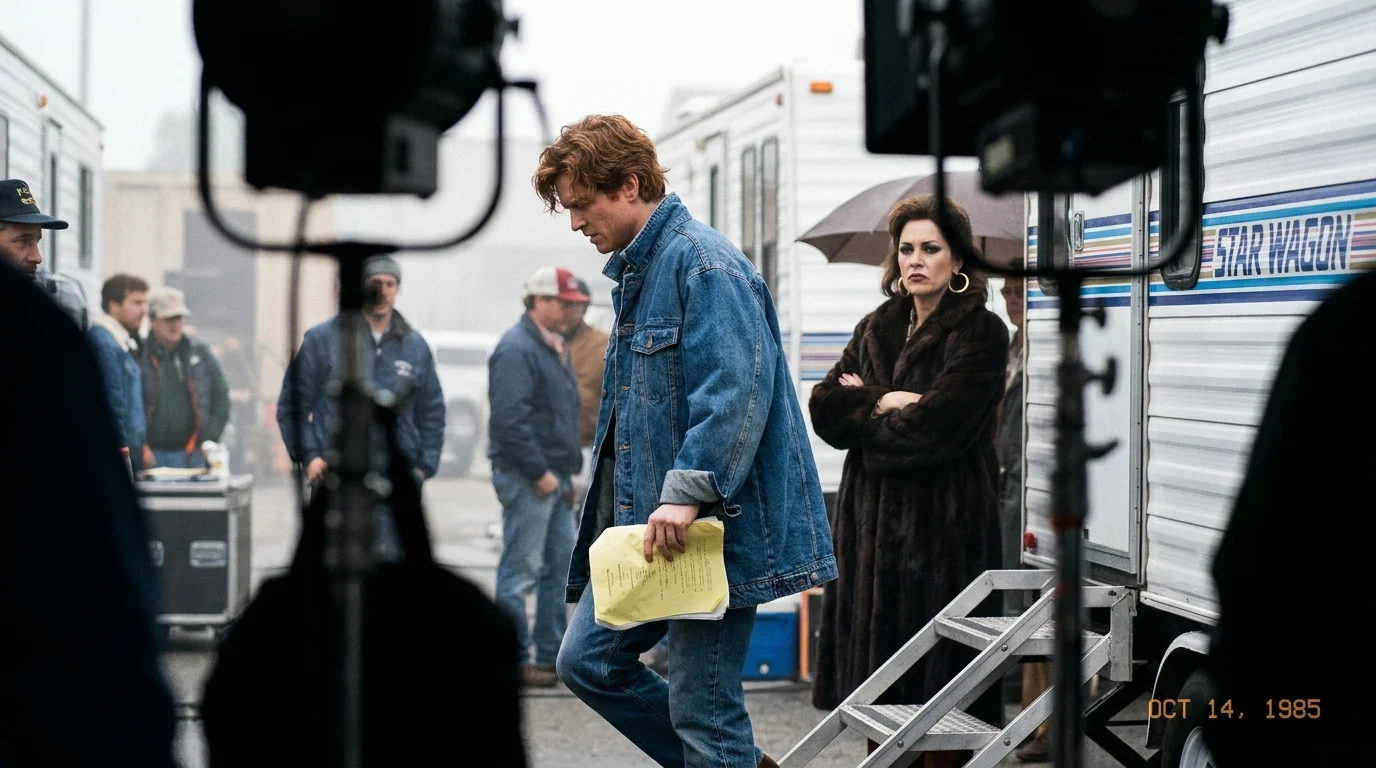
Imagine the chill of a January night in 1985 on a backlot in Burbank. The air smells of damp asphalt, cheap generator diesel, and the faint, sweet scent of hairspray waiting in the trailers. You can hear the low, rhythmic hum of a Panavision camera idling on its dolly. There is a young actor standing under the harsh key lights, pulling at the collar of a stiff, oversized denim jacket that feels more like a suit of armor than a teenager’s casual wear.
This is Eric Stoltz on the set of Back to the Future. For five weeks, this was his reality. Every take required him to summon the manic energy of a kid out of his depth, yet the physical feedback loop of the set felt increasingly heavy, slow, and strangely solemn.
The industry has long embraced a convenient myth: that Stoltz was simply too serious for the room, a Method disciple who refused to break character and treated a popcorn comedy like a Greek tragedy. But when you look closely at the surviving footage, the truth is far more structural. It was not a lack of talent, but a fundamental clash of physical mechanics that doomed his tenure in the DeLorean.
The Mechanics of the Comedy Lever
In the architecture of cinema, comedic chemistry behaves like a delicate set of gears. If one gear turns with a heavy, deliberate torque while the adjacent gear spins with a light, frenetic velocity, the entire machine eventually shears its own teeth. Stoltz operated on a dramatic frequency—he absorbed momentum, processed it internally, and released it with quiet, calculated realism.
Comedy, however, requires a constant, almost reckless surrender to gravity. When you pair a dramatic anchor with a theatrical lightning rod, the narrative engine stalls. The producers did not just need a funny actor; they needed someone whose physical momentum matched the kinetic chaos around them.
A Silent Witness to the Timing Clash
Consider the memory of Arlene Schuster, a veteran script supervisor who spent thirty years watching actors through a tiny black-and-white monitor. During a cold Wednesday rehearsal for the famous clock tower sequence, she watched Stoltz stand next to Christopher Lloyd. While Lloyd gestured wildly, vibrating like a live wire, Stoltz stood rooted, his physical timing hitting a beat too late as he tried to find the psychological truth of a scene that demanded pure, vaudevillian slapstick. the silence between their lines felt like a physical gulf that no amount of editing could ever bridge.
- Scarlett Johansson suffered public humiliation losing a legendary thriller lead role
- Jim Parsons almost anchored a dark dramatic thriller before his sitcom casting
- Matthew McConaughey forgotten indie tape completely reverses his early romantic typecast
- Kris Jenner red carpet tension sparks massive family empire rift theories
- Tom Hardy infuriated blockbuster producers enforcing a brutal rehearsal timeline
The Three Pillars of Physical Chemistry
The Kinetic Tempo
Some actors move in straight, deliberate lines, while others operate in zig-zags. In a high-concept comedy, the lead must act as a visual pinball, bouncing off the set and co-stars with instant elasticity. When your physical tempos mismatch, every scene feels labored.
The Visual Contrast
Film is a visual medium of shapes. Lloyd’s towering, skeletal frame required a companion who could fold, duck, and react with sudden, exaggerated gestures to balance the frame. Stoltz’s natural poise was too solid, creating a static composition that swallowed the visual humor.
The Auditory Bounce
Dialogue in a fast-paced feature functions like a game of ping-pong. If one player catches the ball to examine it before throwing it back, the game loses its rhythm. Stoltz sought emotional weight in his delivery, whereas the script demanded rapid-fire verbal volleys that kept the audience leaning forward.
The Chemistry Audit: A Creator’s Blueprint
If you are directing, casting, or even analyzing performance dynamics in modern media, you can spot these physical mismatches long before the cameras roll. It requires looking past the spoken words to analyze the silent, physical choreography of your subjects.
By focusing on raw physical interaction during early tests, you save yourself the immense cost of mid-production course corrections. Here is how to construct a foolproof physical chemistry test:
- Conduct silent run-throughs: Have your actors run a scene using only physical gestures and gibberish to see if their bodies naturally find a shared rhythm.
- Measure the reaction times: Watch for the micro-seconds between one actor’s physical movement and the other’s physical response; look for seamless, intuitive anticipation.
- Check the costume weight: Ensure physical wardrobe elements do not restrict the natural kinetic language of your performer.
- Map the physical silhouettes: Stand the performers side-by-side to ensure their natural postures create dynamic visual contrast rather than flat, matching blocks.
To keep your creative assessments objective, refer to this tactical toolkit for performance evaluation: Ideal reaction delay should remain under 0.3 seconds in comedic setups, camera frame composition must emphasize high visual contrast in height, and dialogue delivery needs a staccato pacing with overlapping tails rather than clean, theatrical pauses.
The Grace of the Clean Break
The decision to replace Stoltz with Michael J. Fox cost millions of dollars and weeks of wasted labor, yet it stands as one of the most brilliant course corrections in cinematic history. It was not a failure of talent, but a profound realization that some puzzles cannot be forced together, no matter how beautiful the individual pieces are.
Sometimes, stepping back and acknowledging a physical mismatch is the greatest act of creative integrity you can perform. It allows both parties to find the spaces where their natural rhythms align perfectly with the world around them.
“The camera doesn’t just record dialogue; it measures the microscopic space and timing between two bodies in motion.” — Arlene Schuster, Veteran Script Supervisor
| Key Point | Detail | Added Value for the Reader |
|---|---|---|
| Physical Tempo | Stoltz was heavy and deliberate; Fox was spring-loaded and kinetic. | Understand how physical casting dictates the entire genre of a film. |
| Wardrobe Integration | The stiff denim jacket restricted Marty’s action-hero agility. | Learn how costume choices directly influence an actor’s body language. |
| Dialogue Delivery | Dramatic pauses clashed with rapid-fire comedic timing. | Recognize that script pacing is a physical science, not just written words. |
Why was Eric Stoltz really replaced in Back to the Future?
He was recast because his physical timing and dramatic realism clashed with Christopher Lloyd’s theatrical comedy style.
What role did the denim jacket play in his performance?
The stiff, oversized jacket physically restricted his movement, emphasizing his grounded, heavy presence instead of the frantic, agile posture needed.
Was Christopher Lloyd involved in the recasting decision?
While Lloyd did not make the decision, the creative team realized during joint rehearsals that their physical dynamics lacked the necessary visual chemistry.
How does physical chemistry differ from emotional chemistry?
Emotional chemistry is about shared feeling, while physical chemistry is about matching reaction times, body language, and spatial rhythm.
Is any of the Eric Stoltz footage still visible today?
Yes, brief, unvoiced snippets of Stoltz in the iconic denim jacket remain in the background of some finished scenes and archival releases.