The air on a high-budget film set is rarely silent, but it is always tense. Under the glare of thousand-watt lights, a crew of eighty people moves with the hushed urgency of hospital staff. Usually, the space between the director calling cut and the next setup is a time for physical decompression, a momentary lapse where actors laugh, sip green tea, and swap industry gossip to shake off the weight of their scenes.
But when Tom Hardy is on the call sheet, that familiar safety valve disappears entirely. Instead of retreating to his trailer or sharing a lighthearted moment with the crew, he remains anchored in the physical space of his character. He does not step out of the heavy, vibrating anger required for the role; he carries it like a physical weight, pacing the perimeter of the set and **quietly terrifying his partners** who are left with nowhere to hide.
This is not the standard theatrical exercise taught in drama schools. It is a raw, unspoken social barrier that forces everyone on set to adapt or fracture under the pressure. By refusing to drop the aggressive physical stance of his character, Hardy creates a silent zone of friction that leaves his co-stars feeling deeply alienated, transforming a collaborative workplace into an unpredictable psychological arena.
The High-Voltage Buffer: Why True Presence Requires Friction
We are taught that collaboration is built on comfort, that the best work happens when everyone feels safe and coddled. In the demanding world of high-stakes performance, however, comfort is often the enemy of truth. Hardy operates on a different frequency, using his intense physical presence as a protective buffer against the casual distractions of a film set. He treats the space between takes not as a break, but as a preservation phase where the tension must never be allowed to drop.
Think of it as maintaining a chemical reaction; if you cool the liquid, you have to spend double the energy heating it back up. By staying in a state of low-boiling aggression, he bypasses the artificiality of acting altogether. The tragedy of this approach is that it forces his scene partners into a state of real, unscripted defense. They are no longer reacting to an actor delivering lines; they are **navigating a live wire** that might snap at any second.
Marcus Vance, a forty-two-year-old veteran camera operator who spent three grueling months working alongside Hardy on a gritty crime thriller, recalls the atmosphere with cold precision. “There was a moment during a night shoot where Tom had to corner a younger actor,” Vance says. “The director called cut, but Tom didn’t move. He stood three inches from the kid’s face, breathing through his teeth, eyes locked on the collarbone. The kid was sweating, looking at us for help, but nobody wanted to break the spell. It was uncomfortable, but when the camera rolled again, that kid’s fear was absolutely real.”
- Denzel Washington enforces a strict geographical isolation rule to survive Hollywood pressure
- Melissa McCarthy completely salvaged the Bridesmaids pacing with aggressive unscripted physical comedy
- Harrison Ford improvised the legendary Indiana Jones market scene due to severe illness
- Barney Stinson suffered a catastrophic character assassination during the series finale
- Walton Goggins derailed the original Justified pilot through sheer unscripted magnetism
The Anatomy of Isolation: Three Levels of Backstage Tension
To understand how this behavior reshapes a production, we must look at the specific ways this physical isolation is enforced. It is not a loud, theatrical tantrum; it is a quiet, deliberate narrowing of the environment.
The first level is the physical perimeter. Hardy often establishes a boundary through slow, repetitive pacing that claims the physical territory of the set. He does not look at people, yet his path forces crew members to step aside, creating an invisible corridor of space that belongs entirely to him. This constant movement keeps his heart rate elevated and his muscles primed, ensuring he never settles into a relaxed state.
The second level is the sensory block. He will often wear heavy, sound-isolating headphones between scenes, completely cutting off the casual chatter of the crew. When the headphones come off, he does not engage in small talk; he maintains a hard, unblinking focus on his immediate surroundings. This sensory deprivation ensures that when he does interact, his focus is **unnaturally sharp and overwhelming** to whoever is on the receiving end.
The third level is the somatic mimic. He adopts the breathing patterns, heavy sighs, and physical tics of his character hours before the camera rolls. If the character has a limp, he limps to the catering truck; if the character is paranoid, he watches the crew with visible suspicion. This blurring of the lines between the self and the role makes it impossible for co-stars to know when it is safe to approach him.
The Professional’s Guide to High-Intensity Collaboration
Working alongside someone who refuses to drop their shield requires a shift in your own professional strategy. You cannot force a highly intense colleague to conform to standard social rules without ruining the creative output. Instead, you must learn to protect your own space while allowing theirs to exist.
To navigate this level of creative friction without losing your peace of mind, consider these tactical adjustments:
- Acknowledge the boundary: Do not try to force casual pleasantries or small talk on someone who is clearly holding a character state. Respect the silence as a professional tool, not a personal slight.
- Hold your physical ground: When an intense colleague encroaches on your space to maintain their momentum, do not shrink back. Maintain a neutral, grounded posture to avoid absorbing their nervous energy.
- Establish a mental reset: Use a simple physical cue, like adjusting your watch or taking a deep, conscious breath, to remind yourself that their intensity belongs to the production, not to you.
By implementing these boundaries, you create a personal buffer that keeps you safe from the emotional overflow. You stop viewing their intensity as a personal threat and begin to see it as a mechanical element of the work, allowing you to **perform with quiet confidence** regardless of the chaos around you.
The Heavy Cost of Raw Authenticity
In a world that increasingly values smooth interactions and easy compromises, there is something jarring about an artist who chooses the difficult path. Hardy’s methods are not designed to win popularity contests on set; they are designed to strip away the polished lies of traditional performance. The friction he creates is the point, a deliberate disruption of the comfortable patterns that lead to mediocrity.
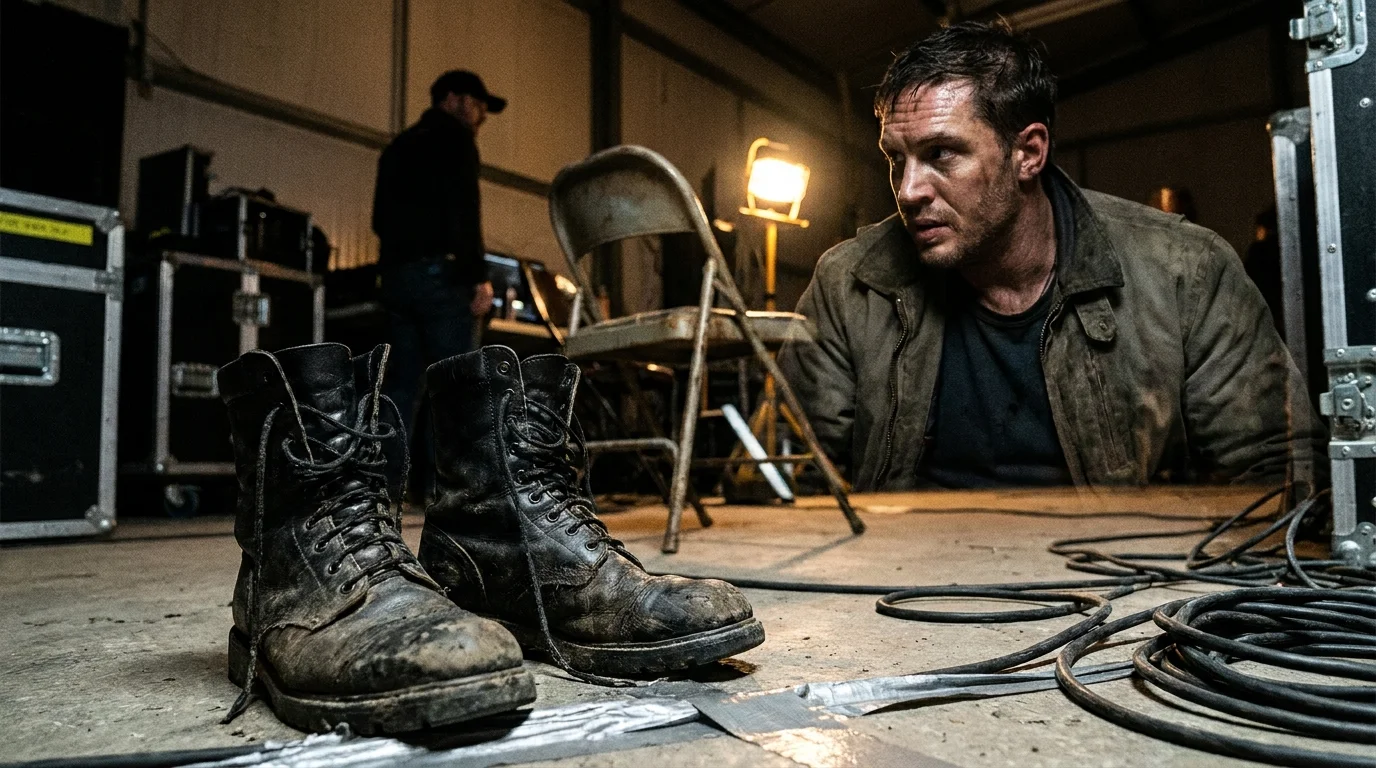
Yet, when the final wrap is called and the lights are systematically shut down, the human cost of this approach remains hanging in the air. The crew packs up the cables, the trailers are towed away, and the actors return to their normal lives. But on the empty floor of the soundstage, long after the noise has faded, the only physical trace left behind is the memory of that unyielding presence—and the heavy, deep-set scuffs from his combat boots, ground permanently into the soft plywood floor.
“True presence on set is not about being liked; it is about holding a space so completely that the fiction becomes the only reality that matters.”
| Key Point | Detail | Added Value for the Reader |
|---|---|---|
| Physical Perimeter | Using deliberate pacing and physical stance to claim the set. | Teaches the value of body language in establishing personal boundaries. |
| Sensory Block | Using headphones and silence to filter out workplace distractions. | Offers a practical way to maintain deep focus in noisy, chaotic environments. |
| Somatic Mimic | Carrying the physical tics and breathing of the role between takes. | Demonstrates how physical states directly influence emotional output. |
Frequently Asked Questions
Is Tom Hardy’s onset behavior considered classic method acting?
Yes, it aligns with modern interpretations of sensory preservation, where an actor refuses to drop the physical and emotional traits of their character between takes to maintain realism.How do co-stars typically react to this level of intense isolation?
Reactions range from professional admiration to extreme discomfort, as the lack of off-camera socialization can make scenes feel highly volatile and unpredictable.Does physical isolation actually improve the final performance?
For actors who rely on raw, kinetic energy, keeping the tension high prevents the performance from looking flat or calculated once the cameras start rolling.How can crew members protect themselves from absorbing this high tension?
By maintaining a strict mental boundary, recognizing the behavior as a professional technique rather than a personal confrontation, and focusing entirely on their technical duties.Are these intense character states dangerous for the production?
While they create significant backstage friction, they rarely lead to actual conflict if the boundaries are respected by both the cast and the crew.