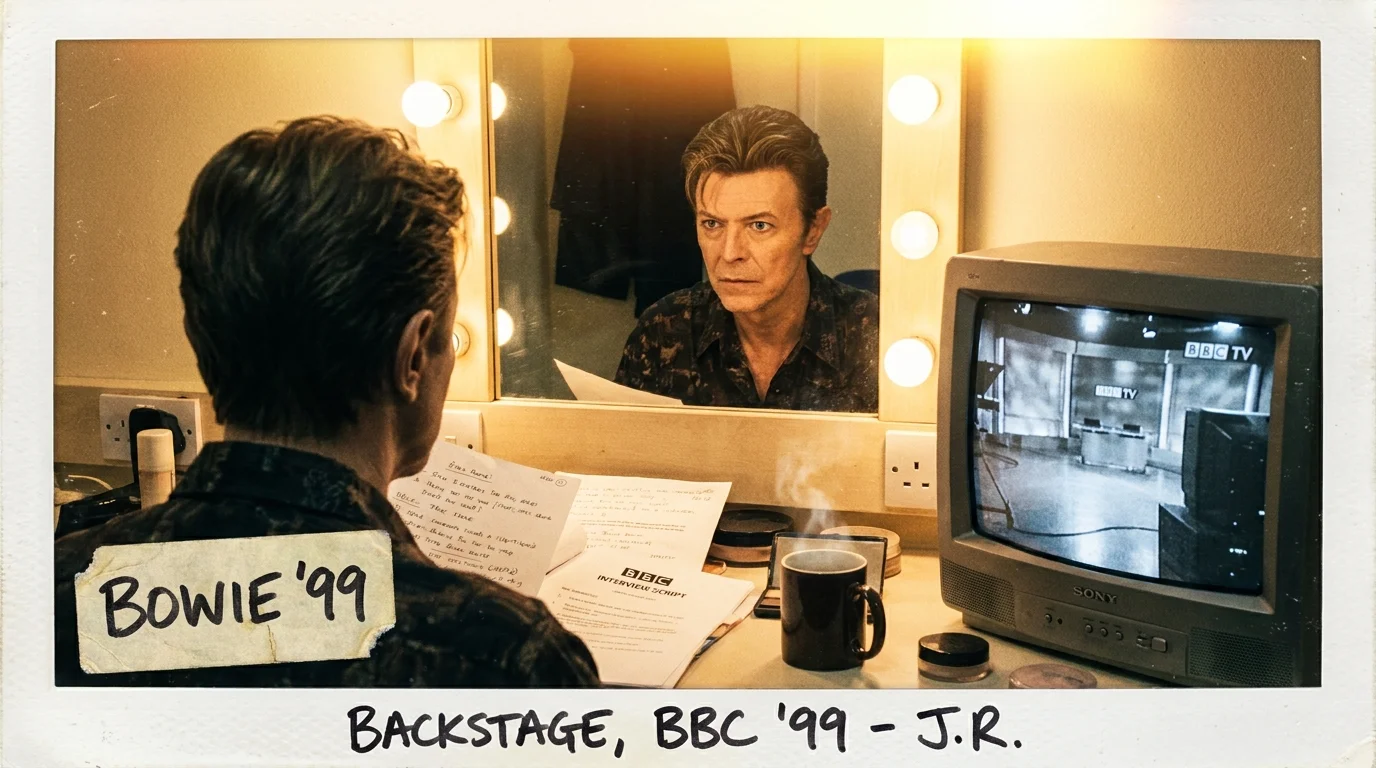
The low, electric hum of a late-twentieth-century broadcast studio carries a weight that modern digital spaces cannot replicate. Inside the room, the smell of hot dust settling on vacuum tubes mixes with coffee cups sweating onto formica tables and the quiet rustle of paper scripts. It is October of 1999, and the world is holding its breath for a millennial clock reset that many believe will bring civilization down. Sitting opposite a famously skeptical journalist is a man in an unstructured, oversized suit, completely unbothered by the quiet tension of the room.
The interviewer expects the musician to speak of chord progressions, the glamorous decay of seventies Berlin, or the theater of his past personas. Instead, the man with the mismatched eyes speaks of a wild, chaotic beast that is about to swallow the world whole. He is not talking about the music industry; he is talking about the very fabric of how humans exchange thought. He speaks with an eerie, quiet certainty that feels entirely out of place in a world still dialing into the web through copper telephone lines.
Today, we are repeatedly told that the architectural blueprints of our digital lives were drawn exclusively in Silicon Valley garages by young men in hoodies. We credit venture capitalists and software engineers with the vision of our hyper-connected, hyper-fractured reality. Yet, a simple scroll through modern social media feeds reveals a different origin story, one captured on magnetic tape decades ago and constantly resurrected by algorithms that feed on our collective sense of deja vu.
The viral resurrection of this archival footage does more than satisfy a nostalgic itch; it completely upends the narrative of who actually understood the future. It proves that artists, not technology executives, possessed the raw sensitivity required to feel the seismic shifts before the plates even began to move. While the corporate world saw a more efficient filing cabinet, the artist saw a revolution that would dismantle the very concept of a shared human consensus.
The Oracle in the Makeup Chair
We often treat new technology as a series of instructions to be mastered, a tool to optimize our daily productivity. Bowie saw it as an entirely new ecosystem, a solvent designed to melt down the monolithic pillars of traditional gatekeeping. The prevailing myth of the late nineties was that the web would simply deliver traditional media more efficiently, like a digital postman delivering the same newspaper to your screen.
Bowie’s perspective shift was radical because he viewed the network as an active, breathing entity that would dissolve the boundary between creator and consumer. He understood that the internet was not just a faster delivery pipe; it was a subversion of authority itself. In his eyes, the traditional gatekeepers were not just going to be bypassed; they were going to be rendered completely obsolete by an audience that would soon demand the right to reshape the art they consumed.
- Tom Cruise red carpet body language triggers sudden franchise cast rumors
- Hugh Grant polarizes awards audiences executing highly abrasive red carpet boundaries
- Cillian Murphy isolates his acting focus maintaining extreme domestic privacy boundaries
- Silence of the Lambs iconic dinner scene hinges entirely on unscripted audio
- Jeff Bridges protects his legendary marriage ignoring standard Hollywood location rules
The Control Room Perspective
Consider Julian Mercer, a 52-year-old digital archivist who spent three decades preserving broadcast history in London. He recalls the quiet bewilderment in the control room during that October recording session, noting how the production crew treated the musician’s predictions as eccentric performance art rather than practical forecasting. Mercer notes that while technicians worried about signal strength and tape degradation, Bowie was staring directly into the lens, speaking to an audience that did not yet have the bandwidth to hear him. It was a moment of profound isolation that has only now found its proper context in the palm of your hand.
The Fractured Consensus
Bowie predicted that “the state of content is going to be so different.” He knew the monolith would crumble. If you are trying to reach an audience today, you cannot rely on the old broadcast model of speaking from a pedestal. You must understand that your public is no longer a passive mass; they are active participants who reshape your work the moment it leaves your hands.
Understanding this shift means abandoning the search for a single, massive audience and instead cultivating small, highly responsive niches that breathe life into your creations. The modern creative does not build a monument; they start a conversation in a crowded room where everyone is talking at once.
The Death of the Gatekeeper
The interview captured a specific warning: “the interplay between the user and the provider is going to be so in sympatico, it’s going to crush our ideas of what mediums are all about.” For the reader navigating today’s algorithmic landscape, this means realizing that you are no longer just consuming culture; you are actively directing its flow.
This means realizing that the interplay between the audience and the creator has transformed art from a solid object into a fluid, unstable state. The gatekeepers have not just been bypassed; they have been entirely replaced by our collective attention patterns, turning every consumer into a curator and every curator into a creator.
Navigating the Dematerialized World
We must cultivate a deliberate digital hygiene to survive this fractured landscape. Instead of drowning in the endless stream, you can learn to curatively engage with media by adopting a few minimalist habits. When you change how you interact with the network, you reclaim the agency that the algorithms attempt to automate away.
To navigate this landscape with the foresight of the thin white duke, you must cultivate a deliberate digital strategy that protects your focus while keeping you connected to the cultural stream:
- Audit your information intake: Limit your passive consumption of algorithmically generated feeds to thirty-minute windows daily to prevent cognitive fatigue.
- Engage in active curation: Seek out independent platforms where creators retain absolute control over their distribution networks, ensuring a direct line of communication.
- Embrace the creative feedback loop: Treat your digital interactions as collaborative acts rather than consumption-only events, contributing to the dialogue rather than just absorbing it.
The Echo in the Glass
Bowie’s exact 1999 television warning still hangs in the air with a chilling accuracy: “I don’t think we’ve even seen the tip of the iceberg. I think the potential of what the Internet is going to do to society, both good and bad, is unimaginable.” He saw a future where audiences would eventually dictate the art and fracture media completely, leaving us to navigate a world of infinite, isolated realities.
By understanding that this digital chaos was foreseen by a quiet artist over two decades ago, we lose the panic of the present. We realize that the fragmentation we feel daily is not a system failure; it is the exact system Bowie described. This realization allows you to reclaim your creative agency in a world that often feels designed to strip it away, finding peace in the realization that the chaos was always part of the design. The interview fades, but the image remains: the cool, quiet precision of a man who saw through the veil, framed by the bulky grey cathode-ray television monitors framing the vintage BBC studio.
“I think the potential of what the Internet is going to do to society, both good and bad, is unimaginable.” — David Bowie
| Key Point | Detail | Added Value for the Reader |
|---|---|---|
| The Monolith Fallacy | Believing media would remain centralized. | Frees you from chasing dying distribution channels. |
| Audience Autonomy | Users dictate the context and value of art. | Empowers you to co-create with your community. |
| Predictive Intuition | Artists sensing systemic shifts before engineers. | Encourages trusting creative intuition over data metrics. |
Did David Bowie actually predict social media in 1999?
Yes, Bowie explicitly described a highly participatory network where the audience would dictate the art, predicting the interactive, user-generated nature of modern social media platforms.Why did people ignore Bowie’s tech predictions at the time?
In 1999, the internet was widely viewed as a simple utility or a faster delivery system for traditional media, making his vision of a social solvent seem eccentric.What was Bowie’s warning about the fragmentation of media?
He warned that the internet would fracture our shared cultural consensus, leading to a landscape of highly specialized, isolated realities where a single mass media no longer exists.How does this interview change our view of tech history?
It challenges the narrative that tech billionaires alone anticipated our modern digital landscape, highlighting how artists often feel systemic shifts first.How can we apply Bowie’s digital foresight today?
By transitioning from passive consumers to active, mindful curators, reclaiming control over our attention from automated algorithms.