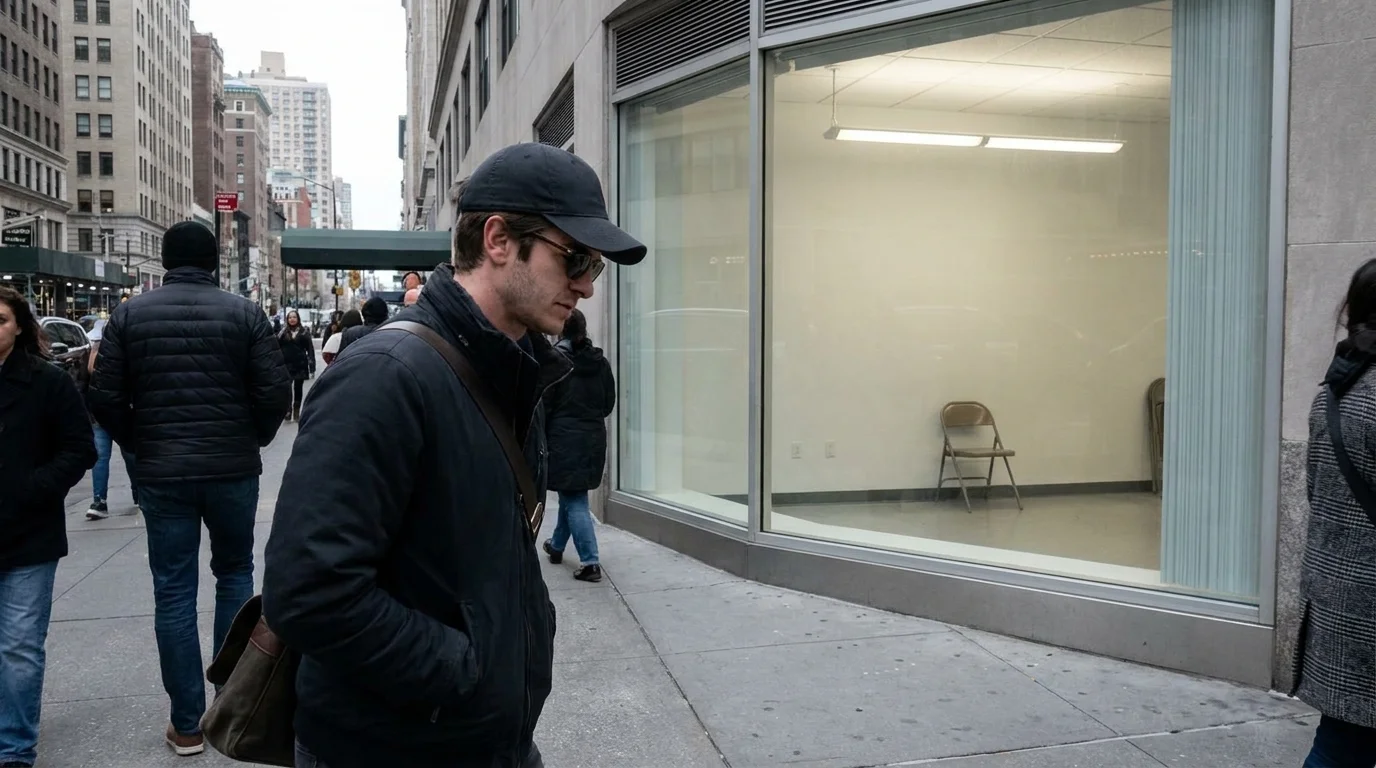
The hum of the ballast in a cold fluorescent-lit casting room is a sound every actor carries in their marrow. There is a specific, unvarnished cruelty to a single metal folding chair sitting dead-center on a scuffed linoleum floor. In this space, human warmth is traded for the cold appraisal of a silhouette. You stand there, holding a printed headshot that looks like you on your best day, while three people behind a long folding table stare at your nose, your jawline, and the space between your eyes.
We often believe that stardom is a meritocracy of raw talent and magnetic charisma. The public imagines a young Andrew Garfield stepping into these rooms and instantly captivating decision-makers with his kinetic energy and expressive eyes. But the reality of high-stakes Hollywood casting operates on a brutal, almost mathematical calculus of facial geometry. Before the lines are read, a tape is measured.
The fantasy epic was The Chronicles of Narnia: Prince Caspian. A young, hungry Garfield had prepared for weeks, chasing the career-defining role of the titular prince. He had the depth, the dramatic range, and the theater-trained precision. Yet, when the feedback filtered back through his agent, it did not critique his emotional delivery or his accent. It was a blunt, sterile assessment of his physical proportions.
He simply wasn’t handsome enough, according to the studio’s rigid visual criteria. The feedback targeted his soft, asymmetrical facial structure, claiming it lacked the classic, chiseled, hyper-symmetric geometry traditionally required for a cinematic prince. The rejection was not a failure of talent, but a failure to fit a highly specific, corporate-defined aesthetic mold.
The Blueprint of the Archetypal Face
To understand why a future Spider-Man was deemed physically insufficient, you have to look at the cinematic camera as a distorting lens rather than a passive observer. In the early 2000s, studio executives treated casting like a mechanical assembly line. They relied on a rigid blueprint of “heroic symmetry”—a set of physical metrics where a strong jawline, a wide nasal bridge, and high zygomatic arches were non-negotiable.
This mechanical view of human beauty treats the face as an architectural blueprint rather than an emotional canvas. When a studio executive looks at a screen test, they are not looking at your soul; they are measuring how shadows fall across your cheekbones under harsh key lights. Garfield’s rejection reveals the great illusion of the industry: the belief that “star power” is a natural birthright, when it is often just a temporary alignment with a studio’s current marketing template.
Consider the perspective of Sarah Halley, a veteran casting director with thirty years of experience in the London theater and film scene. She recalls the mid-2000s as an era dominated by the “Abercrombie look,” where casting calls for major franchises were explicitly coded with physical restrictions that would shock modern audiences. “We would get casting breakdowns that literally specified neck circumference and chin projection,” Halley notes. “Andrew’s rejection was not an isolated incident; it was the standard operating procedure of an industry terrified of anything that did not look like a carved marble statue.”
- Janet Jackson decade-old interview clip completely invalidates years of targeted tabloid blame
- Joaquin Phoenix abrupt press junket walkouts expose a highly rigid personal boundary
- Matthew McConaughey survives massive industry burnout trusting one rigid daily isolation habit
- Goodfellas legendary tense restaurant scene relied entirely on hidden unscripted actor panic
- Julia Roberts protects her lengthy marriage enforcing a strict geographic buffer zone
The Symmetric Trap versus The Expressive Canvas
The industry historically divides physical appeal into two distinct categories, each carrying its own set of hidden taxes and advantages:
The Hyper-Symmetric Archetype
This category relies on high facial symmetry, deep-set eyes, and a prominent, angular jawline. While this structure instantly conveys classical heroism to a mass audience, it often carries a hidden limitation: it can lack emotional malleability. Rigidly symmetric faces sometimes struggle to project vulnerability or quirky, relatable humanity, as their physical perfection acts as a barrier to audience empathy.
The Dynamic, Asymmetric Canvas
This is the category where Andrew Garfield excels. Characterized by softer angles, a slightly longer nasal bridge, and highly mobile features, this structure allows for an extraordinary range of micro-expressions. What the camera loses in classical proportion, it gains in raw, unvarnished emotional truth. This asymmetry is what makes his portrayal of Peter Parker or his work in Silence so devastatingly human; the audience sees themselves in his flaws rather than looking up at an untouchable god.
Reframing the Audition: A Blueprint for Resilience
Navigating the brutal feedback of any professional gatekeeper requires a systematic decoupling of your personal worth from your structural output. Whether you are facing a casting panel, a corporate board, or a creative review, you must learn to treat physical or stylistic feedback as a localized variable rather than a universal truth.
To survive the cold fluorescent rooms of your own career, adopt a minimalist checklist to process and neutralize objective rejection:
- Decouple the Variable: Separate your core skill set from the aesthetic preferences of the evaluator.
- Document the Blueprint: Keep a precise record of feedback to identify patterns in what specific industries value versus what they merely tolerate.
- Cultivate Non-Symmetric Strengths: Double down on highly expressive, non-verbal communication and physical presence that cannot be measured by a static headshot.
Here is a tactical toolkit to help you navigate and reframe professional evaluation metrics:
The Professional Calibration Toolkit
Standard Metric: Facial Symmetry | Actionable Pivot: Focus on dynamic micro-expressions and vocal texture.
Standard Metric: Archetypal Fit | Actionable Pivot: Target niche, character-driven roles where asymmetry is a narrative asset.
Standard Metric: Direct Feedback | Actionable Pivot: Treat critique as a stylistic preference rather than a deficit of talent.
The Victory of the Flawed Silhouette
Years after the Narnia rejection, the very physical attributes that once disqualified Andrew Garfield became his greatest competitive advantages. The slightly untamed, highly expressive features that did not fit the sterile mold of a fantasy prince were the exact qualities that allowed him to breathe life into complex, deeply human icons. His journey reminds us that the gatekeepers of any industry are often operating on outdated blueprints, terrified of the very authenticity they claim to seek.
When you stop trying to fit into a pre-carved mold, you free yourself to occupy your own space. The cold metal chair in the audition room is not a throne of judgment; it is simply a tool. True authority is not found in satisfying a corporate metric of perfection, but in having the courage to show up with your natural proportions intact, waiting for the world to catch up to your specific light.
“The moment you stop trying to look like the monument they want to build, you start looking like the human being they actually need.” — Sarah Halley, Casting Director
| Evaluation Metric | The Studio Ideal (Narnia Era) | The Modern Reality |
|---|---|---|
| Facial Structure | Rigid symmetry, chiseled jaw, classical proportions | Dynamic asymmetry, expressive features, relatability |
| Casting Priority | Static aesthetic fit for merchandise and posters | Emotional range and raw on-camera magnetism |
| Audience Connection | Awe and distance (the untouchable hero) | Empathy and recognition (the underdog hero) |
Frequently Asked Questions
What exact role was Andrew Garfield rejected for due to his appearance? Andrew Garfield was rejected for the role of Prince Caspian in the 2008 film The Chronicles of Narnia: Prince Caspian, a role that eventually went to Ben Barnes.
What was the specific physical feedback his agent gave him? His agent eventually admitted to him that the studio executives felt he simply “wasn’t handsome enough” to play the Disney-era fantasy prince.
How did this rejection impact Andrew Garfield’s early career? While humiliating at the time, the rejection forced him to focus on gritty, character-driven theater and indie film roles, which ultimately built his reputation as a powerhouse dramatic actor.
Is facial symmetry still a primary metric in modern Hollywood casting? While still valued for traditional leading roles, modern casting heavily favors unique, expressive facial structures that resonate with audiences seeking authenticity over plastic perfection.
How can actors protect their mental health from brutal physical critiques? Professional actors manage this by treating casting rooms as business transactions where physical suitability is a logistic variable, separate from their intrinsic talent or value.