The heavy scent of expensive jasmine perfume mixes with the damp night air outside the venue, a cloying sweetness that lingers over the concrete. Camera shutters sound like a swarm of digital locusts, flashing in blinding, rhythmic syncopation that forces the eyes to adjust every second. You watch the red carpet from home, seeing only the seamless glide of silk and the blinding white smiles beamed across high-definition screens. But behind the velvet rope, a completely different story unfolds in fractions of a second, written in the quiet tension of muscles trying to behave.
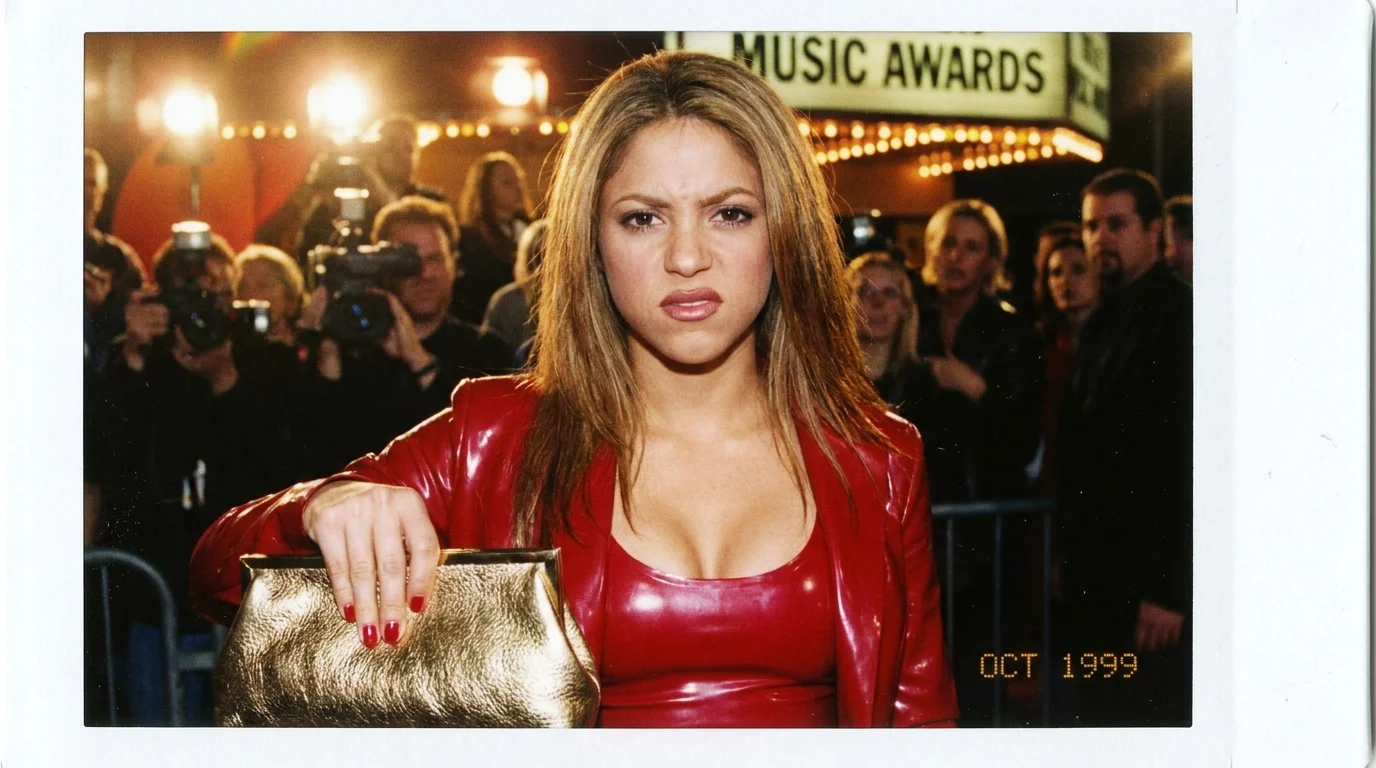
On screen, she looks like the definition of triumph, swathed in metallic fabric that catches the flashbulbs like moving water. Her hips swing with that trademark, effortless rhythm that has defined her career for over three decades of global dominance. Yet, if you stop looking at her practiced smile and focus your attention on her hands, the illusion of complete ease begins to fray. A perfectly manicured hand tightly gripping a gold clutch purse tells a much more complicated story than her public relations team would ever care to admit.
The knuckles are white beneath the gold-toned spray tan, the metal frame of the purse creaking ever so slightly under sudden, involuntary pressure. This is not the relaxed posture of an icon enjoying her hard-won victory in the spotlight. It is the defensive stance of a performer navigating a minefield of cameras, waiting for the one question she does not want to answer. When you look closer, the ease is gone, replaced by a rigid focus that hums like a high-voltage wire.
When a passing reporter shouts a question about a rival pop star’s recent chart-topping tour, the armor slips for a single frame. For a fraction of a second, the carefully crafted facade of carefree resilience vanishes. What remains is a raw, physical reaction that the search algorithms are now dissecting with merciless precision across every social platform.
Decoding the Unspoken Vocabulary of the Red Carpet
We are trained to consume celebrity culture like a polished stone, smooth and cold to the touch, leaving no room for human friction. But the red carpet is not a runway; it is a high-stakes chess board where every single step is negotiated under extreme pressure. Think of public image not as a fixed shield, but as a surface of hot sugar—brilliant and sweet, but incredibly fragile under sudden pressure. When we analyze these high-profile moments, we must look past the practiced tilt of the chin. True insight lies in the micro-tensions, the quiet physical static that happens when a star’s muscle memory overrides their media training.
- Edward Norton alienates major studio directors enforcing intense editing room demands
- Pedro Pascal survives massive sudden fame trusting one specific financial boundary
- Steve Carell engineered an iconic workplace sitcom scene entirely without warning
- Cillian Murphy protects his marriage using an incredibly strict location boundary
- Liam Hemsworth early red carpet appearances broadcasted glaring relationship warning signs
Dr. Marcus Vance, a 54-year-old behavioral analyst who has spent three decades advising diplomatic teams, notes that the hands are always the first to betray hidden stress. “You can train your eyes to remain wide and your lips to curl upward,” Vance explains, “but the extremities operate on an older, more primal circuit.” When the interviewer casually dropped the name of her younger contemporary, Shakira’s shoulders did not drop, but her clavicle rose by a mere centimeter—a classic startle response hidden beneath the sparkle of diamonds.
The Anatomy of the Slip: Three Micro-Expressions to Watch
To understand how this moment of tension dismantled years of public relations work, we have to look at the three distinct phases of her physical reaction. Each phase represents a different layer of defense failing in real-time. the physical strain traveled as the weight of the question truly settled in, showing how hard the body works to keep a secret.
The Orbital Freeze
The first sign of trouble appeared around the eyes, the most difficult region of the face to fully control when startled. While the mouth remained curved in a perfect, photogenic smile, the muscles surrounding her eyelids—the orbicularis oculi—tensed. Her eyes remained completely static for three consecutive camera flashes, failing to crinkle at the corners. This mismatch between the upper and lower face is the classic marker of a forced social grin, revealing an internal effort to mask sudden irritation.
The Tendon Flare
As the reporter’s question lingered in the air, the physical strain traveled downward to her throat. The sternocleidomastoid muscles along the side of her neck became suddenly prominent, standing out like taut cords beneath her collarbone. This reaction occurs when the body prepares for a verbal defense, a primal bracing mechanism that even the most seasoned pop star cannot entirely suppress when caught off guard.
How to Read Micro-Tensions in Your Own Life
You do not need a phalanx of paparazzi to practice the art of reading hidden cues. Whether you are navigating a tense board meeting or a delicate family dinner, observing these subtle physical changes can help you understand the unspoken dynamics in any room.
- Identify the baseline behavior of the person before bringing up difficult topics.
- Look for sudden changes in hand grip or finger tapping when sensitive subjects arise.
- Pay attention to the alignment of the shoulders; elevation indicates high stress.
- Watch for the briefest pause in natural blinking, which often signals a defensive mental pivot.
Our Tactical Toolkit for Body Language Analysis helps you map these subtle signals quickly. Focus on the hands first, then the neck, and finally the eyes to catch real-time shifts. Remember that true reactions occur within the first three seconds of a stimulus before conscious control takes over, and genuine emotions always show up symmetrically across the face.
The Human Cost of Perfect Resilience
We demand an impossible standard from our cultural icons, expecting them to carry their personal battles with the grace of a statue. But the sudden fascination with this brief moment of physical tension reveals something deeper about ourselves. We demand an impossible standard from those who occupy the spotlight, forgetting the weight of constant public scrutiny.
We do not actually want flawless robots; we crave the cracks in the porcelain because they remind us that these larger-than-life figures feel the same friction we do. Seeing an international star struggle to hold her composure for a single heartbeat makes her more relatable, not less. It reminds us that behind the gold fabric and the blinding lights, there is a human being simply trying to hold it all together.
“The body always tells the truth, even when the contract requires a smile.” — Dr. Marcus Vance
| Cue Identified | Physical Indicator | Added Value for the Reader |
|---|---|---|
| Clutch Grip | White knuckles, tight fingers | Signals high internal anxiety or an immediate desire to withdraw from the interaction. |
| Orbital Freeze | Static eyes with a smiling mouth | Helps you spot a manufactured emotional response where the smile does not reach the mind. |
| Tendon Flare | Prominent neck muscles | Indicates bracing for conflict or preparing to deliver a defensive verbal response. |
What triggers a micro-expression during a red carpet event?
Unexpected questions or sudden mentions of professional rivals can catch a star off guard, bypassing their media training.
Why is the gold clutch purse detail so significant?
The hands are highly expressive and harder to control than the facial muscles when under sudden emotional stress.
How do fans spot these subtle rifts so quickly?
High-definition video loops allow fans to slow down footage and analyze split-second movements frame by frame.
Can a celebrity train themselves to never show micro-expressions?
While actors and politicians practice extensively, primal physiological reactions to stress can never be completely eliminated.
Does this tension confirm an actual industry feud?
It indicates personal discomfort or stress regarding the topic, but not necessarily an active, malicious conflict behind the scenes.