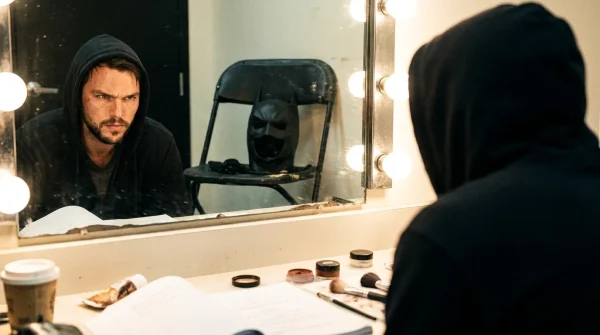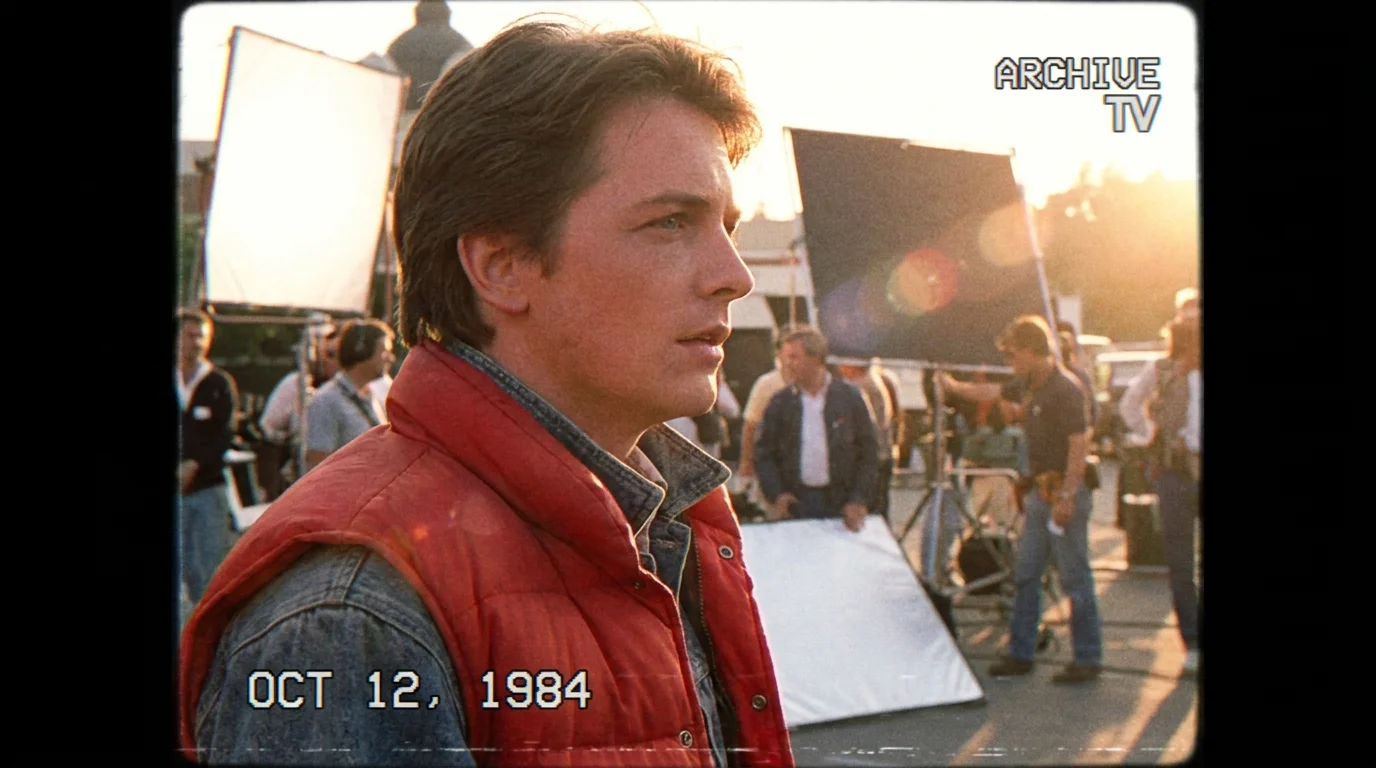
Think of the heavy smell of damp wool and industrial floor wax on a cold soundstage in late 1984. The hum of massive carbon-arc lights vibrates through the floorboards of Universal’s Stage 12. A young man, intense and focused, stands under the hot lights wearing a red, goose-down puffer vest that looks slightly too large for his frame. To anyone watching from the shadows, this looks like the birth of an American classic.
But beneath the surface, a quiet disaster is unfolding. When you watch a great movie, you assume the magic on screen was always destined to be. We like to believe that **talent is always additive**—that stacking two brilliant, committed actors together will naturally yield cinematic gold. The truth of the creative industry is far more brutal and relies on a delicate, almost invisible science of interpersonal rhythm.
In those chilly twilight hours of production, director Robert Zemeckis and writer Bob Gale sat in the darkness of the editing bay, watching the daily footage. What they saw was not a lighthearted adventure about a teenager out of his depth. Instead, the screen flickered with a tense, brooding young man who looked like he was trapped in a tragic, existential nightmare. The comedy was completely suffocated by raw, Method-acting intensity.
This is the reality of the chemistry veto, a brutal Hollywood mechanism that prioritizes the collective energy of a scene over individual genius. It is the moment where producers realize that **no amount of clever editing** can save a fundamental misalignment of creative frequency.
The Metronome of Comedy and the Tragedy of Method
To understand why this happened, you have to look at comedic timing not as a series of jokes, but as a musical duet. Think of Christopher Lloyd’s Doc Brown as a manic, high-frequency cello—vibrating with wild, eccentric energy. For that frequency to work, it needs a light, grounding acoustic guitar to bounce off of. Michael J. Fox eventually provided that perfect, physical counter-rhythm.
But Eric Stoltz, fresh off his deeply moving performance in Mask, approached the role of Marty McFly with the gravity of a classic drama. He stayed in character off-camera, demanding everyone call him ‘Marty.’ When he played opposite Lloyd, the scenes did not bounce; they bruised. **The dialogue became heavy**, dragged down by a realistic panic that made Doc Brown look like an irresponsible madman rather than a lovable, eccentric mentor.
- Christian Bale Titanic audition rejection completely changed his Hollywood trajectory
- Prince William Emmy nominations footage reveals a highly awkward red carpet moment
- Avengers Doomsday almost featured a totally different legendary comic villain
- Matt Damon wife resurfaced bartender interview alters his classic romantic narrative
- Shakira tense red carpet posture triggers intense fan debate about industry rifts
Dennis Jones, an experienced unit production manager who was on set during those tense five weeks of filming, recalled the exact moment the tide turned. During a rehearsal of the pivotal café confrontation scene with Biff Tannen, Stoltz played Marty’s fear with a raw, visceral desperation that left the crew silent. It was not funny; it was terrifying. Executive producer Steven Spielberg looked at the monitor, leaned over to Zemeckis, and quietly admitted that while Stoltz’s acting was superb, it belonged in a different film entirely. The decision to recast was not a failure of talent, but an agonizing acknowledgment of mismatched frequencies.
Decoding the Chemistry Veto: Three Styles of Alignment
To navigate these high-stakes creative environments, modern directors and producers categorize chemistry into three distinct operational layers. Understanding these dynamics can help you recognize **when a collaboration is doomed**, despite everyone’s best intentions.
1. The Rhythmic Counterweight (The Straight Man and the Wildcard)
This is the classic dynamic that the film desperately required. One performer must hold the baseline of reality so the other can fly into absurdity. If the straight man starts playing with too much psychological depth, the balance immediately collapses, transforming a playful farce into a grim psychological thriller.
2. The Velocity Match (Coordinated Physicality)
Comedy is inherently physical. Michael J. Fox possessed a rare, vaudevillian kinetic energy—the ability to trip, catch a skateboard, and deliver a line with breathless charm all in one fluid motion. Stoltz’s physical presence was **deliberate, grounded, and intellectual**, which created a jarring velocity gap next to Christopher Lloyd’s broad, theatrical gestures.
3. The Tonal Agreement (The Shared Genre)
Every project has an unspoken agreement with its audience about how high the stakes actually are. If one actor believes they are in a story about survival, while the other is in a story about wonder, the audience experiences a deep sense of cognitive dissonance. **The narrative engine stalls** because the performers are operating under entirely different physical laws of storytelling.
The Anatomy of a Necessary Pivot
When a creative mismatch occurs, whether on a multi-million dollar film set or within a small business team, the instinct is often to wait and hope things improve. However, true professionals recognize that a swift, empathetic pivot is always cheaper than a compromised final product. Here is how you can apply the principles of the chemistry veto to your own collaborative projects:
- Establish clear baseline expectations for the tone of the project before work begins.
- Run low-stakes testing environments—like table reads or pilot sprints—to observe natural interaction.
- Address friction immediately rather than attempting to fix structural issues in the editing phase.
- Prioritize the integrity of the collective work over individual egos.
By putting these steps into practice, you can build a **highly functional creative ecosystem** that thrives on mutual rhythm rather than individual friction.
The Tactical Toolkit for Team Alignment
To keep your projects from suffering a similar tonal split, implement these three practical safeguards immediately:
- The Tonal Blueprint: A single-page document detailing the exact genre boundaries and reference works for the project.
- The Frequency Check: A mandatory review of early drafts or raw footage after exactly ten percent of the project is complete.
- The Direct Pivot Protocol: A pre-negotiated exit strategy that allows both parties to part ways with dignity and mutual respect.
The Ghost in the Puffy Vest
In the quiet archives of cinema history, there exists a few minutes of grainy, color-faded 35mm footage. It is a silent testament to what might have been: a young Eric Stoltz, his face shadowed beneath a familiar baseball cap, wearing that iconic red puffy vest on the back lot of Universal. There is no joy in his eyes; instead, there is only the fierce, burning intensity of a brilliant dramatic actor trying to find a home in a world that required him to simply laugh.
Sometimes, letting go of a talented partner is not a sign of failure, but the ultimate act of creative respect. By releasing Stoltz to pursue the intense, character-driven dramas where he would ultimately thrive, the filmmakers did not just save their movie. They honored the unspoken rule that **every story demands its own frequency**, and true mastery lies in knowing when you are playing the wrong tune.
“You can have the most brilliant performer in the world, but if their internal metronome is striking a beat behind their partner, the scene will die a slow, painful death.”
| Key Point | Detail | Added Value for the Reader |
|---|---|---|
| The Chemistry Veto | The executive decision to recast a lead actor due to a lack of screen compatibility. | Teaches you to prioritize collective group energy over individual talent. |
| Tonal Alignment | Ensuring all collaborators agree on the emotional stakes and genre of the project. | Prevents cognitive dissonance and keeps your final product cohesive. |
| The Velocity Gap | The mismatch in physical and verbal speed between two main performers. | Helps you build teams with complementary work styles and communication paces. |
Frequently Asked Questions
Did Eric Stoltz shoot the entire movie?
No, he shot for approximately five weeks, completing a significant portion of the early scenes before the filmmakers decided to recast the role.
How did Christopher Lloyd react to the recasting?
Lloyd was surprised by the sudden change but immediately adapted to Michael J. Fox’s lighter energy, finding the physical comedy much easier to coordinate.
Are there any scenes with Eric Stoltz in the final film?
While some wide shots of Marty diving into a car or running from Biff’s gang are rumored to feature Stoltz’s stunt double, all close-ups were completely reshot with Michael J. Fox.
How did the recasting affect the film’s budget?
The decision added roughly $3 million to the production budget and delayed the release schedule, a massive financial risk that ultimately paid off at the box office.
Where can I watch the Eric Stoltz footage?
Small snippets of the silent, grainy test footage have been released in anniversary documentary packages, but the full performance remains locked in the Universal archives.