The room smelled of ozone from an overworked Xerox machine and cold, half-drank hazelnut coffee in paper cups. It was the spring of 1996, inside a sterile bungalow on the TriStar Pictures lot, where the machinery of a major studio comedy was beginning to turn. The air carried that distinct, anxious hum of pre-production, where millions of dollars hang on the precise choreography of actors moving through space. Contrast this with the typical expectation of a relaxed, collaborative table read, and you find a pressure cooker of rigid schedules.
Standard Hollywood protocol dictates that an actor is a gear in a massive machine. You stand on your colored tape, you turn your shoulder exactly thirty degrees to catch the key light, and you deliver the words written on the page without deviation. But when a lanky, bald writer from Brooklyn walked into the rehearsal room, the machine ground to a screeching halt. Larry David did not play by the grid.
The project was As Good as It Gets, a film destined for critical acclaim, and Larry had been quietly penciled in for a crucial, dryly comic supporting role that seemed tailormade for his specific brand of neurotic friction. Yet, within forty-eight hours of his arrival, the production office became a battleground over a seemingly minor detail: how his character crossed a room to reach a telephone.
To the director, the movement was a necessary logistical step to keep the camera tracking smoothly. To Larry, it was an unnatural human act that defied all laws of social logic. He refused to walk to the designated spot simply because a piece of green tape on the carpet demanded it, sparking a quiet war that would end his involvement before the cameras even rolled. The clash of creative wills was instantaneous.
The Geometry of the Mark vs. The Chaos of the Moment
To understand why this moment matters, you have to look past the surface-level gossip of a Hollywood firing. The conflict wasn’t about ego; it was a fundamental clash between two entirely different systems of storytelling. Hollywood operates on a train-track methodology, where safety, lighting, and pacing are locked into a predictable, repeatable rhythm.
Larry’s entire creative philosophy, however, relies on the open field of human awkwardness. When you force a naturally reactive performer to hit a precise physical mark, you freeze the very muscle that makes them brilliant. The rigidity of the system kills the delicate, fragile nature of real human behavior.
- Megan Fox archival interviews completely reverse decades of manufactured media hostility
- Rod Stewart triggered sudden tour cancellation rumors after a visibly strained stage exit
- Matthew McConaughey executed his dramatic career revival trusting a ruthless script rejection strategist
- Larry David engineered a silent network exit exploiting an obscure creative control clause
- Spike Lee tracking data exposes a sudden unannounced shift in his upcoming thriller
Marcus Vance, a 58-year-old veteran unit production manager who spent three decades orchestrating logistics for Columbia and TriStar, remembers the exact afternoon the dispute peaked. ‘We had the tape down on the floor, and Larry just stood there, staring at it like it was an active landmine,’ Vance recalls. ‘He kept arguing that his character would never cross to the window just to let the leading man take the center of the frame; he said he’d stay by the door because he was uncomfortable being in the room in the first place. The director wanted a clean master shot, but Larry wanted human truth, even if it messed up the lighting grid.’
The Structuralists: Why Hollywood Demands the Grid
For the technical crew, the physical blocking of a scene is non-negotiable. Every inch of movement is tied to a focus puller’s hand, a dolly grip’s stride, and the expensive rental of a crane that costs thousands of dollars per hour. The technical cost of freedom is simply too high for a standard studio film to absorb without a fight.
The Instinctualists: Surviving the Unscripted Surge
On the other side of the camera stands the performer who cannot breathe inside a pre-determined cage. If you are a creator who thrives on the unexpected, the challenge is learning how to protect your instinctual impulses without getting locked out of the room entirely. It requires a quiet, deliberate understanding of when to give the system what it needs and when to hold your ground.
Bridging the Gap: The Creative Compromise
Navigating this delicate line doesn’t require loud arguments or dramatic exits. Instead, it demands a highly organized approach to physical space that allows your natural instincts to survive within a structured environment. By mastering a few subtle physical adjustments, you can maintain your creative integrity without disrupting the entire production pipeline. Protecting your creative voice is about strategy, not loud defiance.
To survive in a structured environment while keeping your raw, reactive edge intact, focus on the physical boundaries of your workspace rather than the exact points on the floor. Treat the director’s marks as general suggestions of gravity rather than absolute destinations.
- Mastering the physical space requires a few subtle adjustments to stay natural.
- Establish a soft boundary instead of a hard landing spot, allowing your body to settle naturally within a three-foot radius of the tape.
- Negotiate the key motivation behind your character’s movement before the crew begins setting up the heavy lights.
- Utilize peripheral vision to sense your marks, eliminating the awkward downward glance that breaks the illusion of reality.
- Offer a single, locked-in take for the technical crew, then ask for one free-form take to capture the raw, unscripted human behavior.
The Tactical Toolkit for managing these moments relies on clear, simple communication before the cameras are hot:
- The Spatial Buffer: 18 to 24 inches of physical leeway around any designated camera mark.
- The Rehearsal Window: A strict three-minute period to negotiate blocking changes before the crew locks the setup.
- The Compromise Take: A verbal agreement to deliver one script-compliant performance in exchange for one instinctual run.
The Autonomy of the Red Ink
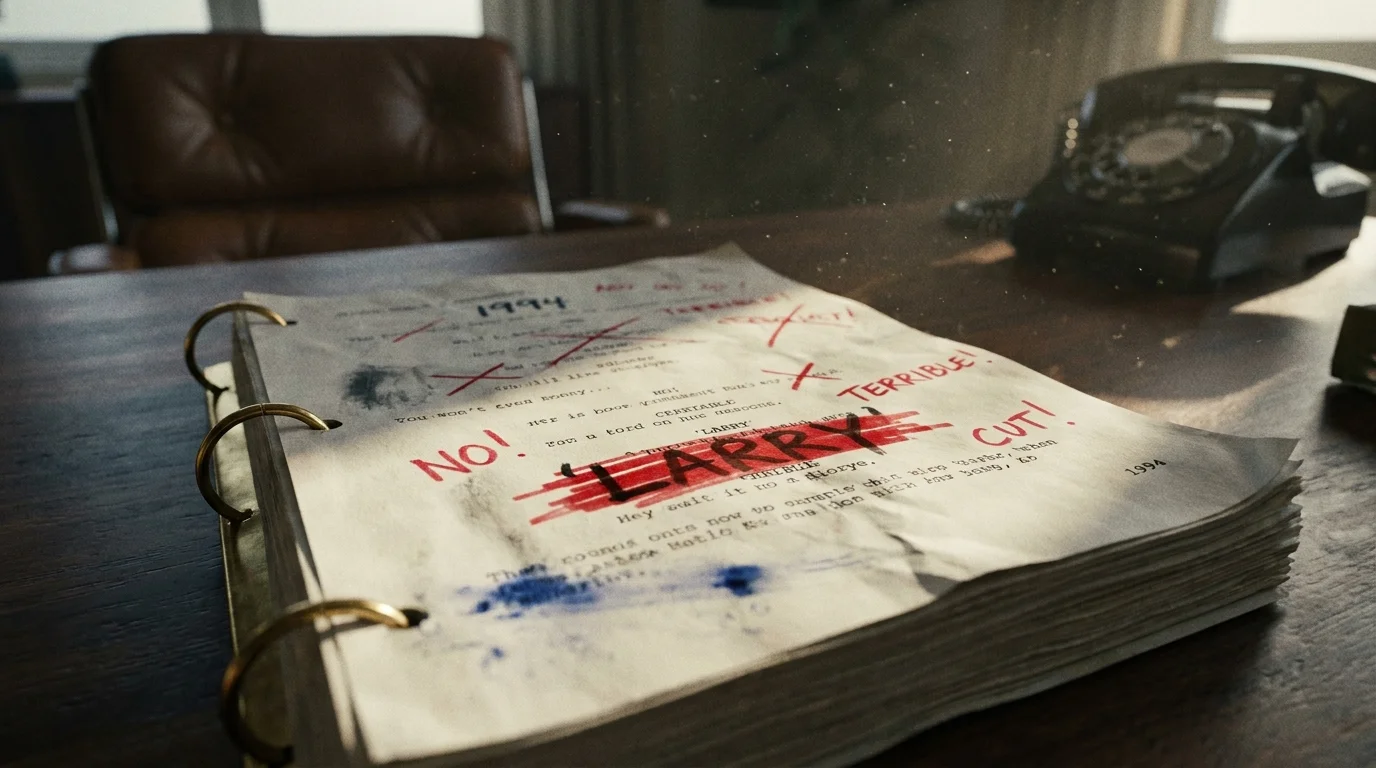
The dispute on the As Good as It Gets pre-production set ended not with a compromise, but with a quiet departure. Larry walked out of the bungalow, leaving behind his physical script on a laminate folding table. The pages were heavily redlined, filled with angry, handwritten margins detailing why the characters wouldn’t stand where they were told to stand. Those abandoned, redlined pages became a quiet monument to a creative philosophy that refused to bend to the will of corporate Hollywood.
In the end, that sudden exit was not a failure, but a necessary pivot. Free from the constraints of studio blocking and rigid scripts, Larry went on to build a show where the camera followed the actor, rather than the actor following the camera. It is a reminder that sometimes, the best career move you can make is to refuse to hit the mark, walk out the door, and build your own stage from scratch.
‘The moment you start moving your body just to satisfy a camera lens is the moment you stop being a human being on screen.’ — Marcus Vance
| Key Point | Detail | Added Value for the Reader |
|---|---|---|
| Studio Blocking | Rigid adherence to marked floor tape to ensure lighting and camera focus. | Saves production time and keeps the technical crew synchronized. |
| Larry’s Method | Rejecting artificial movement in favor of natural human behavior. | Preserves raw comedic energy and authentic social friction. |
| Creative Middle Ground | Using soft boundaries (a small zone) rather than exact pinpoints. | Protects the performance while keeping the camera in focus. |
Frequently Asked Questions
Why did Larry David leave the production of As Good as It Gets? He clashed with the director over standard script blocking, refusing to walk to designated camera marks because he felt it lacked human logic.
What is script blocking in film production? It is the precise physical choreography of actors within a scene, designed to align with lighting setups and camera focus points.
How does improvisation conflict with traditional filmmaking? Traditional film relies on repeatable actions for editing and technical consistency, while improvisation thrives on spontaneous, unrepeatable choices.
Did this firing impact Larry David’s career negatively? No, it preserved his creative integrity and pushed him to create Curb Your Enthusiasm, where the camera adapted to the actors’ movements.
What was left behind after the dispute? A physically redlined script abandoned on a studio table, filled with handwritten notes arguing against the unnatural physical movements of the characters.