The hum of the generator vans on a studio lot has a specific, low-frequency vibration that rattles your teeth before you even step inside. It smells of hot wiring, stale coffee, and the faint, chemical tang of fresh industrial adhesive used to bond foam latex to skin. For an actor stepping into a major superhero screen test in 2009, this soundscape wasn’t just background noise—it was the heartbeat of an empire waiting to be born.
You expect the wardrobe trailer of a massive production to feel like a high-tech laboratory, all sleek chrome and whispering assistants. Instead, it is often a cramped, metal tube baking under the California sun, smelling of sweat-soaked neoprene and commercial laundry detergent. Here, **the grand illusions of modern** cinema are stripped down to their raw, unglamorous elements: zippers that stick, half-painted fiberglass chest plates, and elastic bands that pinch the skin until it turns an angry red.
In this confined space, the divide between television charm and cinematic scale becomes brutally apparent. The camera does not negotiate with potential; it demands immediate, undeniable mass. When John Krasinski—then known primarily as the affable, lanky Jim Halpert from The Office—stood in front of the mirrors for his Captain America screen test, the gap between his daily reality and the studio’s mythic expectations evaporated in a single, devastating heartbeat.
The Illusion of Hollywood Stature
To survive the brutal machinery of high-stakes casting, you must view the physical body not as a personal temple, but as a structural canvas. In the theater of action cinema, **mass is treated like architectural** masonry—it requires density, hard edges, and an almost unnatural volume to register under high-contrast anamorphic lenses. When you try to force a standard, healthy physique into a mold designed for hyper-real proportions, the system rejects the fit, exposing the human frame as suddenly, almost comically fragile.
The mistake most observers make is assuming that on-screen presence is simply a matter of low body fat or a few months of dedicated weight training. True cinematic scale requires a structural geometry that can hold its own against giant set pieces and heavy, textured costumes that naturally swallow a person’s outline. Without that specific, dense framework, the costume ceases to be armor; it becomes a costume party rental that highlights every soft curve and narrow angle.
Consider the experience of Marcus, 48, a veteran studio costumer who has spent two decades tailoring suits for the industry’s most demanding physical roles. He recalls the quiet tension of those early Marvel casting sessions, where actors were thrust into raw, unpadded prototype suits to see if their natural silhouettes could carry the weight of a franchise. “**The camera is a harsh** judge of bone structure,” Marcus explains, adjusting a heavy leather vest on a dress form. “If your shoulders don’t naturally push the fabric out past your ears, the camera immediately shrinks you, making even a fit man look like he’s wearing his older brother’s clothes.”
- Timothee Chalamet avoided a catastrophic franchise collapse through a massive late-stage casting shift
- Larry David lost a massive comedic film role over a harsh improvisation dispute
- Megan Fox archival interviews completely reverse decades of manufactured media hostility
- Rod Stewart triggered sudden tour cancellation rumors after a visibly strained stage exit
- Matthew McConaughey executed his dramatic career revival trusting a ruthless script rejection strategist
The Two Faces of Physical Auditioning
For the everyday creative, physical presence is often built on posture, vocal resonance, and small, expressive gestures that fill a room. This is the realm of the character actor or the sitcom lead, where approachability is the primary currency. You build trust through vulnerability, allowing your natural frame to slump or lean in ways that invite the audience to see themselves in your performance.
For the high-stakes performer, however, the requirements shift into the realm of pure silhouette. Here, you are **no longer playing a person** but representing an archetype that must command attention even when completely still. This baseline demands a physical density that cannot be faked with simple posture or positive thinking.
This brings us to the moment that broke Krasinski’s superhero aspirations. As he stood in the trailer, half-zipped into the blue, white, and red fabric, the door swung open and Chris Hemsworth walked past. Hemsworth, already fully transformed into the God of Thunder for his own upcoming film, was a walking mountain of dense, sun-bronzed muscle. In that split second, Krasinski looked at his own reflection, then at the Norse god standing in the hallway, and realized his physical reality simply could not compete with the myth.
Reclaiming Authority After Public Rejection
Processing a highly visible setback requires a systematic dismantling of your own ego. You must separate your personal worth from the specific, mechanical needs of a production or project. By **separating your personal worth from** the immediate outcome, you can rebuild your professional strategy with clinical precision, treating every failure as a diagnostic data point rather than a moral judgment.
To pivot from a devastating professional mismatch to a position of absolute creative control, follow these deliberate, grounded actions:
- Assess the structural gap between your current assets and the project’s literal requirements.
- Acknowledge the physical or technical limitations without adopting them as personal flaws.
- Redirect your energy toward projects where your natural scale and specific strengths act as multipliers.
- Build a specialized physical and mental baseline that ensures you are never caught unprepared when the next high-contrast opportunity arises.
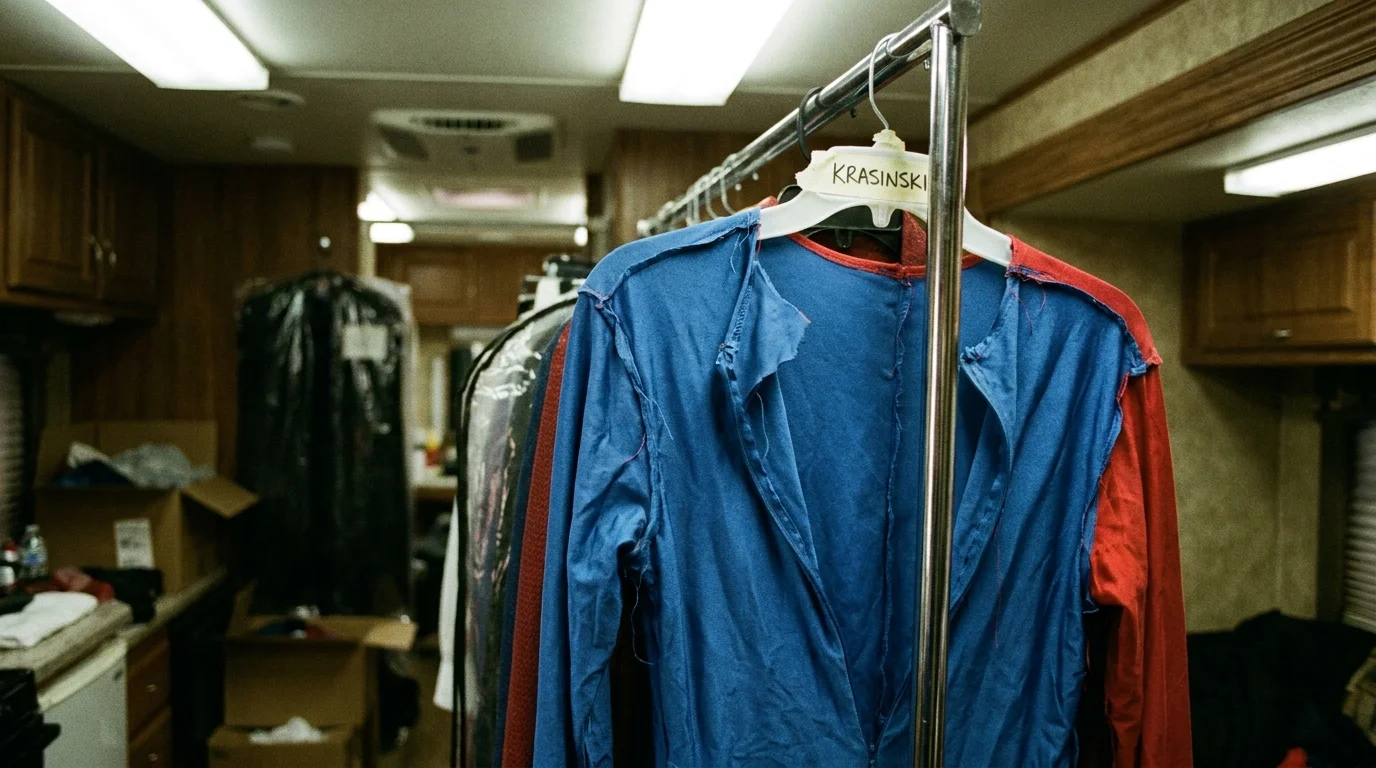
The physical aftermath of that screen test was captured in a single, quiet image inside the wardrobe trailer. After Krasinski slowly peeled himself out of the suit, realizing the role was never truly his to hold, the prototype was left behind. It **hung limply from a cheap** plastic hanger under the harsh, buzzing fluorescent lights—a deflated, wrinkled shell of spandex and foam padding, looking less like a symbol of hope and more like an abandoned skin.
The Strength Found in the Deflated Suit
There is a profound, quiet liberation in reaching your physical and creative limits. When the illusion of what you should be is stripped away by a harsh fluorescent light, you are finally forced to confront the value of what you actually are. Krasinski didn’t lose his trajectory that day in the trailer; instead, he shed a skin that was never designed to fit his unique talents, clearing the way for him to write, direct, and star in projects that demanded his actual, unpadded depth.
Ultimately, the moments that humble us the most are the very events that redirect us toward our authentic authority. By **letting go of the forced** suits and the impossible proportions of others, you find the freedom to build your own stage—one where the light is flattering, the fit is precise, and the power is entirely real.
True presence cannot be padded; it is either carved into your posture or it does not exist.
| Key Point | Detail | Added Value for the Reader |
|---|---|---|
| Physical Scaling | Matching bone structure to heavy wardrobe materials | Saves months of wasted effort trying to fit into pre-designed character molds. |
| Psychological Separation | Isolating professional rejection from personal value | Protects creative confidence during high-stakes evaluations. |
| Strategic Redirection | Shifting focus to self-authored projects and roles | Maximizes natural authority instead of forcing an unnatural fit. |
Frequently Asked Questions
How did John Krasinski handle the physical humiliation of his superhero audition? He acknowledged the mismatch immediately, using the moment to pivot away from generic leading-man roles and toward directing and writing his own projects.
Why do studio costumes look so different in person compared to on the movie screen? Film costumes are built with intense textures, shadows, and specific shapes meant to interact with professional anamorphic lenses, making them look awkward under normal trailer lighting.
Can you train your body to overcome structural frame limitations for acting? While you can add muscle density, your natural skeletal frame—like shoulder width and torso length—determines how a heavy cinematic costume drapes across your body.
What should you do when you realize you are completely outmatched in a professional setting? Accept the reality without shame, study the gap between your skills and the requirements, and redirect your focus toward environments where your natural traits are prized.
Why does the author emphasize the image of the deflated suit? The empty, hanging prototype suit represents the artificiality of forced expectations, reminding us that trying to fit into someone else’s mold only highlights our perceived shortcomings.