The air inside a luxury stadium suite smells of expensive leather, spiced bourbon, and the faint, cold draft of winter air slipping through the glass partition. Outside, seventy thousand voices scream in unison as a leather ball crosses the goal line. Inside, the noise is muffled, reduced to a heavy vibration that rattles the stems of delicate glassware resting on marble countertops. You see the immediate, explosive joy of a touchdown celebration—the jumping, the spilled beer, the theatrical hugs that dominate the broadcast feed.
But when you look away from the official camera angle, the atmosphere shifts. There is a secondary language spoken in these glass boxes, one that has nothing to do with the scoreboard. It is written in the tight muscles of a jaw, the sudden stillness of a collarbone, and the way two people occupy the same narrow physical airspace under the glare of a thousand smartphone lenses. The hum of seventy thousand spectators fades into the background when the lens zooms in close enough to capture a single, unscripted breath.
A fan’s shaky smartphone video, captured from three sections over, bypasses the polished broadcast production. In this raw, twelve-frame-per-second reality, the celebratory chaos of a Kansas City touchdown becomes a slow-motion study in human distance. As the room erupts, you watch the sudden transition from performative joy to physical retreat.
The Architecture of the Accidental Frame
When you watch a viral clip of public figures, you are rarely seeing an actual relationship; instead, you are witnessing a complex narrative refraction where minor physical adjustments are magnified into major personal declarations. We live in an era of hyper-scrutiny where a single turned shoulder is treated as a declaration of conflict. The human brain is hardwired to seek patterns, and in the absence of verified tension, we use body language as a proxy for the truth.
Consider the metaphor of the social shock absorber. In a high-profile VIP box, every movement is cushioned by the knowledge that someone is always watching. When those shock absorbers fail—even for a split second during a chaotic touchdown celebration—the raw skeletal frame of human discomfort is exposed. You are not seeing a rift in the traditional sense; you are seeing the natural friction that occurs when two entirely different worlds are forced into a single, highly commodified frame.
To understand how these micro-expressions function under pressure, consider the work of Dr. Julian Vance, 44, a forensic kinesiologist who has spent two decades analyzing non-verbal cues in high-stress corporate negotiations. “When a human being is placed in an environment where they feel culturally or socially mismatched, their physical baseline shifts,” Vance explains. “They perform the expected social rituals—like smiling or nodding—but their peripheral muscles remain locked in a defensive posture. They are essentially breathing through a pillow, trying to maintain composure while their nervous system signals a desire to withdraw.”
- Tom Hardy alienates longtime press crews demanding absolute silence during junket interviews
- Harrison Ford anchors his massive career by aggressively ignoring standard industry validation
- Heath Ledger accidentally created his most terrifying villain trait completely on camera
- Sarah Jessica Parker maintains her lengthy marriage through a strict social separation
- Jennifer Lopez early red carpet appearances broadcast massive unspoken behavioral warning signs
The Frozen Smile: Defense vs. Distance
Look closely at the moment the touchdown is signaled. While the rest of the suite leaps forward, you notice a distinct delay in physical alignment. The smile appears instantly, but it does not reach the eyes; the delicate muscles around the temples remain entirely flat. This is the classic social mask, a protective barrier used to signal participation without committing to genuine emotional vulnerability.
For the observer trying to decode this dynamic, the key lies in duration. A genuine smile of shared excitement blooms and fades naturally, mirroring the rhythm of the event. A performative smile snaps into place like a shutter and lingers just a fraction of a second too long, frozen in anticipation of the camera’s gaze.
The Angled Shoulder: Guarding Personal Space
The most telling physical boundary in the viral footage is not the face, but the angle of the torso. As the celebration reaches its peak, one shoulder turns inward, creating a subtle but impenetrable physical wedge between the two women. This positioning is an instinctive spatial guard, a way to claim personal sovereignty in a room that feels increasingly crowded by public expectation.
When you analyze this movement, you realize it is not necessarily born of malice. It is the silent defense mechanism of an individual who values their private boundaries, refusing to let their personal space be absorbed into a larger, louder brand identity.
The Anatomy of the Frozen Frame
Decoding these highly scrutinized public moments requires a methodical, objective approach rather than emotional speculation. You must learn to strip away the fan commentary and look at the physical evidence as a series of isolated physical actions.
To read these high-stakes interactions without succumbing to social paranoia, focus on the following non-verbal markers:
- The Oculomotor Freeze: Watch the gaze direction immediately after a shared laugh. If the eyes instantly drop to the floor or dart toward an exit, the connection is manufactured.
- The Scapular Pivot: Note whether the shoulders are squared toward the companion or angled away toward the safety of the room’s perimeter.
- The Digital Clench: Observe how objects are held during moments of apparent relaxation. A white-knuckled grip on a glass reveals a high level of internal tension despite a smiling face.
Here is your tactical toolkit for analyzing raw public footage:
- Frame Rate: Slow the video down to 0.25x speed to separate voluntary expressions from involuntary micro-flashes.
- Baseline Comparison: Compare the subject’s behavior in this viral clip to their relaxed state in native, low-pressure environments.
- Ambient Noise Factor: Account for the physical overwhelm of a roaring stadium, which naturally triggers defensive, closed-off posturing even among close friends.
Beyond the Pixelated Glass
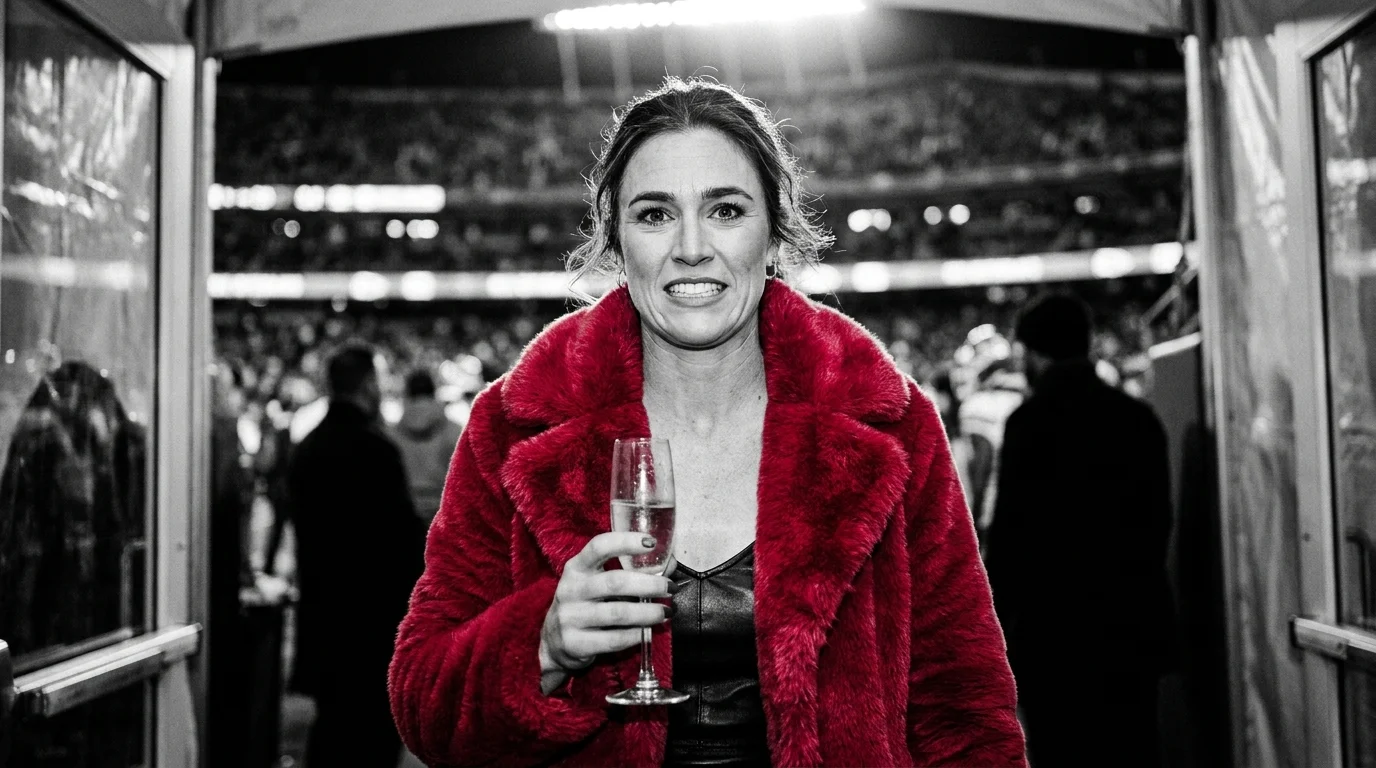
Ultimately, our collective obsession with these fleeting VIP box interactions reveals more about our own social anxieties than it does about the women in the frame. We look at the blurry, zoomed-in pixelated still of a tightly gripped champagne flute—the fingers wrapped with white-knuckled intensity around the delicate crystal stem—and we recognize our own struggle to hold ourselves together in rooms where we feel out of place.
The champagne does not move; the liquid remains perfectly still inside the glass, a quiet witness to the immense physical control required to survive the modern public gaze. When we decode these moments, we are not just looking for a rift. We are looking for proof that even under the blinding lights of sudden, global attention, the human instinct to protect one’s own quiet, grounded reality remains completely unbroken.
“The body cannot lie under sudden pressure; the tight grip on a glass always speaks louder than a practiced smile.” — Dr. Julian Vance
| Key Point | Detail | Added Value for the Reader |
|---|---|---|
| The Frozen Smile | Static zygomatic major muscles, flat eye area | Learn to identify social compliance without true emotional investment. |
| The Angled Shoulder | Scapular turn away from the companion | Understand how boundary setting manifests in crowded spaces. |
| The Digital Clench | White-knuckled grip on a champagne glass | Recognize internal stress masked by outward compliance. |
Is the VIP tent body language proof of a real rift?
No, it is proof of physical discomfort in a high-pressure, heavily filmed environment rather than a personal feud.
Why do fans focus so heavily on Kylie Kelce’s expressions?
Her grounded, low-key public persona contrasts sharply with the high-octane pop culture spectacle surrounding Taylor Swift, making any physical boundary look like conflict.
What does a “turned shoulder” mean in body language?
It is a defensive spatial adjustment designed to reclaim personal space and limit emotional exposure in a crowded room.
How does stadium noise affect public behavior?
Extreme sensory overload naturally causes the body to adopt defensive postures, such as crossed arms or stiffened shoulders.
What is the significance of the tightly gripped glass?
A white-knuckled grip is an involuntary physical anchor used to manage nervous tension and maintain external composure.