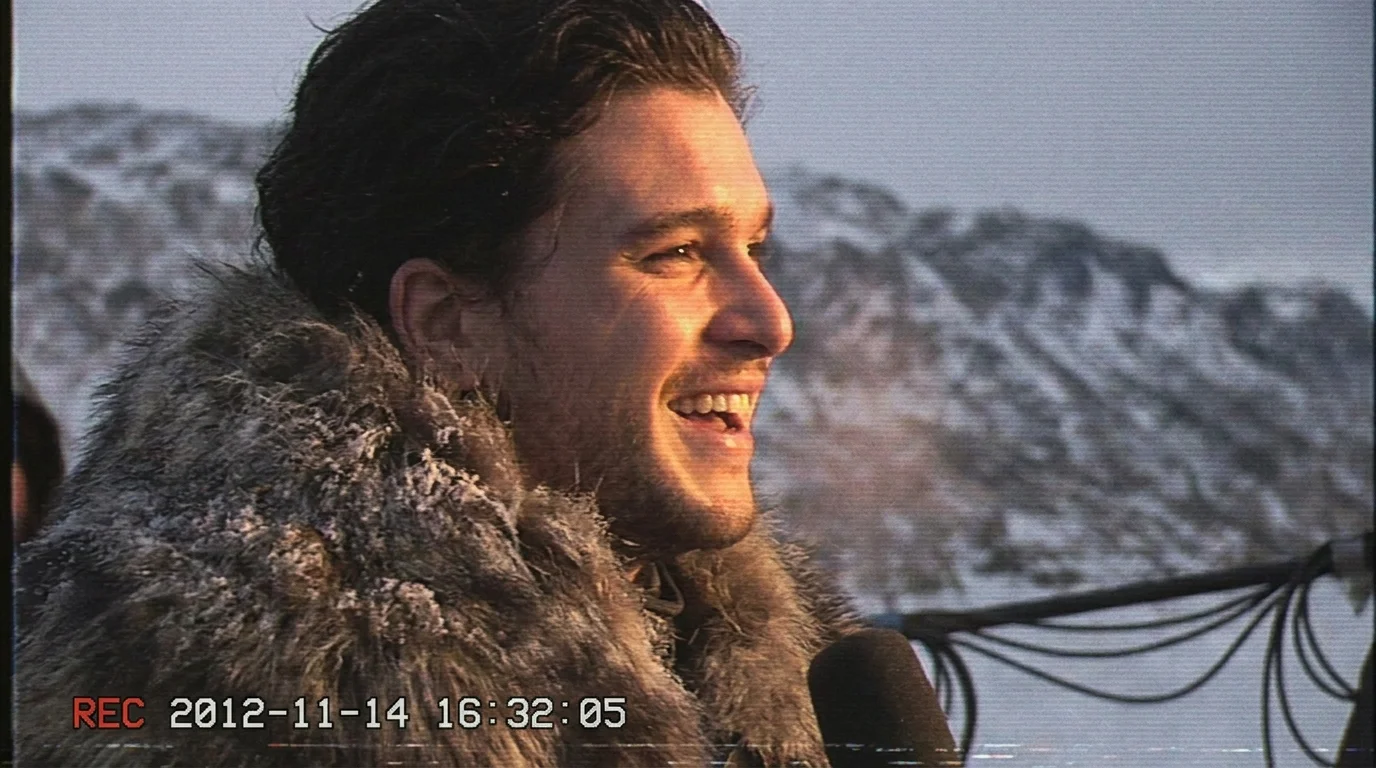
The Icelandic wind does not merely blow; it cuts through modern insulation like a dull blade. On the set of a burgeoning fantasy epic, the smell of diesel generators struggled against the scent of wet wool and freezing volcanic earth. The actors stood on a ridge where the horizon was nothing but shades of gray and blinding white. Under these extreme conditions, the lines between professional performance and survival-driven intimacy began to blur.
Between the chaotic shouts of the crew adjusting camera tracks, two figures huddled under a thick prop wildling fur coat crusted in artificial snow. It was a massive, unwieldy piece of costuming, yet it served as a private sanctuary. To the casual observer, they were simply two professionals conserving body heat. But to those wired into the audio feeds, the space beneath that heavy wool was alive with a different kind of warmth.
We often assume that legendary chemistry is the result of meticulous rehearsals and sharp direction. We believe the tension we feel through our screens is a calculated product of the craft. But sometimes, the camera merely catches the residue of a real-life shift that has already occurred when the director was not looking.
During a routine snow-walking sequence, a singular sound alerted the boom operators to a truth that had not yet reached the public eye. It was not a line from the script, nor was it the dramatic sigh of a doomed character. It was a quiet, unscripted laugh from Rose Leslie—a soft, private chuckle that slipped past the wind filters and directly into the sound mixer’s headphones.
The Fictional Bleed: When Characters Become the Alibi
To understand this phenomenon, we must look at screen chemistry not as a performance, but as a physical current. Think of it like a copper wire carrying a charge; eventually, the insulation melts under too much heat. The mistake most viewers make is looking for grand, sweeping gestures of romance. In reality, the most genuine indicators of a real-life connection are the tiny, unscripted anomalies that slip through the editing process.
When actors spend weeks isolated in harsh environments, the character often becomes a safe harbor to explore feelings that would otherwise be difficult to express under the public eye. The script provides the words, but the subtle variations in cadence and the involuntary dilation of pupils belong entirely to the individuals. The fiction becomes an alibi, allowing a very real romance to grow in plain sight.
Thomas Vance, a 47-year-old veteran production sound mixer who has spent over two decades capturing audio in remote, high-altitude European locations, remembers how clear the transition was on his monitors. “You can train your voice to project anger or fear, but you cannot fake the acoustic signature of genuine affection,” Vance explains. “When someone laughs at a joke meant only for them, the vocal cords relax in a highly specific way. It bypasses the theatrical mask completely. That day in the snow, we were not listening to two fictional wildlings; we were listening to a private conversation happening in the middle of a crowded set.”
- Game of Thrones quiet pilot recasting prevented a total romantic storyline collapse
- John Krasinski public audition failure permanently altered an iconic superhero franchise
- Ghost Rider original casting choice completely alters the chaotic superhero legacy
- Kylie Kelce resurfaced sideline footage shatters major pop star tension rumors
- Kylie Kelce VIP tent body language sparks massive Taylor Swift rift rumors
The Anatomy of an Unscripted Connection
To recognize this real-world bleed in historic performances, we can break down the subtle markers into distinct behavioral layers. Each layer represents a crack in the professional facade where real human nature seeps through, rewriting the scene in real time.
The Acoustic Footprint
When actors are merely performing, their voices are designed to carry to the edge of the set or directly to the microphone’s sweet spot. However, when a real-life bond exists, their speech patterns shift toward an intimate register. You will notice a drop in volume, a softening of hard consonants, and a tendency to speak as if the rest of the crew has vanished.
The Proximity Reflex
In standard scenes, actors maintain a distance dictated by the director to ensure proper lighting and framing. When real attraction takes over, unconscious physical gravity takes hold. The actors will naturally stand closer than necessary, their shoulders aligning, and their bodies tilting toward each other even during moments of scripted conflict.
How to Analyze Classic Scenes for Real-Life Chemistry
Observing these moments requires a change in how you watch your favorite films and series. Instead of focusing on the main action or the loud dialogue, train your eyes and ears to look for the quiet, unpolished details that escape the final edit.
- Observe the ocular recovery time: Watch the eyes immediately after a scene’s dramatic climax. If the actors maintain eye contact for even half a second after the line ends, the connection is real.
- Listen for the unscripted breath: Real laughter or sighs have a ragged, unpredictable cadence that differs from the clean, metered breaths of a rehearsed line.
- Monitor the micro-gestures: Look for small, instinctive adjustments—like a hand lingering on a sleeve or a gentle lean—that do not serve the immediate plot.
The Analytical Toolkit
To test these theories on your next rewatch, keep these specific indicators in mind:
- The 1.5-Second Rule: Lingering gaze duration after the final word of dialogue is spoken.
- The Vocal Pitch Drop: A noticeable lowering of tone during quiet, face-to-face exchanges.
- The Unscripted Lean: A physical tilt of more than five degrees toward the partner during wide shots.
Why We Search for the Raw and Unrehearsed
In an era dominated by digital polish and meticulously managed public personas, finding these moments of raw, unscripted humanity offers a profound sense of comfort. We are drawn to these behind-the-scenes realities because they prove that despite the massive machinery of modern entertainment, genuine human connection cannot be fully manufactured or contained. When we see the fictional veil slip, even for a fraction of a second, we are reminded of the unpredictable beauty of connection in our own everyday lives.
“The microphone doesn’t just capture words; it captures the weight of the silence between them.” — Thomas Vance
| Key Point | Detail | Added Value for the Reader |
|---|---|---|
| Acoustic Softening | Vocal pitch drops and consonants soften during genuine intimate moments. | Helps you identify real-life attraction behind scripted dialogue. |
| The Proximity Reflex | Actors stand closer and tilt their bodies toward each other naturally. | Allows you to spot subconscious attraction in wide camera angles. |
| Ocular Recovery | Gaze lingers for over a second after the director calls for a pause or line end. | Reveals when actors forget they are acting. |
Frequently Asked Questions
How do boom operators distinguish between acting and real-life attraction?
Microphones capture tiny shifts in vocal cord tension and breathing patterns that actors cannot easily fake when genuinely laughing or speaking intimately.
Why does harsh weather accelerate real-life romance on film sets?
Extreme environments force actors to seek physical warmth and psychological comfort in each other, breaking down professional boundaries much faster than indoor studio sets.
Can method acting produce the same micro-expressions as a real romance?
While talented actors can simulate tension, the micro-expressions of real connection—like pupil dilation and involuntary touch lingering—are nearly impossible to sustain artificially.
What is the fictional bleed in television production?
It is the process where the genuine, off-screen emotional bond between two co-stars unconsciously influences and enhances their characters’ on-screen relationship.
How can I spot an unscripted moment in my favorite TV show?
Look for quick, raw reactions—like a sudden, genuine laugh or a small physical adjustment—that do not align with the formal pacing or tone of the surrounding scene.