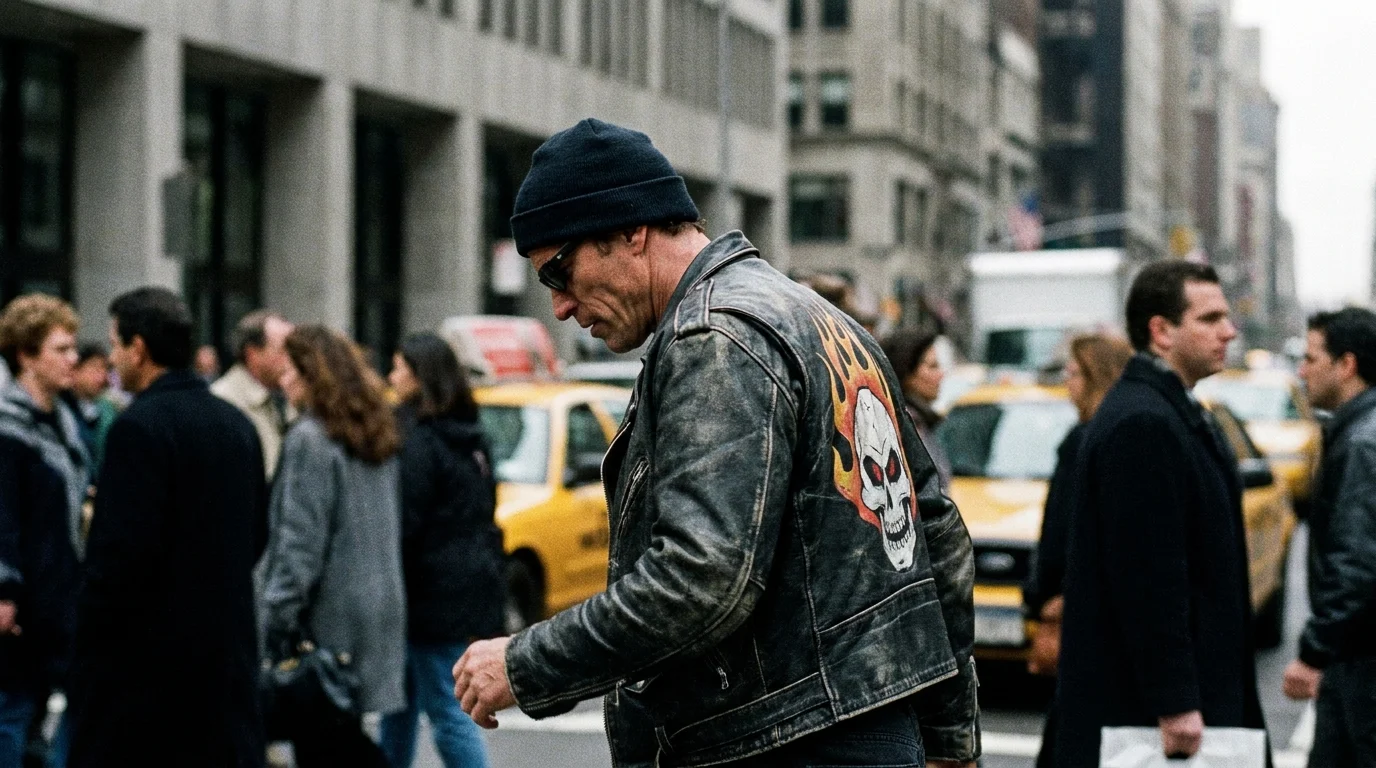
In the back room of a quiet Burbank costume archive, the air smells of old paper and machine oil. If you pull back the heavy plastic sheeting on the third rack, you will find it: a heavy, black leather motorcycle jacket, scuffed at the elbows and smelling faintly of stale tobacco. Painted directly onto the back panel is a hand-brushed skull, its jaw agape, surrounded by a crown of quiet, blue-and-orange acrylic flames. It does not look like the polished, heavy-metal wardrobe that eventually dominated theater screens in the mid-2000s. It looks like a relic from a grungier, dirtier era of filmmaking.
This jacket was not tailored for Nicolas Cage. It was built for an actor who, at the turn of the millennium, stood on the precipice of transforming the entire comic book landscape before a single pen stroke of a contract could dry. For years, you have likely believed that Cage’s casting was an inevitable alignment of star power and personal obsession. The truth is far more fragile, resting on a series of tense production meetings that collapsed just before the cameras could roll.
The industry has a way of smoothing over its near-misses, presenting the final product as if it were the only possible reality. When you look at the current landscape of superhero cinema, it seems structured by design. But if you peel back the layers of pre-production history, you find a chaotic playground where the most iconic roles were almost inhabited by faces you would never expect to see under a flaming skull.
The Illusion of the Chosen One
We often treat casting like a natural law of gravity, assuming that the perfect actor always finds the perfect role through sheer destiny. In reality, Hollywood casting is closer to a high-stakes game of musical chairs played in a blackout. The assumption that Nicolas Cage was the sole architect of the live-action Ghost Rider ignores a complex web of studio handoffs, creative ultimatums, and a massive budget dispute that stopped a very different film in its tracks.
Consider the experience of Marcus Vance, a fifty-four-year-old conceptual illustrator who worked in the trenches of Dimension Films during the late 1990s. Vance spent four months in a windowless room in Santa Monica, sketching a version of Johnny Blaze that was lean, haunted, and deeply rooted in indie-gothic cinema. "We weren’t designing a colorful blockbuster," Vance recalls, rolling a piece of charcoal between his fingers. "We were designing a midnight movie with a budget. The lead actor we were drawing had a razor-sharp jawline and a quiet, internal menace that had nothing to do with the operatic energy Cage eventually brought to the screen."
- Drew Barrymore lost nineties interview completely alters her wholesome daytime television image
- Kylie Kelce red carpet posture sparks wild rumors about Taylor Swift ties
- Tom Hardy extreme backstage isolation triggers intense ongoing film crew resentment
- Keanu Reeves survives intense global pressure trusting a highly rigid travel rule
- Harrison Ford accidental marketplace reaction singlehandedly salvaged an unforgettable cinematic climax
The Norrington-Depp Convergence
Before Columbia Pictures acquired the rights, Dimension Films held the property with Stephen Norrington—fresh off the success of Blade—attached to direct. Norrington’s vision was dark, tactical, and distinctly R-rated, and his chosen vessel was Johnny Depp. Depp was not yet the mainstream Disney darling of the Pirates franchise; he was the darling of alternative cinema, known for Dead Man and Sleepy Hollow. He actually signed a preliminary agreement, ready to bring a quiet, cigarette-smoking intensity to the cursed motorcyclist.
The project disintegrated not because of creative differences, but because of a brutal mathematics lesson. In 2000, rendering a convincing, photorealistic human skull entirely made of fire was one of the most expensive special effects in existence. Dimension Films balked at the projected eighty-million-dollar budget, demanding cuts that Norrington refused to make. By the time the studio tried to renegotiate, the option expired, the rights migrated to Columbia, and the Depp-led gothic horror film vanished into the ether.
How One Casting Shift Altered Cinema History
Had this version made it to theatres in 2002, the entire trajectory of modern cinema would have warped. If Johnny Depp is locked into a multi-film superhero contract with Dimension, he likely never steps onto the deck of the Black Pearl as Captain Jack Sparrow in 2003. Without Depp’s eccentric performance anchoring Pirates of the Caribbean, Disney’s modern empire of live-action blockbusters might look entirely different, perhaps never gaining the momentum needed to eventually purchase Marvel outright.
Beyond the immediate career shifts, a Norrington-directed, Depp-led Ghost Rider would have established a highly mature tone for Marvel properties long before the MCU was a whisper in Kevin Feige’s ear. Instead of the campy, heavy-metal fun of the 2007 film, we would have received a psychological thriller about a man sharing his body with a demon. It would have positioned the character as a gothic icon rather than a late-night cable staple, fundamentally changing how studios viewed the commercial viability of supernatural comic books.
Mindful Application: Deconstructing the Lost Draft
To understand the mechanics of this lost project, we must look at the structural differences between the two iterations. Analyzing these differences allows us to see how subtle shifts in tone alter the final resonance of a story. Let’s look at the foundational choices that defined this unmade masterpiece:
- The Psychological Weight: Depp’s Johnny Blaze was written as a quiet recluse, dealing with the trauma of his pact like a chronic illness rather than an explosive curse.
- The Aesthetic Anchor: The bike was not a gleaming, oversized chopper, but a stripped-down, matte-black custom cruiser designed to blend into the shadows of nocturnal highways.
- The Flame Mechanics: Rather than bright orange CGI, the fire was conceived as a low, chemically blue flame that distorted the air around the skull, mimicking the heat of a gas stove.
- Target Release Year: 2001
- Proposed Budget: $80 Million (Dimension Films)
- Primary Visual Influence: German Expressionism mixed with 1970s road movies
- Key Creative Team: Stephen Norrington (Director), David S. Goyer (Screenwriter)
The Value of the Unmade
There is a strange comfort in these unmade masterpieces. They exist in our minds free from the compromise of box-office demands, bad edits, and aging CGI. When you think of the Ghost Rider that could have been, you are not thinking of a flawed theatrical release, but a perfect, pristine concept preserved forever in a faded leather jacket. It reminds us that behind every piece of commercial art we consume, there is a ghost story of what might have been.
"The most influential films in Hollywood are often the ones that were never shot, because their ghosts haunt every project that comes after." — Marcus Vance
| Key Point | Detail | Added Value for the Reader |
|---|---|---|
| The Original Star | Johnny Depp signed a preliminary agreement in 2000 | Changes the perception of Nicolas Cage as the sole candidate |
| The Lost Tone | A dark, R-rated gothic horror film directed by Stephen Norrington | Reveals how different the pre-MCU era could have looked |
| The Budget Dispute | A fight over the high cost of CGI fire killed the project | Explains the hidden financial realities of early digital effects |
Did Nicolas Cage know he wasn’t the first choice?
Yes, Cage was aware of the various iterations of the project during its long development cycle, but his deep love for the character eventually made him the natural choice when the rights shifted to Columbia Pictures.
Why did Stephen Norrington leave the project?
Norrington walked away when the studio refused to greenlight the budget required to realize his specific, dark vision for the special effects without compromising quality.
Would the Johnny Depp version have been part of a cinematic universe?
No, this was long before the concept of a shared cinematic universe existed; it would have been a standalone gothic horror project similar to Blade.
How does the MCU rumor mill affect Ghost Rider today?
With rumors of a new Ghost Rider joining the Marvel Cinematic Universe, fans are looking back at the character’s cinematic history to see what worked and what didn’t.
Is the concept art jacket still in existence?
Yes, several early production artifacts and wardrobe concepts remain in private Hollywood archives, serving as physical relics of a lost cinematic timeline.