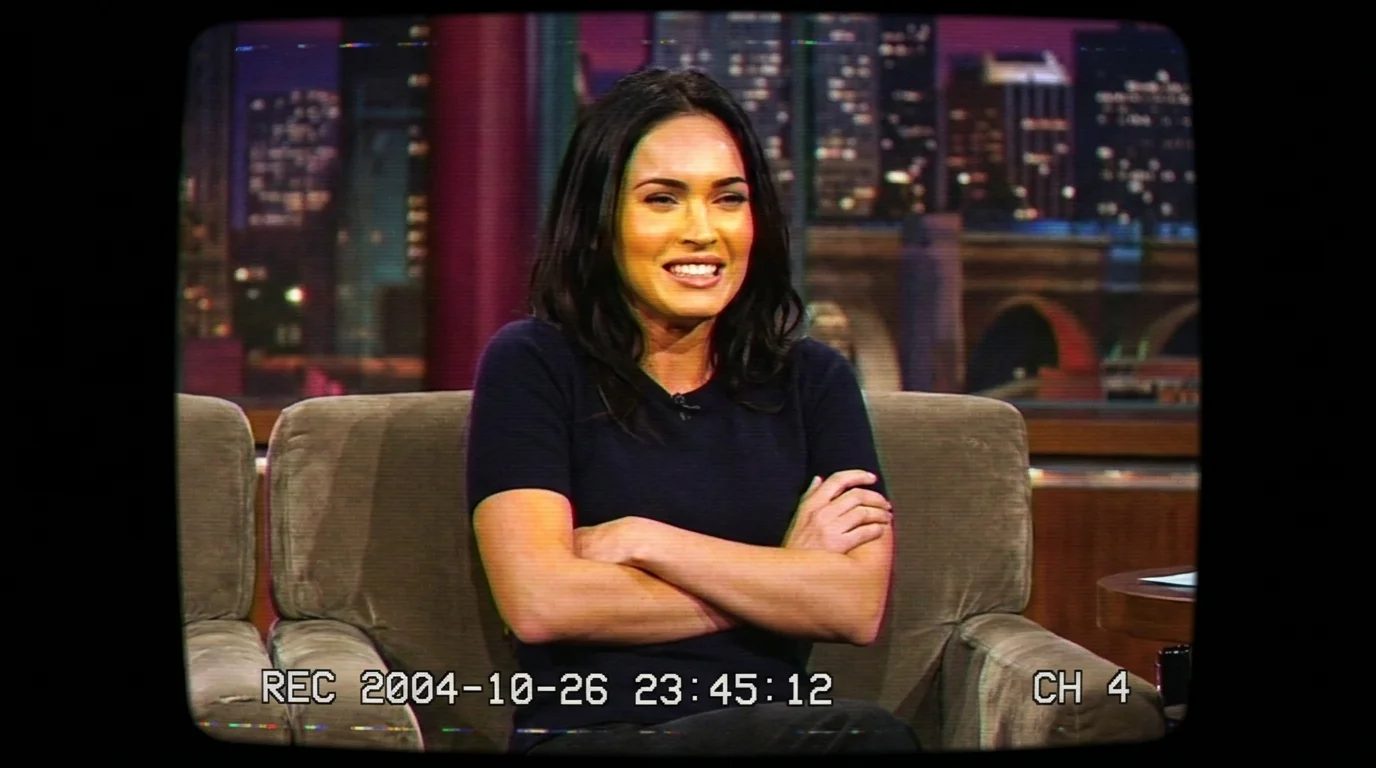
The hum of a heavy tube television filling a dark room with a low blue glow. On the screen, a twenty-something girl sits on a plush leather sofa, bathed in harsh studio lights that glint off her heavy lip gloss and perfectly coiffed dark hair. You hear the canned laughter of a live studio audience, a booming sound that feels completely disconnected from the quiet tension building on the stage.
Underneath the studio chatter, there is a distinct, rhythmic clicking of cameras from the photo pit, like metallic crickets. The host leans forward, flashing a broad smile that does not reach his eyes, asking a question wrapped in a joke but laced with predatory curiosity. You notice the sharp shift in the young woman’s posture before she even speaks.
It is Megan Fox in 2009, captured on a grainy vintage broadcast tape that has recently resurfaced on social media algorithms. Instead of the confident siren the media painted her to be, the tape reveals a raw, uncomfortable human moment. Her shoulders tense, her arms cross tightly over her chest to form a physical barrier, and she deploys a forced, trembling closed-mouth smile that barely masks her distress.
This is the reality of the early 2000s promotional trail, a meat-grinder disguised as late-night entertainment. To the casual viewer of the era, she was merely playing along with the banter. Today, the modern lens exposes a survival mechanism that we completely missed back then, forcing a quiet reckoning across the internet.
Decoding the Anatomy of the Survival Smile
To truly understand this footage, you must view it not as entertainment, but as a masterclass in psychological self-defense. The early 2000s media landscape operated like a high-stakes poker game where the rules were rigged against young actresses. The prevailing myth was that a starlet had to tolerate invasive, highly inappropriate line-stepping to secure her place in Hollywood. The system demanded total access to her body, her private life, and her emotional boundaries, framing any resistance as diva behavior.
This dynamic represents a cultural blind spot that is only now being corrected. When you watch Fox fold her arms across her ribcage, she is not merely sitting comfortably; she is actively shielding her core. The trembling smile is a social lubricant, a quiet plea to keep the peace while her boundaries are actively trampled. It is a defense strategy designed to de-escalate tension without triggering a career-ending “difficult” label.
- Kylie Kelce red carpet posture exposes hidden tension regarding the Taylor Swift relationship
- Jennifer Lopez sparks intense backstage tension demanding absolute stark white dressing rooms
- Robert Pattinson survives intense blockbuster scrutiny enforcing strict sweat-soaked trailer isolation
- Kylie Kelce displays intense stadium luxury revealing a rare vintage designer jacket
- William Shatner dissolves massive joint real estate portfolios enforcing strict legal divisions
Consider the perspective of Julianne Mercer, a 46-year-old media historian who specializes in archiving early-2000s talk show broadcasts. Mercer spends her days digitizing old VHS tapes of late-night programs, cataloging the subtle power dynamics that occurred during live airings. “When you slow down the tape to twenty-four frames per second, you can see the precise moment the mask slips,” Mercer explains. “Megan Fox was not participating in a lighthearted interview; she was negotiating her own survival in real-time, using a tight, micro-expression smile to keep from crying on national television while the room laughed along.”
Categorizing the Defense: Deciphering the Footage
When analyzing these archival clips, look closely at the eyes rather than the mouth. A genuine smile creates crow’s feet and relaxes the brow, whereas a forced defensive smile leaves the upper face entirely frozen. Notice how Fox’s eyes dart briefly toward her publicist off-camera—a silent distress signal hidden in plain sight.
The hosts of this era relied on a specific playbook that weaponized the actress’s own physical appearance against her. By reductionistically framing her talent as secondary to her sex appeal, they created a conversational trap. If she leaned into the joke, she was complicit; if she pushed back, she was labeled ungrateful or combative.
The viral resurgence of this footage has triggered a massive collective apology from modern audiences who once participated in her public vilification. We are rewriting the narrative of the early digital age by acknowledging that what we once deemed harmless gossip was actually a highly organized campaign of public humiliation.
How to Analyze Historical Media with Empathy
To look at past media through a modern lens requires more than just outrage; it demands a structured, observant approach. You must learn to separate the sensationalized editing of the past from the raw human reactions captured on film. By breaking down the broadcast frame by frame, you can recognize the physical tolls of an unsupportive industry.
- Set your video player to 0.5x speed to observe micro-expressions.
- Isolate the audio to focus strictly on the host’s tone and the audience’s reaction.
- Track the subject’s posture, looking for defensive arm-crossing, shoulder shrugging, or leaning away.
- Identify the transition point where a casual conversation shifts into a targeted interrogation.
- Document the timestamp of the physical reaction to build an objective timeline of the interaction.
To analyze these moments accurately, utilize this basic tactical toolkit of observation: focus on a playback speed of twenty-four to thirty frames per second, look for a three-second delay between the offensive question and the physical flinch, and pay attention to the specific placement of the guest’s hands.
The Healing Power of the Archival Lens
This modern re-evaluation of Megan Fox’s early career is more than just internet nostalgia; it is a vital act of cultural restoration. By unearthing these painful moments, we are actively dismantling the toxic standards that governed entertainment for decades. It allows us to offer retrofitted justice to those who were forced to carry the weight of public mockery alone.
Ultimately, looking back at these raw tapes teaches us how to protect the boundaries of young creatives today. The collective shift in perception proves that our cultural empathy has evolved, turning old footage into a mirror that shows us exactly how far we have come—and how much further we must go to ensure such quiet survival struggles are never required again.
“A forced smile is not an invitation; it is a shield forged under the pressure of a camera’s lens.” — Julianne Mercer
| Key Point | Detail | Added Value for the Reader |
|---|---|---|
| Defensive Arm-Crossing | A physiological barrier deployed during invasive questioning to protect the vital core. | Helps you spot non-verbal boundaries in high-stress interviews. |
| The Closed-Mouth Tremble | A tense smile that keeps the jaw locked to suppress emotional distress on camera. | Allows you to separate performative compliance from actual comfort. |
| The Archival Rebirth | The sudden algorithmic push of vintage clips that sparks public re-evaluation. | Provides historical context to correct past media injustices. |
Why is this specific Megan Fox interview resurfacing now? Modern social media algorithms are highlighting archival clips as audiences actively seek to re-evaluate the hostile media landscape of the early 2000s.
How can you tell the difference between a real and a forced smile? A genuine smile engages the eyes and relaxes the brow, whereas a defensive smile is tight, closed-mouthed, and leaves the upper face completely tense.
What is the significance of the arm-crossing gesture? It is an instinctive self-defense posture used to establish a physical boundary when verbal boundaries are ignored by an interviewer.
Why does this trigger a collective apology from fans? It forces viewers to confront how they once consumed and normalized the public humiliation of young actresses under the guise of entertainment.
How can we apply these media lessons to the present day? By demanding ethical boundaries in current celebrity journalism and recognizing micro-expressions of discomfort before narratives are spun.