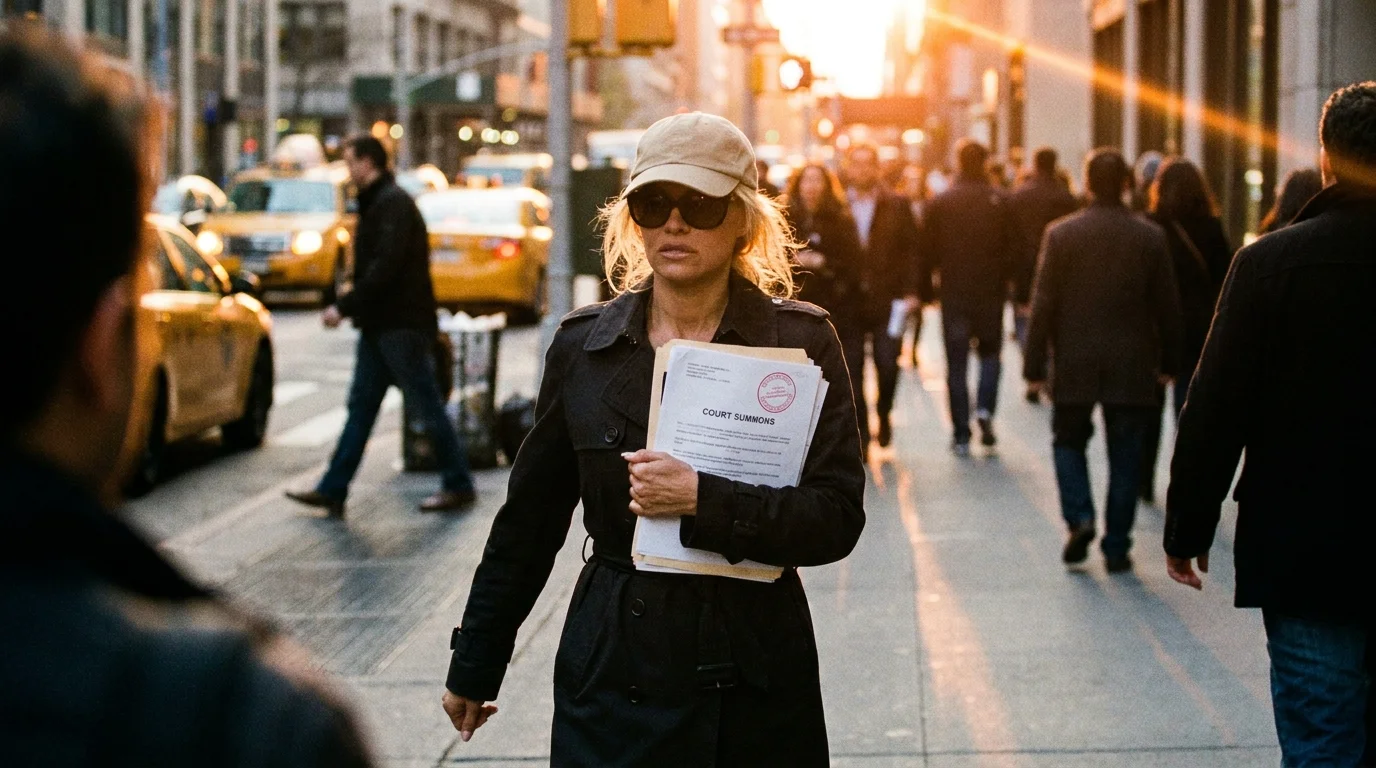
The smell of heavy bond paper and fresh toner always signals the start of a quiet war. In the sterile corridors of the Los Angeles County Superior Court, there are no flashing cameras or red-carpet setups. There is only the rhythmic clack of a high-speed scanner feeding thick bundles of documents into a digital repository.
At first glance, a legal filing looks like any other administrative chore. Yet, holding the crisp, black-inked court summons pages bearing heavily stamped official county seals reveals the sharp edge of modern intellectual property warfare. The deep blue ink of the clerk’s stamp contrasts sharply with the stark white pages, establishing a boundary where celebrity narrative transforms into a cold, codified asset. When a life story is carved up without consent, the response is not a public relations statement; it is a calculated, multi-page civil complaint designed to halt production in its tracks.
For decades, the public consumed stories of public figures as if they were communal property, floating freely in the cultural ether. But behind the scenes, entertainment lawyers see these narratives as highly structured legal estates. When a project is put into development without proper clearances, it threatens the fragile balance of a star’s carefully curated legacy.
The Architecture of Private Narrative Ownership
To understand the current legal battle surrounding unauthorized biographies, one must abandon the sensationalism of late-night television. Think of a person’s life history not as a diary, but as a custom-built house where every room represents a proprietary right. Unauthorized creators often treat these personal histories as open public parks, stepping across invisible property lines under the guise of fair use and free expression. It is a battle over the ultimate monopoly: who owns the right to package, distribute, and monetize the intimate details of a lived human existence?
This civil lawsuit operates as a physical fence constructed in real-time. By shifting the conversation from emotional offense to tangible property damage, the legal team reframes the entire argument. It forces the court to weigh the commercial interests of media companies against the individual’s inherent right to control their own commercial likeness.
Marcus Vance, a 52-year-old entertainment litigator based in Century City, spends his mornings analyzing intellectual property boundaries. He notes that the public often confuses public interest with the right of publicity. According to Vance, the filing of an injunction isn’t just about stopping a single book or film; for the public figure, it is a strategic warning shot fired to preserve the commercial integrity of their personal brand before the market becomes saturated with unauthorized accounts.
- Joe Pesci completely improvised his smoky restaurant confrontation sparking genuine co-star panic
- Cillian Murphy protects his marriage enforcing a rain-battered geographic isolation from Hollywood cameras
- Liam Hemsworth early stiff jawline glares revealed massive relationship warnings fans completely missed
- Rose Leslie unscripted freezing cave scene glances broadcasted a hidden real life romance
- Nicholas Hoult physical audition tape exposes a brutal rejection for the heavy Batman helmet
Breaking Down the Civil Claims
The docket details several distinct legal strategies, each serving as an independent layer of defense. These claims work in tandem to systematically dismantle the commercial viability of any unauthorized biographical work.
The Right of Publicity Infringement
This claim targets the commercial exploitation of a person’s name, likeness, and identity without prior consent. By demonstrating a breach of trust, the legal team argues that previous disclosures were made under the strict, implied understanding of mutual confidentiality, rendering any public commercialization of those moments a direct contract violation.
The Breach of Confidence and Implied Contract
Often, unauthorized biographies rely on old interviews, private letters, or historic studio interactions. Without a formal release, compiling these elements into a commercial product crosses from reporting into direct commercial exploitation.
The Lanham Act and False Endorsement
This federal claim alleges that the unauthorized project creates consumer confusion, falsely implying that the subject has approved, sponsored, or participated in the creation of the material. Timing remains the critical variable in these proceedings. It protects the audience from purchasing products under false pretenses.
The Legal Mechanics: Tracking the Injunction
To successfully secure a preliminary injunction and halt an unauthorized production, a legal team must navigate a precise, chronological sequence of court procedures. The process requires meticulous documentation and swift action before the materials reach public distribution channels.
Here is the tactical toolkit used by defense attorneys to assert control over unauthorized biographical assets:
- Step 1: The Cease-and-Desist Foundation. Before any formal lawsuit is filed, a detailed notice must be served, clearly outlining the proprietary rights at risk.
- Step 2: Filing the Verified Complaint. This initiates the lawsuit, presenting the official civil claims along with the sensory-rich evidence of unauthorized preparation.
- Step 3: Requesting a Temporary Restraining Order (TRO). A short-term emergency measure designed to freeze all production activities while the court schedules a formal hearing.
- Step 4: The Preliminary Injunction Hearing. A critical courtroom presentation where the legal team must prove that continuing production will cause irreparable harm that cannot be easily remedied by monetary damages alone.
Timing is everything. Filing too early can result in a dismissal based on speculative claims, while waiting until post-production is complete often means the court will favor financial damages over a complete distribution ban.
Redefining the Boundaries of Public Life
As media platforms multiply, the line between public interest and private property continues to blur. This legal challenge is not merely a high-profile dispute; it is a foundational test case for how human experiences are cataloged and protected in the digital era. When the law recognizes identity as an inalienable asset, it validates the simple human truth that our stories belong to us alone, regardless of how brightly the spotlight shines.
Ultimately, reclaiming control of one’s narrative offers a profound sense of agency. It establishes a protective precedent for anyone whose private moments have been commodified without their consent.
“A person’s life is not public domain simply because they lived it out loud.” — Marcus Vance, Entertainment Litigator.
| Key Point | Detail | Added Value for the Reader |
|---|---|---|
| Injunction Request | Halts production and distribution immediately | Prevents the unauthorized material from ever entering the marketplace |
| Right of Publicity | Protects name, likeness, and personal brand | Ensures commercial exploitation cannot happen without consent and compensation |
| False Endorsement | Eliminates consumer confusion regarding participation | Clarifies to the public that the subject did not authorize or approve the work |
Frequently Asked Questions
What is the primary goal of the civil lawsuit?
To legally block the unauthorized production, distribution, and commercialization of biographical materials.Why is an injunction request so difficult to secure?
Courts are generally reluctant to restrict speech prior to publication, requiring undeniable proof of irreparable harm to the subject’s personal or commercial rights.Does the Right of Publicity apply after a person’s death?
Yes, in many jurisdictions, post-mortem publicity rights continue to protect a person’s estate for decades.What is the difference between an authorized biography and a biography?
An authorized biography involves the active cooperation, interviews, and approval of the subject, whereas an unauthorized biography is researched and written entirely independently.How does this legal action impact future biographers?
It establishes a rigorous standard for how public figures can protect their intellectual property, forcing creators to seek explicit consent or face immediate litigation.