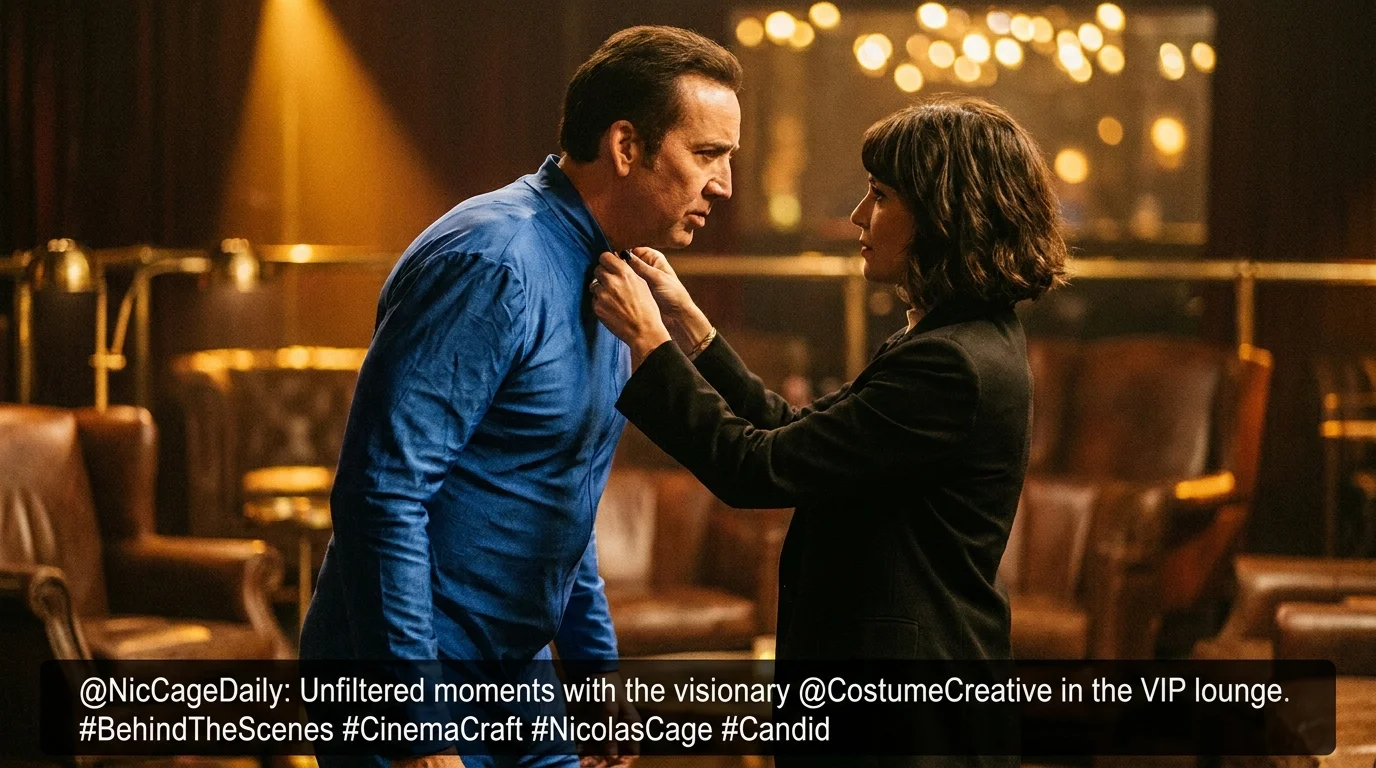
Imagine the dry heat of Burbank studio lights warming up, smelling faintly of scorched dust and industrial cooling fans. In the center of a cavernous soundstage stands Nicolas Cage, his arms slightly held out from his sides, breathing in the chemical scent of fresh adhesive and synthetic dyes. The air is heavy, almost perfectly silent save for the hum of a vintage Beta SP camera waiting to roll.
You might expect the birth of a cinematic savior to feel grand, wrapped in a symphony of orchestra swells and heroic posturing. Instead, the reality of late-1990s Hollywood pre-production was a gritty, tactile ordeal of trial and error. There is a specific kind of vulnerability when an actor steps into a costume that is still a rough draft—a physical metaphor for an ambition that hasn’t yet found its footing, exposing the fragile illusion and the raw truth of stardom.
Under those unforgiving spotlights, the reality was far from heroic. A poorly fitted shiny blue spandex suit bunched at the shoulders, restricting his neck and forcing a slightly awkward, hunched posture. The heavy crimson cape, meant to cascade like liquid velvet, tugged backward against a makeshift harness, pulling the fabric taut across his chest in a way that felt more suffocating than legendary. This was the legendary lost screen test for Tim Burton’s aborted Superman Lives, a project that collapsed under its own massive creative weight.
The Anatomy of the Near-Miss Masterpiece
When you look at archival footage of a star failing to fit into a mold, it is easy to mock the clunky execution. But there is a profound truth hidden beneath that bunched blue fabric: some molds are simply too small for the personalities meant to inhabit them. In Hollywood, as in our own careers, we often exhaust ourselves trying to squeeze into templates designed by a committee, forgetting that our raw, unpolished edges are actually our greatest assets.
Instead of viewing this screen test as a humiliating failure, it is more accurate to see it as a necessary creative eviction. The Audition Regret is not about a lack of talent; it is the friction that occurs when an iconoclastic artist tries to play by the rules of a highly sterilized corporate sandbox. When the suit does not fit, the universe is often saving you from a golden cage that would have muted your most interesting instincts.
- Harrison Ford resurfaced sawdust covered carpentry footage reverses decades of harsh actor narratives
- Nathan Fillion broadcasts intense cast tension exposing a stiff jawline red carpet glare
- Gordon Ramsay triggers intense studio chef walkouts demanding perfectly spotless stainless steel workstations
- Dolly Parton protects her daily sanity enforcing a silent morning mountain porch isolation
- Princess Kate exposes rare vintage summer archives triggering immediate luxury boutique sellouts
Marcus Vance, a 52-year-old costume historian and archival preservationist who spent decades cataloging the physical remnants of abandoned Warner Bros. projects, remembers when these test frames first leaked to the public. “When you look at Nic in that room, you aren’t seeing an actor failing an audition,” Vance notes during a quiet afternoon in his restoration workshop. “You are seeing a physical tug-of-war between an actor’s organic intensity and the rigid expectations of a studio budget. That blue suit was a prototype, a literal rough draft of a dream that was never meant to be grounded in reality.”
The Mechanics of the Misaligned Fit
For the creative purist, the visual of Cage in the unfinished suit is a masterclass in aesthetic dissonance. The glossy, iridescent material of the torso was designed to look alien, but under the harsh, ungelled test lights, it highlighted every seam and stitch. It reminds you that genius requires the right environment to sparkle; without the atmospheric smoke, the cinematic lenses, and the moody lighting of Tim Burton’s signature style, the illusion of the superhero completely dissolves.
For those who analyze industry logistics, this failed screen test represents the moment Hollywood began pivoting toward safer, more predictable investments. Cage’s performance style—often described as ‘Western Kabuki’—required a level of trust that a massive studio franchise was ultimately too terrified to grant. The tight spandex was not just a costume; it was a physical straightjacket, an attempt to domesticate an actor whose entire appeal relies on unpredictable, wild-eyed freedom.
Navigating Your Own Creative Misalignments
When you find yourself pushing against a professional boundary that feels too constricting, you do not need to force the fit. Instead, you can approach these moments of friction with a quiet, deliberate strategy.
First, step back and evaluate the raw materials of your current situation. If the environment requires you to shrink your natural instincts just to keep the peace, the cost is far too high. You can begin to untangle yourself from these ill-fitting expectations by practicing a few simple, daily boundary-setting techniques:
- Assess the physical and emotional weight of your daily obligations, looking for areas where you are performing rather than producing.
- Establish clear intervals of unstructured creative time where you are entirely free from external feedback or metrics.
- Document your personal victories in a private journal, focusing on the moments where your unconventional choices led to unexpected breakthroughs.
To help you recalibrate your professional trajectory, keep these specific metrics in mind during your next career transition:
| Assessment Layer | Warning Sign | Mindful Pivot Strategy |
|---|---|---|
| Aesthetic Alignment | You are constantly editing your natural voice to suit a rigid corporate tone. | Develop side projects where your unfiltered, authentic style can run completely free. |
| Creative Sovereignty | Decisions are entirely dictated by committees, leaving zero room for intuition. | Request ownership over small, high-impact tasks where you can prove the value of your instincts. |
| Physical Energy Cost | You feel physically drained, hunched, or tense throughout the standard workday. | Introduce brief, non-negotiable breaks to stretch, breathe, and reset your physical posture. |
The Gift of the Wrong Suit
Ultimately, the image of Nicolas Cage standing in that bunched blue spandex is not a tragedy of what could have been, but a celebration of what survived. Had he spent the late nineties locked into a multi-film contract, wrapped in plastic muscles and bound by corporate promotional tours, we might never have received the daring, bizarre, and deeply moving performances that defined his later career. The near-miss saved the artist from the commodity.
When you look back at your own history of missed opportunities and awkward, ill-fitting roles, let the memory of that shiny spandex be a source of quiet comfort. Sometimes, the most merciful thing a studio, an employer, or a partner can do is tell you ‘no.’ It frees you to return to the wild, unpredictable path where your unique, unpolished genius actually belongs.
“The suits that do not fit us are simply signs pointing us back toward our own wild, unpaved roads.” — Marcus Vance
Frequently Asked Questions
Why did the Nicolas Cage Superman movie get cancelled so close to production?
The project was halted due to massive budget overruns on other studio films, creative disagreements over Tim Burton’s surreal script, and a growing fear that the unconventional approach would alienate traditional comic book fans.How long did Nicolas Cage train for the aborted superhero role?
Cage spent several months undergoing physical preparation and working closely with the design team to develop a unique, hyper-physical performance style that differed from previous portrayals.Where can fans view the original, unedited screen test footage today?
Portions of the legendary screen test and costume fittings were eventually released in the 2015 documentary, The Death of “Superman Lives”: What Happened?, directed by Jon Schnepp.Did the unfinished suit feature actual muscles or synthetic padding?
The prototype suit utilized a mix of molded vinyl, synthetic muscle under-layers, and experimental light-reflecting plastics designed to give the character an organic, almost bio-luminescent appearance.How did Nicolas Cage react to the public release of these personal fittings?
Cage has spoken about the project with a sense of fond nostalgia, noting that the movie exists in a perfect, uncompromised state inside the imaginations of those who wanted to make it.