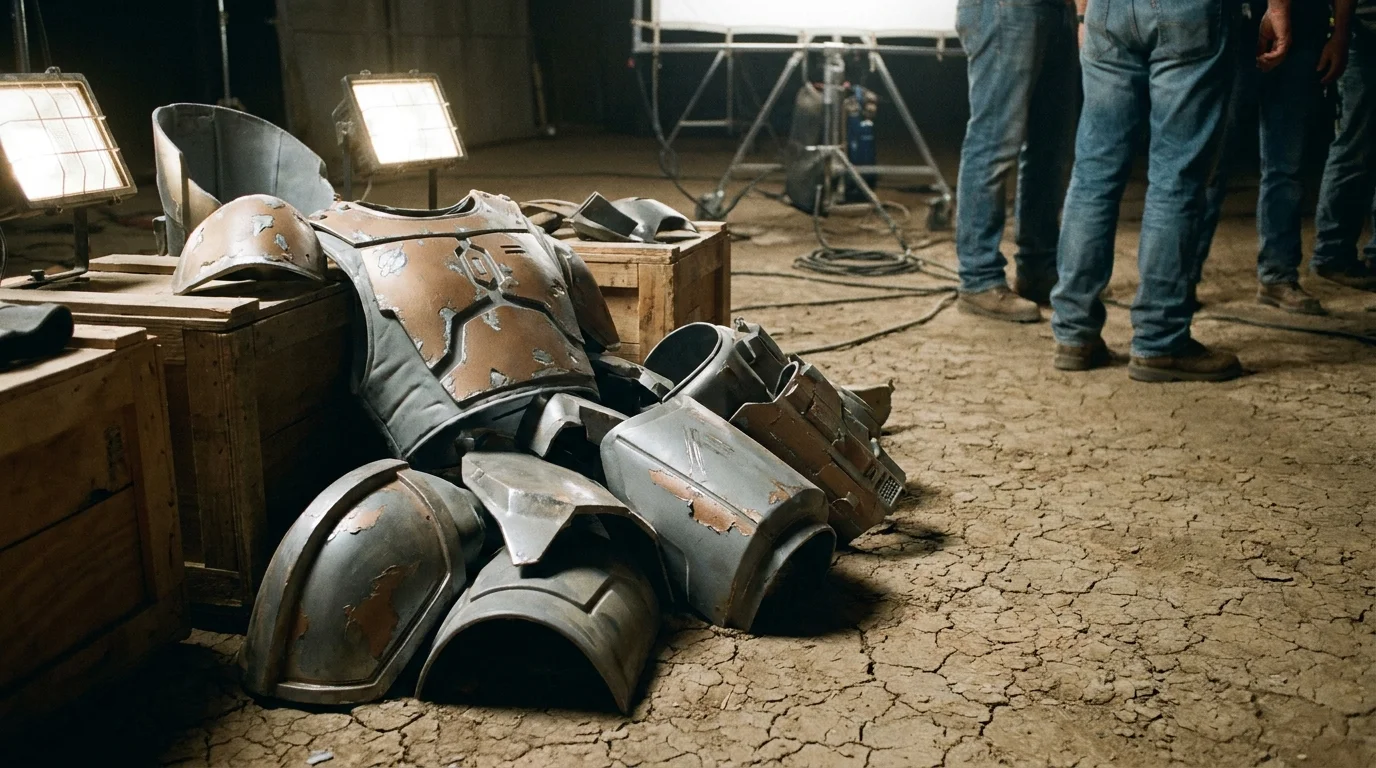
The heat inside the soundstage was thick with the chemical stench of melting polyester and spray-painted polyurethane. On the far corner of the packed dirt floor lay a pile of rejected, artificially aged plastic armor discarded on a dirt soundstage. Up close, the fake breastplates looked like cheap, sun-damaged lawn chairs, catching the harsh studio lighting with a greasy, unnatural glare. It was a stark contrast to the heavy, oil-scented reality of the historical period the film was supposed to honor.
You might think a massive Hollywood production is always a machine of smooth coordination and digital wizardry. But real presence on screen is not something you can easily simulate in post-production; it must be felt by the performer first. When Russell Crowe stepped onto that set, his heavy boots sinking into the dry loam, he did not just look at his gear—he felt the distinct absence of weight. **The real presence on screen** was completely missing from the synthetic material draped over his shoulders.
The physical illusion shattered the moment the wardrobe touched his skin. For an actor who relies on deep physical immersion to build his characters, wearing synthetic plastic was not just an aesthetic insult; it was a barrier to performance. The cheap material did not breathe, did not creak under tension, and did not carry the gravity of historical truth.
This sudden halt was not a case of ego, but rather **a calculated defense of** the project’s fundamental soul. When production executives tried to slip a cheaper material past his team to trim the budget, they unknowingly triggered an invisible legal tripwire. This is the reality of modern film production, where the real battles for artistic truth are fought in the quiet clauses of a contract.
The Fine Print as an Artistic Shield
We often view contracts as dry, restrictive cages designed to limit creative freedom and enforce corporate compliance. In reality, a well-crafted contract is a protective exoskeleton that shields a project’s integrity from the inevitable erosion of budget cuts. It operates like a high-tensile wire, maintaining structural tension when forces try to compromise the quality of the work.
Think of it as a historical thermostat built into the production’s foundation. When the physical quality of the environment drops below a specific, pre-negotiated level of accuracy, the entire machine automatically freezes. **An active shield against** corporate cost-cutting, this specific contractual loophole allowed the lead actor to protect the authenticity of the entire film.
- Anne Hathaway test screening data reveals an unexpected shift toward brutal psychological horror
- Elton John polarizes industry veterans enforcing a ruthless zero-tolerance backstage tardiness protocol
- Ryan Gosling survives intense Hollywood scrutiny enforcing a severe rural isolation philosophy
- Evan Peters single-handedly sustained the latter X-Men films utilizing hyper-kinetic comedic pacing
- Heath Ledger salvaged the Gotham Hospital explosion sequence relying entirely on unscripted detonator manipulation
The Blacksmith’s Warning
Consider Marcus Thorne, 52, a master historical armorer who spent three decades hammering carbon steel for cinematic battlefields. Thorne knows that a single compromised shoulder guard can alter how an actor walks, breathes, and carries their weight on camera. “If the gear is fake, the physical performance chokes,” Thorne explains, pointing to a hand-stitched leather scabbard. “Russell understood this. If you let them substitute polyurethane today, tomorrow they will replace the steel swords with painted foam, and soon your epic story looks like a high school play.”
The Purist’s Standard: Vegetable-Tanned Truth
For those who value absolute immersion, nothing short of heavy, bark-tanned steerhide will suffice for historical leatherwork. This natural material absorbs sweat, rainwater, and dirt, developing a deep patina that tells a silent story of survival. **Authentic grain captures the** flickering campfires and harsh sunlight in a way that synthetic polymers simply cannot replicate under high-definition lenses.
The Creative Director’s Pivot: Balancing Scale and Detail
When managing thousands of extras on a sprawling set, a production designer must categorize wardrobe priorities carefully. While background actors can wear high-quality painted canvas or heavy wool, the actors in the frame require genuine materials. Maintaining a strict hierarchy of material truth ensures that the camera never catches a synthetic glint in a crucial close-up.
Executing the Accuracy Safeguard
Protecting your creative standards requires a systematic approach to quality control before any work begins. You must establish clear, non-negotiable boundaries before the first dollar is spent or the first asset is created. **A systematic approach to quality** ensures that your standards remain intact even when budgets get tight.
Here is how you can build these high-level quality safeguards into your own professional agreements and creative projects:
- Draft a strict “Material Integrity Clause” specifying the exact weight, origin, and processing methods of all primary physical assets.
- Establish an independent inspection schedule where a qualified expert must sign off on materials before they enter the active workspace.
- Define a clear, tiered escalation path for non-compliance, starting with a written warning and ending in an immediate work stoppage.
- Incorporate a specific, painful financial penalty to ensure that any deviation from the agreed quality standards has immediate fiscal consequences.
Implementing these standards requires a reliable framework. **The Tactical Toolkit for** material validation includes these specific parameters to keep your standards completely uncompromised:
- Minimum Leather Weight: 8 to 10-ounce full-grain steerhide for all front-facing armor plates.
- The Burn Test: Genuine leather singes and smells of organic hair; synthetic plastic melts, drips, and smells of chemical fuel.
- The Weight Threshold: A complete historical harness must weigh no less than 22 pounds to force authentic physical posture.
- The Stoppage Penalty: A mandatory $150,000 daily fine, charged directly to the production’s contingency fund, for any unauthorized synthetic substitutions.
The Legacy of Uncompromised Detail
Insisting on authentic materials is not about stubborn pride; it is about respecting the relationship between the creator and the audience. When you refuse to accept a cheap substitute, you send a clear signal to your entire team that every detail matters. This level of dedication raises the focus of everyone in the workspace, turning simple labor into true craftsmanship.
When the dust settles and the lights dim, the lens does not lie. The physical reality of a heavy leather strap, the natural creak of a genuine saddle, and the unforced sweat of a performer carrying real weight create an undeniable gravity. **True quality leaves a** permanent footprint on the final work, proving that the struggle for authenticity is always worth the cost.
“If you do not feel the weight of the history you are representing, you are just an actor in a costume, not a vessel for the story.”
| Key Point | Detail | Added Value for the Reader |
|---|---|---|
| Material Integrity | Requires 100% genuine vegetable-tanned steerhide instead of synthetic alternatives. | Ensures authentic texture, scent, and weight under close-up inspection. |
| Contractual Leverage | A hyper-specific historical accuracy clause with a $150,000 daily stoppage penalty. | Protects creative standards against sudden corporate budget cuts. |
| Physical Realism | Forcing the use of heavy, historically accurate gear weight of 22 pounds. | Automatically shapes the actor’s physical posture and natural movement. |
Frequently Asked Questions
What exactly triggered the production stoppage on Russell Crowe’s set?
The production team attempted to swap genuine, hand-crafted leather armor for cheaper, synthetic polyurethane breastplates, violating a hyper-specific contract clause.How much did this wardrobe dispute cost the production company?
The contract clause triggered an immediate work stoppage penalty of $150,000 for every day the synthetic materials remained on the set.Why is synthetic leather so easy to spot on a modern film set?
Synthetic materials do not absorb light or age naturally; under high-definition cameras, they present a greasy, reflective sheen that betrays their plastic origin.What is a Material Integrity Clause?
It is a legally binding contract agreement that dictates the exact composition, weight, and authenticity of the physical assets used in a project.How does wearing authentic gear affect a performer’s work?
Genuine materials impose real physical weight, forcing authentic posture, natural fatigue, and realistic body language that cannot be artificialized.