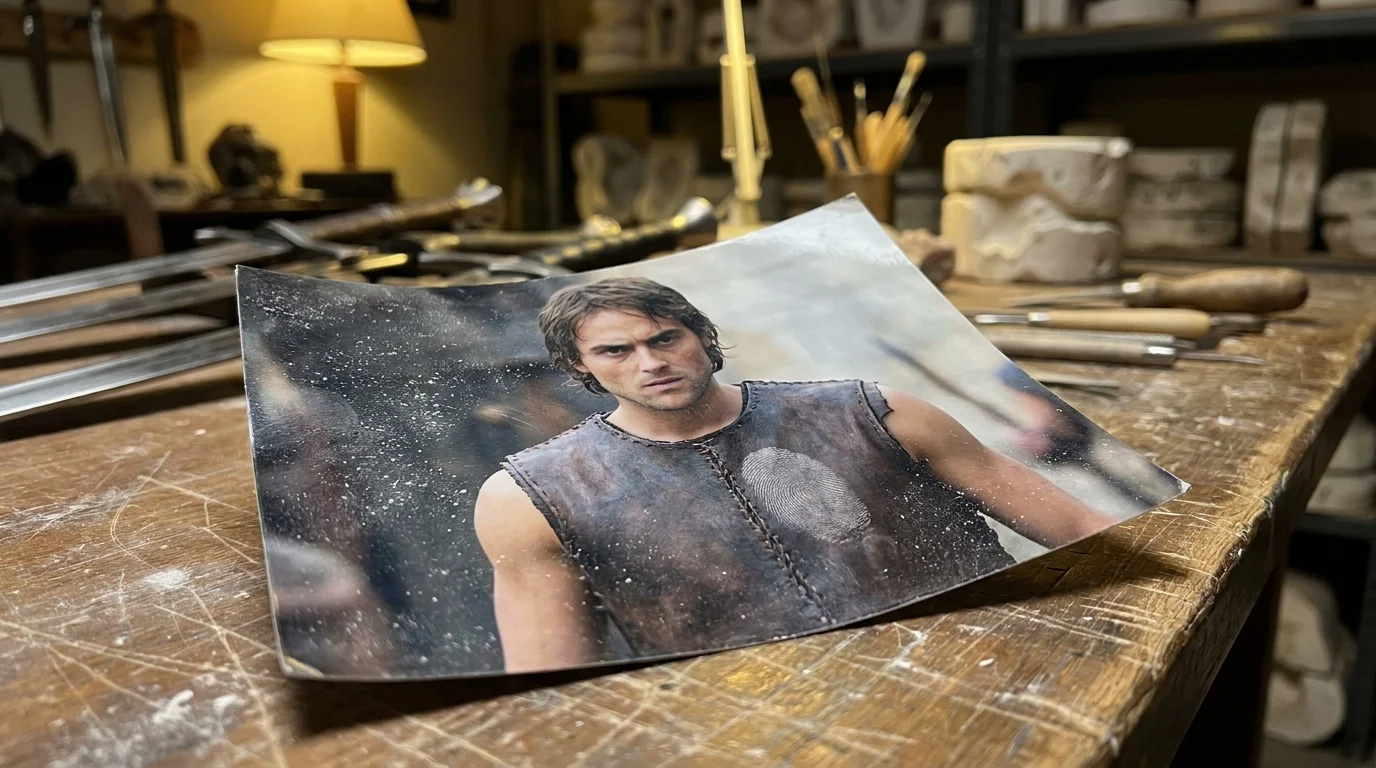
Imagine the smell of damp wool and industrial floor polish inside a chilly warehouse in Wellington, New Zealand, circa October 1999. In a quiet, poorly lit corner of the Weta Workshop archive sits a cardboard box labeled with fading black marker. Inside, a single, dusty, abandoned Aragorn costume fitting photograph captures a twenty-six-year-old Stuart Townsend. He is clad in distressed leather, his hand resting on a sword hilt, but his eyes tell a story of profound displacement. It is an image frozen in time, taken just days before he was quietly sent packing, initiating one of the most famous recasting dramas in modern cinema history.
For decades, the official narrative surrounding Townsend’s sudden exit from The Lord of the Rings has been wrapped in a tidy PR ribbon: he was simply “too young” to play the rugged Ranger of the North. We were told that Peter Jackson looked at the footage and realized he needed someone with more mileage on their face, someone who looked like they had slept in the mud for fifty years. But Hollywood’s public relations machine excels at turning uncomfortable artistic friction into neat, blameless logistical errors. The truth of his departure is far more complex, hidden not in the birth dates on a passport, but in the invisible mechanics of performer chemistry.
When an ensemble cast is assembled for a multi-year project, individual talent is entirely secondary to collective resonance. A production of this scale is like a delicate watch mechanism where every gear must catch the next with absolute, unyielding precision. On those chilly New Zealand soundstages, Townsend was an exquisite gear, but he was spinning at an entirely different frequency than the rest of the machinery.
The Rhythm of the Fellowship: Beyond the Age Excuse
To understand why Stuart Townsend was replaced by Viggo Mortensen, you must discard the superficial excuse of age and analyze the unseen physics of performance rhythm. Acting is not merely delivering lines in a costume; it is a continuous game of energetic catch. When a character speaks, they throw a ball; the other actor must catch it at the exact tempo required to maintain the scene’s gravity. When a young, intense method actor is placed opposite classically trained stage royalty, the difference in tempo can feel like two musicians playing in different keys.
This was not a failure of talent, but a fundamental clash of theatrical languages. Townsend approached the character with a modern, coiled intensity—a style that thrived on internal tension and unpredictable, sharp movements. Contrast this with Sir Ian McKellen’s Gandalf, whose presence is anchored in a sweeping, theatrical cadence that commands the entire room. When these two energies collided in early rehearsals, the result was not a spark of creative tension, but a quiet, agonizing drag on the narrative’s momentum.
Consider the testimony of Alastair McInnes, a fifty-four-year-old veteran scenic technician who was present during those frantic pre-production weeks. “You could see the friction during the very first week of blocking,” Alastair recalls, gesturing with hands scarred by years of set construction. “Stuart was incredibly focused, almost painfully so, but he was playing to a private camera inside his own head. When Ian [McKellen] would deliver a line with that rolling, Shakespearean weight, Stuart’s response would come in like a modern indie film—underplayed, fast, and completely out of sync with the mythic tone Peter was trying to build. It was like watching a jazz drummer try to keep time with a cathedral organ.”
- Eddie Redmayne Star Wars screen test failure exposes the severe cruelty of modern franchise casting
- Russell Crowe Wolverine rejection transferred an entire comic book legacy to an unknown actor
- Sally Field co-star anecdote reveals a brutal studio recasting decision that altered cinematic history
- Winona Ryder archival talk show footage completely dismantles decades of manufactured difficult set rumors
- Jelly Roll backstage camera flash exposes a sudden involuntary posture shift sparking intense rumor
The Mechanics of a Casting Mismatch
The failure of chemistry on a film set rarely happens in a single explosive argument. Instead, it is a slow erosion that manifests across three distinct performance layers, eventually rendering the footage unusable.
The Linguistic Friction
In a high-fantasy setting, dialogue is the heaviest lift. You must speak of ancient rings and dark lords without letting the words sound ridiculous. This requires an unshakeable belief in the reality of the world. While McKellen and the British theater veterans treated the dialogue like sacred text, delivering it with projection and formal weight, Townsend’s instinct was to ground it in contemporary realism. This created a jarring tonal whiplash that threatened to break the audience’s suspension of disbelief.
The Physical Silhouette
An actor’s physical presence must match their character’s mythic weight. Viggo Mortensen eventually brought a feline, utilitarian grace to Aragorn—a man who moved only when necessary, blending seamlessly with his environment. Townsend’s physicality was sharp and nervous, radiating a youthful, urban anxiety that clashed with the ancient, weary dignity of a fallen king. In group shots, he looked like a visitor in Middle-earth rather than its protector.
The Reaction Variable
The ultimate test of any ensemble is the silent reaction shot. When Gandalf speaks, the camera cuts to Aragorn to see the weight of the wizard’s words land. If the reaction lacks depth, the entire stakes of the scene collapse. During early read-throughs, the silence between McKellen’s proclamations and Townsend’s reactions felt empty, lacking the invisible thread of mutual respect and history that needed to unite the ranger and the wizard.
The Rehearsal That Changed Middle-earth
The breaking point occurred during a closed-door sword-training rehearsal coordinated by legendary fight choreographer Bob Anderson. It was here that Peter Jackson realized the core fellowship dynamic was fundamentally broken and cannot be rescued by clever editing.
To understand how this physical misalignment manifested, you can look at the sequence of movements required during these early combat tests:
- The Tempo Check: The actors were instructed to move through a mock skirmish where Aragorn had to defend Gandalf’s flank. While McKellen moved with deliberate, sweeping steps, Townsend’s movements were frantic and hyper-accelerated, leaving the older actor physically out of position.
- The Eye-Contact Lock: During a pivotal moment of defensive coordination, the actors were required to lock eyes to signal a synchronized retreat. The connection failed repeatedly, with Townsend looking down at his footwork while McKellen kept his focus upward, looking for his partner.
- The Weight Distribution: In physical training, a warrior must look like they carry the weight of their gear and their history. Townsend moved like a modern athlete—light and quick—which stripped the swordplay of its brutal, historical gravity.
Tactical Casting Alignment Toolkit:
- Standard Tempo: 60-70 BPM (Used for high-fantasy epic delivery)
- Townsend’s Physical Pulse: 95+ BPM (Modern cinematic tension)
- Spatial Distance: 4.5 feet (The gap where eye-contact chemistry failed)
The Necessity of Artistic Ruthlessness
Ultimately, the decision to replace Stuart Townsend was not a reflection of his capabilities as an actor, but a clear sign of the uncompromising demands of cinematic scale. A lesser director might have yielded to the immense pressure of the studio, avoiding the financial and logistical nightmare of a last-minute recasting to keep the production on schedule. But Peter Jackson understood that a single misaligned element in the foundation would eventually cause the entire trilogy to crumble under its own weight.
This brutal transition serves as a powerful reminder of how we navigate our own professional landscapes. Sometimes, a failure to fit into a specific team or project has nothing to do with our competence, and everything to do with our alignment. Being the wrong piece for a specific puzzle does not mean you are a broken piece; it simply means your unique shape is meant for a different picture entirely. When Viggo Mortensen stepped off the plane in Wellington, he didn’t just replace an actor—he completed a rhythm that had been waiting for its perfect counterpart.
“The hardest part of directing is realizing that a brilliant actor can still be the wrong color for your canvas.”
| Key Point | Detail | Added Value for the Reader |
|---|---|---|
| The Age Myth | PR claimed Townsend’s youth (26) was the sole reason for his departure. | Reveals how studios use logistical excuses to cover up delicate creative conflicts. |
| The Rhythm Gap | Townsend’s modern acting cadence clashed with Ian McKellen’s theatrical tempo. | Illustrates how unseen communication styles can ruin professional collaborations. |
| The Swordplay Pivot | A critical rehearsal under Bob Anderson exposed physical misalignment. | Shows that physical action is just as expressive and telling as spoken dialogue. |
Frequently Asked Questions
Was Stuart Townsend actually fired from Lord of the Rings? Yes, he was let go just days before filming began, after spending months training in New Zealand.
Did Stuart Townsend get paid for his time on the film? No, reports indicate he was not paid because the studio claimed he was in breach of contract for not being ready, which remains a point of bitterness.
How did Viggo Mortensen react to taking over the role? Mortensen was hesitant to take the role on such short notice, but his son Henry, a massive fan of the books, convinced him to accept.
Are there any existing scenes with Stuart Townsend as Aragorn? No completed film footage has ever been released, though polaroids and costume test photos exist in private archives.
Did Stuart Townsend ever work with Peter Jackson again? No, their professional relationship ended permanently with the recasting decision.