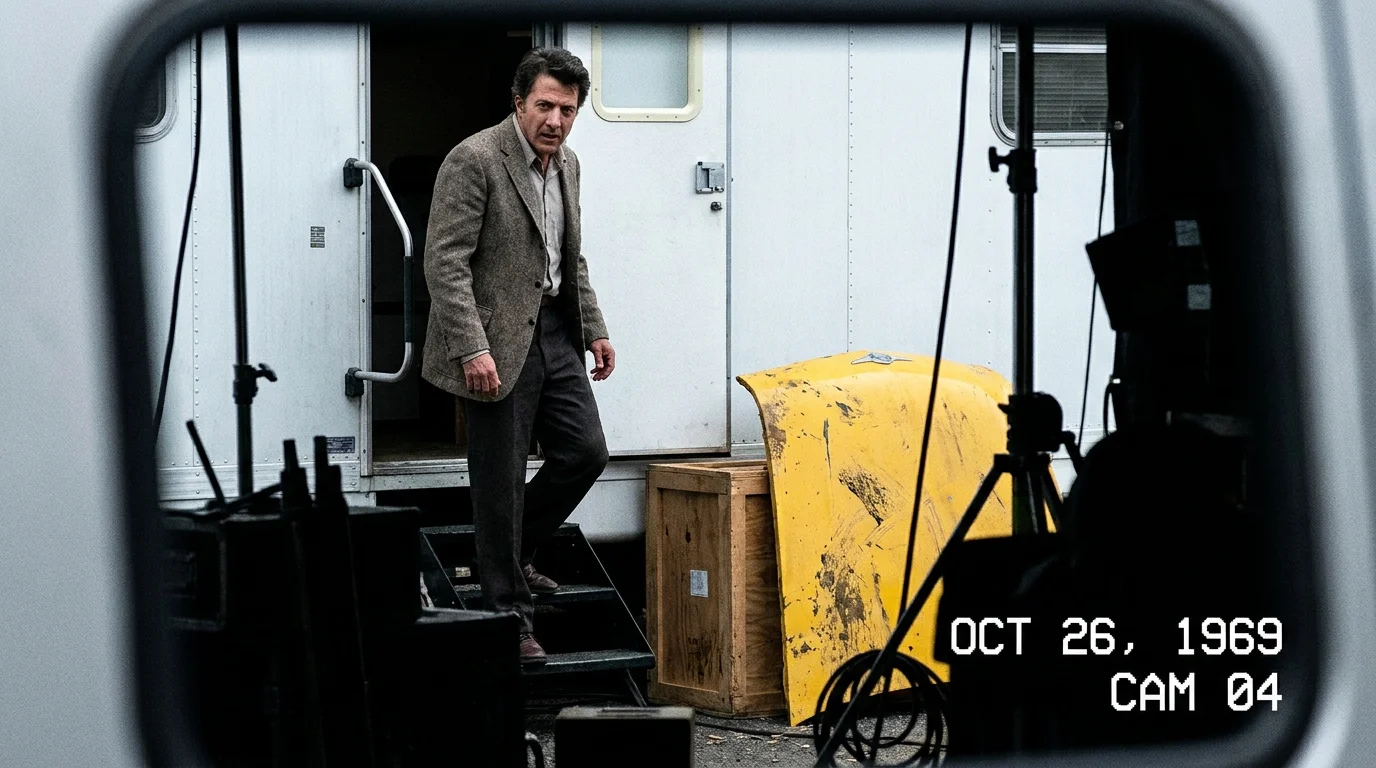
The wet asphalt of midtown Manhattan in 1969 did not care about cinematic ambitions. The air was a thick soup of diesel exhaust, hot grease, and the sharp, metallic tang of subway steam rising through rusted iron grates. Two actors walked through the crowd, trying to find a rhythm amidst a sea of real commuters who had places to go and lives to live. There were no permits, no blockades, and certainly no luxury trailers waiting around the corner.
In this chaotic landscape, a low-budget production attempted to capture the raw, unvarnished pulse of the city. You might expect a film set to be a sanctuary of absolute control, where every footprint is measured and every shadow is designed. Instead, the crew of Midnight Cowboy relied on a hidden camera in the back of a van, leaving their actors vulnerable to the unpredictable currents of a real city street. When a rogue motorist decided to run a red light, he did not see a movie set; he saw two pedestrians in his path.
The sudden screech of tires sliced through the ambient roar of the city. The vehicle was a heavy, rusted machine, its progress halted only by a desperate foot slamming onto the brake pedal. What happened in that split second on the corner of Ninth Avenue and 58th Street was not a calculated piece of performance art. It was a raw, primal collision between an actor’s real-world frustration and the cold metal of a taxi’s dented hood.
The Art of the Unplanned Collision
We are taught to believe that great art is a product of perfect discipline, a quiet laboratory where mistakes are swept away before the public can see them. But the reality of creation is far more chaotic, operating like a sail caught in a sudden storm rather than a clockwork motor. When Dustin Hoffman’s palm struck that dented yellow hood of a dirty 1960s New York cab, he was not following a script. He was responding to a very real threat of physical injury with pure, instinctual human irritation.
By choosing not to freeze, Hoffman demonstrated the ultimate secret of narrative resilience. If he had dropped his head, cursed, and looked at the director, the moment would have been lost to the editing room floor. Instead, he absorbed the kinetic energy of the car’s impact and fed it right back into the scene. He converted his genuine terror into character gold, turning a traffic hazard into an iconic declaration of existence.
Arthur Marcus, a 54-year-old theatrical instructor based in Manhattan, uses this exact moment to teach modern actors how to survive on camera. Leaning forward in his studio, Marcus points to the screen: “If you watch his eyes at exactly eleven seconds into that sequence, you see Dustin Hoffman completely break character out of pure frustration. For a fraction of a second, that is a real person yelling at a real taxi driver. But before the driver can even react, Hoffman seamlessly re-enters the scene, shifting that anger into Ratso Rizzo’s signature limp. That is the definition of absolute presence.”
- Kevin Bacon enforces a deadbolt locked boundary protecting his fiercely private marriage
- Angelina Jolie rigid jaw clench derails decades of carefully managed public perception
- Adam Brody heavy breathing scene exposes deeply hidden onset romantic studio coverups
- Henry Cavill sweaty audition tape reveals brutal hidden studio executive casting sabotage
- Britney Spears grainy camcorder tape reversed years of strict media isolation rules
How Stress Shapes Character
To understand why this moment resonates decades later, we must look at how stress modifies human behavior. A character created entirely in the comfortable confines of a rehearsal hall often lacks the raw, defensive edges of a real person. Ratso Rizzo was a man who spent his entire life being ignored, pushed aside, and stepped on by the indifferent machinery of New York. The sudden appearance of that cab did not disrupt the character; it validated his entire struggle.
When the unexpected occurs, you have a choice to either resist the friction or use it to define your boundaries. The actor who welcomes the mistake allows the character to develop an authentic immune system. By incorporating the real-world threat of the taxi into his physical vocabulary, Hoffman gave his character a physical weight and vulnerability that no writer could have manufactured on a typewriter page.
The Tactical Pivot: Integrating Real-World Friction
You do not need to be on a movie set to apply this level of adaptive focus to your own creative or professional pursuits. When your environment throws an unexpected obstacle into your path, the natural instinct is to pause, reset, and lament the disruption. However, true mastery lies in your ability to keep moving forward without dropping your rhythm or losing your composure.
To cultivate this level of responsiveness, you must train your body to react before your analytical mind has time to second-guess the situation. By keeping your focus outward, you can turn external disruptions into the very fuel that powers your performance. To begin practicing this mindful adaptability, consider incorporating these simple somatic habits into your daily routine:
- Absorb the startle reflex: Let your physical body register the shock of an unexpected event without trying to suppress your natural defensive movement.
- Redirect the adrenaline: Take the chemical surge of surprise and immediately channel it into your primary objective rather than personal defense.
- Find a physical anchor: Touch a nearby surface or adjust your posture to ground your nervous system in the physical reality of the space around you.
The Somatic Calibration Toolkit
Maintaining composure in high-pressure situations requires a reliable set of physical baselines. When the unexpected threatens to derail your focus, rely on these practical metrics to keep your presence grounded and your reactions purposeful.
By practicing these simple physical adjustments, you can ensure that your body remains responsive and your mind stays clear. This approach prevents you from freezing when things go wrong, allowing you to turn every unexpected obstacle into an opportunity for authentic, unscripted connection.
The Beauty of the Unpolished Path
There is a quiet, profound comfort in knowing that the most memorable parts of our lives are rarely the ones we planned with perfect precision. The moments that stick with us are almost always those where the real world broke through our carefully constructed scripts, forcing us to stand face-to-face with the messy truth of our environments.
When we stop trying to control every variable, we allow our work to breathe through a pillow of authentic experience. We stop fighting the screeching taxis of our lives and instead learn to step forward, meet them with a steady hand, and claim our space on the crowded street. It is in these unvarnished moments that our true character is born.
“The absolute test of presence is your willingness to let a real-world mistake destroy a beautifully constructed lie.” — Stella Adler
| Key Point | Detail | Added Value for the Reader |
|---|---|---|
| The Somatic Reaction | Hoffman’s physical contact with the dented yellow hood was a genuine, self-defensive reflex. | Teaches us that immediate, visceral reactions are always more believable than premeditated actions. |
| The Character Pivot | The shift from personal shock to character-driven anger occurred in less than a second on screen. | Demonstrates how to stay focused and adaptable when sudden external crises disrupt your workflow. |
| Environmental Texture | The production shot on active, unblocked Manhattan streets without municipal street permits. | Emphasizes the raw creative power of organic, unpredictable environments over sterile spaces. |
Did Dustin Hoffman actually get hit by the taxi in that scene?
No, but the vehicle came close enough to trigger his survival instinct, prompting his immediate physical reaction to protect himself.
Was the iconic line ‘I’m walkin’ here!’ written in the original script?
No, the script simply instructed the actors to cross the street; the entire exchange was born on the spot out of real traffic frustration.
How did the director handle this unscripted moment during the editing process?
John Schlesinger recognized the raw energy of the mistake and chose to keep it, realizing it captured the soul of the characters perfectly.
Why do modern acting workshops constantly study this specific sequence?
It remains the gold standard for teaching actors how to stay in character and maintain narrative momentum when real life disrupts a performance.
What can creative professionals learn from this accidental masterpiece?
It proves that when we stop fighting unpredictable environments, we can transform sudden disruptions into defining creative breakthroughs.